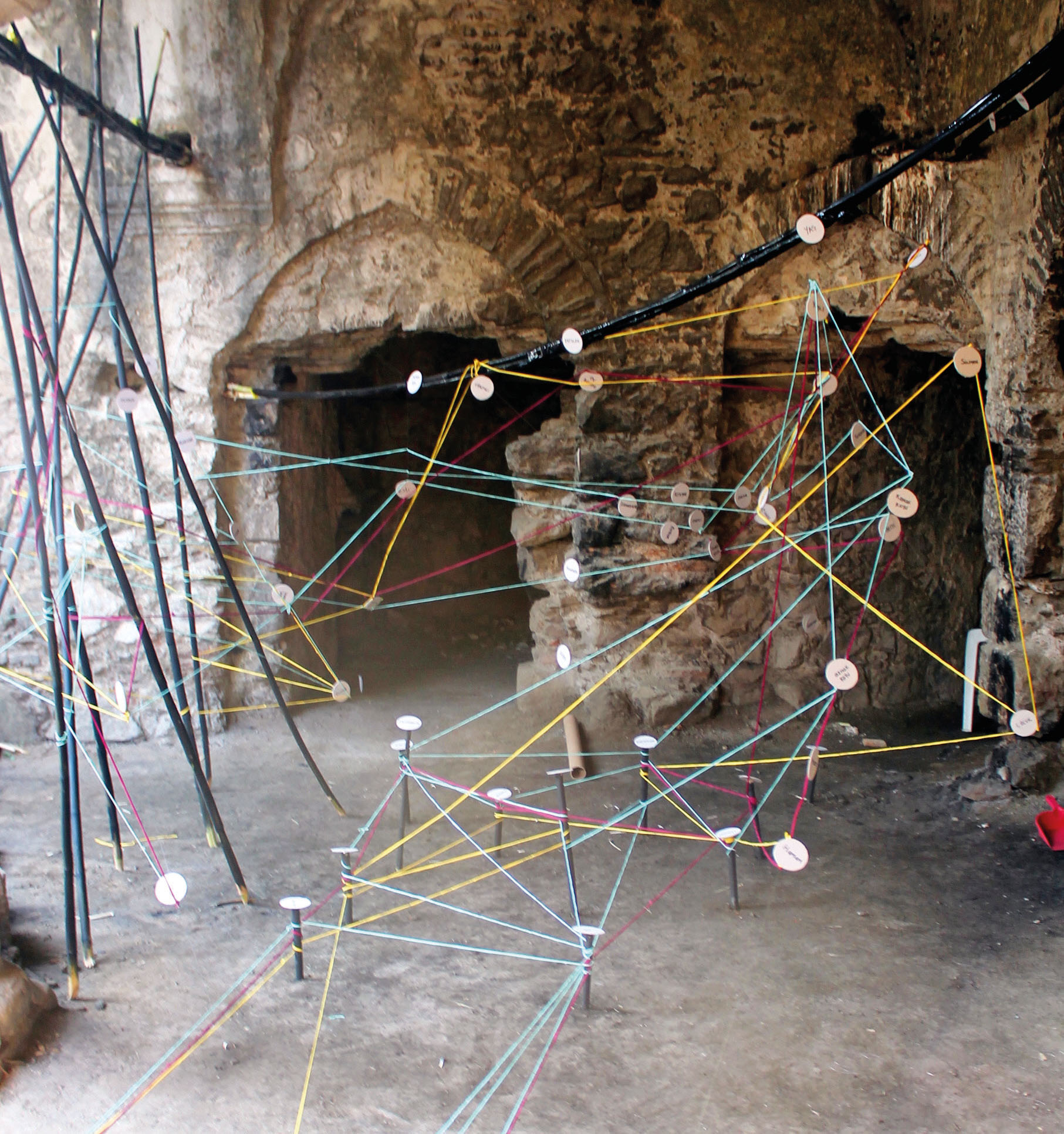

The student meeting organized each year as part of UMÖB (National Architecture Students Meeting)
was this year in Izmir. The meeting, which took place for the 32nd time, was the guest of Düzce Village
of Seferihisar from July 27 to August 3, with 120 participants, 27 workshop conductors and the
organization team of 13. The team, which functions totally on voluntary basis, described this year’s
meeting.
UMÖB is a student meeting organized since
1993 twice a year in different cities of Turkey,
without any affilitiation with any institution or
organization. It is totally a student initiative, is
independent and perhaps the most original aspect
of the event that it is totally done on voluntary basis.
At the end of each UMÖB, various cities become candidates
and make presentations to hold the next UMÖB. After the
presentations, the location of the next meeting is voted for.
The story of design village started, when at the last year’s
meeting in Trabzon, İzmir was the winning candidate. Not
schools but cities are in question because each one of the
events are taken on by students whose common point is
studying architecture in that same city. UMÖB 15 – Design
Village Izmir team comprises 13 students studying architecture
in 9 Eylül University and Yaşar University.
Why Design Village?
UMÖB 15 team’s Deniz Yıldırım explains the design village
idea” Under the undergraduate programs of architecture faculties,
an idea which emerged over focusing of the design
discipline just on the relationships with the city and city resident;
the idea of ‘being in the village’. Right from the start,
we aimed for a meeting underscoring that when studying
and working, architecture is looked at only from the city scale,
that there could be an alternative experience, carrying the
production and social relationships in the rural areas, leaving
aside the means and technologies of the city dweller. Our
camp grounds, the yard of Düzce Village Elementary School,
was the place village kids, aunts and uncles joining the chat
from the road stopped by all hours of the day.
Another important point which made Design Village different
from past years was to open this event, which took
place only with the participation of architecture students. to
anyone involved in and working in the field of design. Besides,
departments like architecture, interior design, landscape
design, planning, industrial design and graphic design from
37 different universities, participants studying sociology and
political science interested in design, also came to the village.
This diversity seriously exposed not only the workshops but
the meeting week as a whole, to inspiring and mind opening
possibilities.”
In addition to 14 workshops which progressed simultaneously
during the week, running in the form of teams of 8-10,
there were 4 joint workshops which participants could take
turns to attend flexibly.
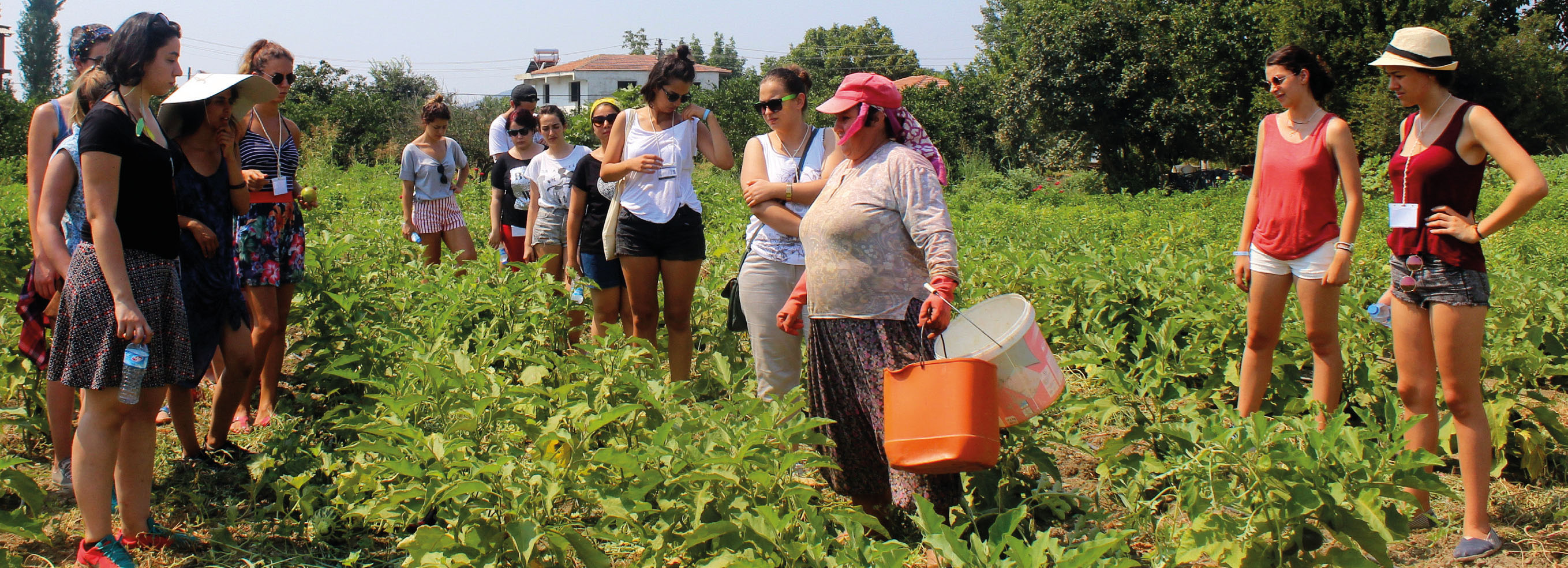
In the “Rural Production System” workshop, the neighboring
fields and farms were visited; the prototypes of the traditional
production tools were remade. The workshop “Local Sound
Landscapes” did studies on local sounds unheard in the city.
In the “Character Design Workshop”, the participants picked
up objects from and around the village, creating a character
design with these objects, combining collage or drawing techniques,
then wrote a story for each character. In the “Sofra
(Dining Table) Workshop”, sofra was set up time and time
again at a designated location of the village as the field of eating,
sharing and communicating and new relationships and
sense unions were sought. The constructed sofra was left for
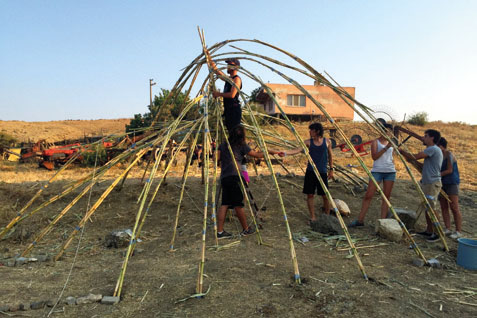
the villagers at the end of the workshop. In the “Parametric
Pavillion” workshop, designs made employing computational
design techniques were built by local material bamboos. In
the “Flipbook” animation workshop, animation techniques
were studied and short animated films were produced. With
the “settle” workshop conducted by “Architecture for Everyone
Association”, children games were designed and played
collectively. In Tag Platform’s “Design Hunt” workshop, the
doors of all village houses were knocked on to discover the
nameless designs and designers of the village.
One can access all other workshop processes at Tasarım
Köyü Izmir Facebook page and www.tasarimkoyuizmir.com.
Work is under way for a catalog compiling all the deliverables
of the workshop. Let us leave the last word to
UMÖB 15 team:
“We left behind a meeting week which stood on the
ground, relating to the ground, in which exchange of information
took place mutually with the villagers, going
beyond being designers living in bubbles. One of the questions
remaining in our minds is how can a studying environment
alternative to the molded design education in schools be?
To what extend do the meetings accomplish this?
We would like to remind everyone that the next meeting
will be in Gaziantep in February, hoping that student meetings
where production and sharing are at high levels, can
find the necessary energy and motivation all the time.”