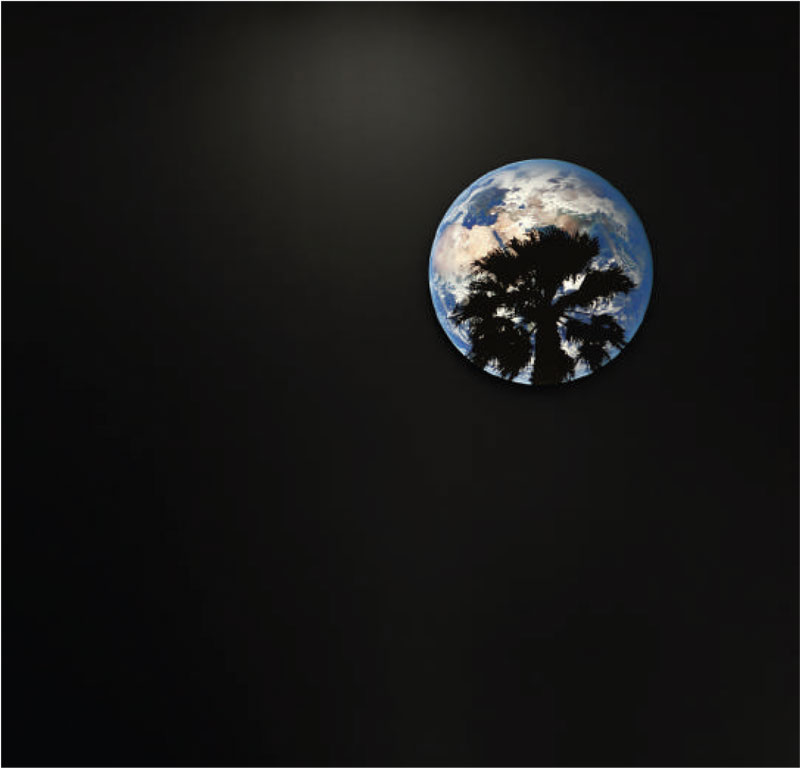

Between March 7 – April 13, Versus Art Project will host Bulgarian artist Krassimir Terziev on the occasion of his first solo exhibition in Turkey, Future Unforgettable, which will be curated by Fırat Arapoğlu. In our age of imagery, in which quite different means of expression are employed in conveying the interaction between art, technology and media, the exhibition entitled “Future Unforgettable” brings new narrative techniques together with visual recordings, auditory constructs and cinematic language. Krassimir Terziev, through his lenses, presents the audience with nearly a 50-year period extending from the day when the first human set foot on the moon to our day and age, which mark the period of “Human Mission to Mars”, while also bringing forward the following questions: “Did we really leave this period behind us?”, “Is space that far away so that it can fill itself up with junk from the Earth and future dreams of people, or is it close enough that we can access every day with our mobile devices and collect thousands of visual and auditory data from the surface of Mars?, and “Is there a place for concepts such as authoritarian behavior, well-worn social structures, humanity, nation and culture in a scenario in which day-night, past and future do not exist?”. In the exhibition entitled Future Unforgettable, the artist Krassimir Terziev, who devotes himself to a quite deep research process in his productions, aspires to make visible the contradictions related to the attempt at creating a “civilized” space, and since 2008, the attempt to civilize space has been both an artistic strategy and a research subject for the artist. Cosmic waste, technological elements, space suits and icons of astronauts have become the essential motives used regularly by the artist in the scope of his studies tackling the philosophical conflict between human and machine. Krassimir Terziev, one of the first artists to transition from classical media into digital media during the 1990s, uses this platform as a device, a subject and the work itself that he endeavors to create at the end. He makes the relationship between time and space transparent so as to create a new temporaryreality by using a combination of techniques and expression tools such as video/film, photography, painting/pattern. The artist invites the spectator to a sort of time travel through the utopia of humanity settling on exoplanets, accompanied by an “invisible” yet “imaginable” paradigm. Svetlana Kuyumdzhieva makes the following observations regarding this issue: “In fact, if we were to consider Krassimir Terziev’s approach to art as a journey, we would see that this process moves at its own pace. Each moment of this journey gives place to questions about depleting or previously-depleted probabilities concerning future. According to Kubrick’s narrative, this is a journey that is free of superhuman qualities, that doesn’t end by turning the screens off, yet constantly concludes by the artist turning back to their own essence. It takes the artist back to present time and to the past, which once was future.” The artist, whose works have been previously exhibited in different art institutions, galleries and biennials in Turkey, including Salt, Antrepo İstanbul, Bilsart, 3rd Mardin Biennial, 6th Çanakkale Biennial, Gaia Gallery and Evin Art Gallery, also participated in the exhibitions at TATE Modern London, Antwerp Museum of Contemporary Art (MuHKA), Budapest’s Kunsthalle Mucsarnok, Berlin Akademie der Kunste (Berlin Academy of Arts), Institute of Contemporary Art – Sofia, The National Gallery, The Stedelijk Museum Amsterdam and Ljubljana Moderna Galerija (The Ljubljana Museum of Modern Art ). The works by Krassimir Terziev, who is one of the leading figures of contemporary art, are featured in the private collections of Paris Centre Pompidou, Arteast 2000+, Ljubljana Moderna Galerija, Sofia City Art Gallery and Kunstsammlung Hypovereinsbank.