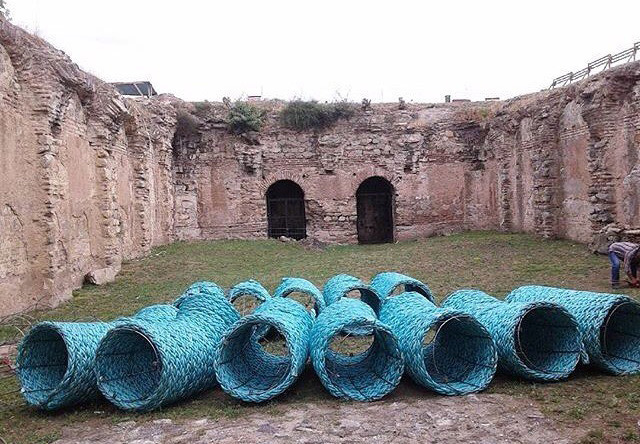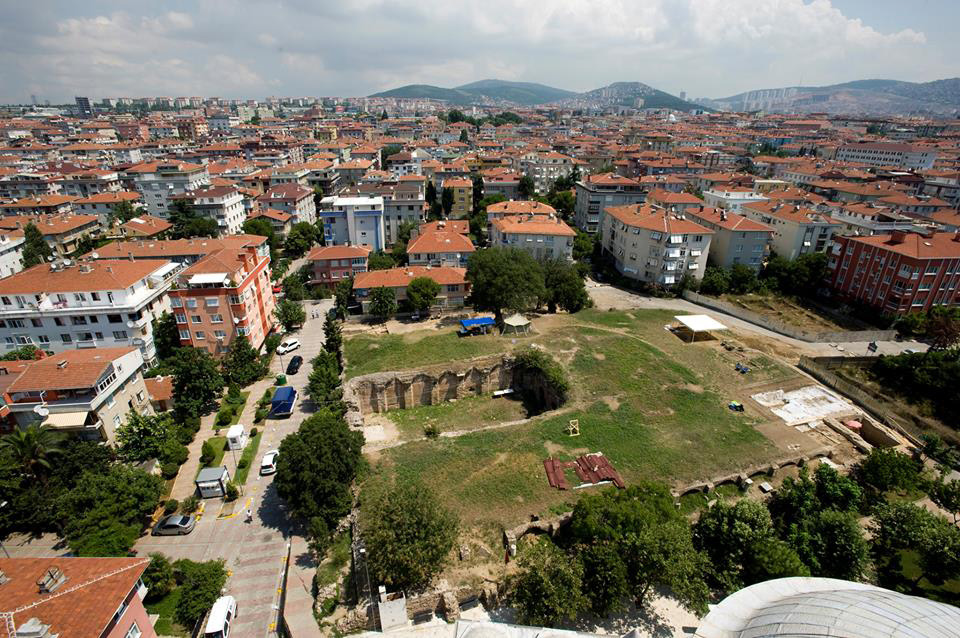

Supported by the İstanbul Development Agency (İKA), the guest artist of the program “Traces of the Past For Contemporary Creativity: Urban Archaeology and Küçükyalı Archaeopark”, Hera Büyüktaşçıyan exhibits her installation work Rising… A small height from the ground until July 30 at the İstanbul Küçükyalı Archaeopark. As a significant archaeologic site where a scientific excavation is being carried out at the Asian side of İstanbul, Archaeopark includes a monastery complex which is estimated to be built in the second half of 9th century by Ignatios Constantinople (847-857 AD and 867-877) who had been expatriated to Prince Islands during a specific period. Today, the remains of the complex are surrounded by a dense urban settlement and population.
The work of the artist designates an unknown history that lies underneath our feet with an imaginary creature fantasy. The relevant creature lives in an invisible world through collecting the memories of the lost city and space but reappears for evoking what has been forgotten. The project invites the audience to explore the Monastery of Satyros which contains this fictional creature that has gone beyond time through connecting the waves of today and the temporal sea of the islands where Ignatios had been expatriated.
Explored by the German researchers 150 years ago, the Küçükyalı Archaeology Park is located within the boundaries of the Çınar District of Maltepe, spreading over approximately 2800 sqm. A monastery that dates back to Byzantine period (867-877), a sepulture and a monastery tower lie within the Küçükyalı Archaeopark. The tomb of the Patriarch Ignatius, son of the Emperor Michael I, has also been described in a depiction pertaining to the 11th century at the Vatican archives. The depiction that refers to Ignatius, who died in 877 and has been transported to his tomb in Küçükyalı following the burial ceremony that had been taken place in Hagia Sophia, shows the monument along with its remaining details where it was possible to see from the islands and sea during that period.
The most important aspect of the Archaeopark excavations marks the only patriarchic tomb from the Byzantian period and the initial uncoverings of the silver Byzantine coins that belong to the 14th century (Andronikos III Palaiologos era). A bronze oil lamp that belongs to the Late Byzantine Period was also found in the excavations. Tours are currently being organized to present the site especially to children with disabilities and children in the elementray education age.