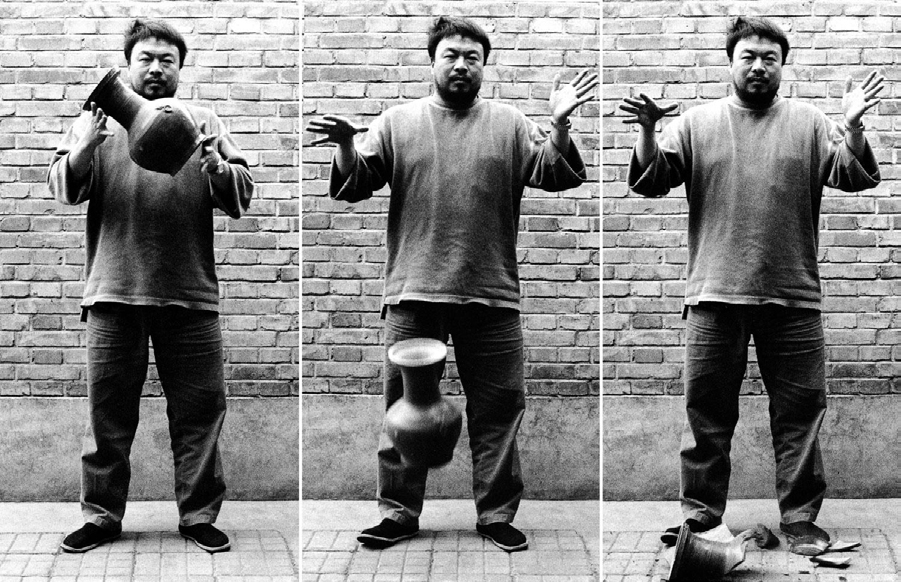
Sabancı University Sakıp Sabancı Museum hosts Ai Weiwei’s first exhibition in Turkey. A wide selection of artists’ works along with his new pieces will be presented in the exhibition which will be launched on September 12. Focusing on Ai Weiwei’s porcelain works, the exhibition’s narrative carries the traces of both his life story and his approach towards the tradition of craftsmanship and the history of art.
Each stage of Ai Weiwei’s porcelain journey is represented by the artist’s iconic works at the exhibition. The artist conveys the messages of today’s world through traditional Chinese handicrafts and provides a perspective on the paradoxes of our time.
The exhibition offers a comprehensive insight to Ai Weiwei’s art through a structure that has been designed using the themes repeatedly seen in his works. Meditating on the concepts of authenticity, the transformation of value systems over the ages, and cultural history, the artist’s works invite the audience to understand cultural, artistic and historical values in question. Ai Weiwei, who put “ready-made objects of culture” into his works, provides the audience with new interpretation possibilities and demonstrates how the objects can be judged in their contexts based on completely different values.
In his replica studies, Ai Weiwei examines the concept of authenticity and refutes the difference between the original object and its copy. In the light of the ruins of antiques that have survived until today, Ai Weiwei dwells on history by adapting the logic of Chinese and Greek pottery ornaments and Egyptian wall paintings and gives us an extensive perspective regarding the contemporary world.
Ai Weiwei’s exhibition at the Sabancı University Sakıp Sabancı Museum, with its extensive selection in the field of porcelain –his oldest work is forty years old and he has over 100 works in the exhibition – stands out as a unique environment in which the audience can explore the works of this authentic artist.
About Ai Weiwei:
Ai Weiwei, one of the most influential people in modern contemporary art who was born and raised China, works in a wide range of disciplines including sculpture, large scale installations, film and architecture. His works tackle authenticity in the context their presentations and the transformation of value systems, which give the audience an insight into today’s political and cultural issues. As a political and social commentator who gives one a piece of his mind, Ai Weiwei’s topical messages represent indispensable parts of our perspective on our values of culture, history and art. Born in Beijing in 1957, the son of the dissident poet Ai Qing, Ai Weiwei has made vital contributions to the sprouting of contemporary art in China. Grown up in a “re-education camp” where he was sent along with his family because of the accusations of Chinese Communist Party towards his father in 1959, Ai Weiwei went to the US in 1981. Being acquainted with the art of Marcel Duchamp and Andy Warhol in the US, has greatly influenced his approach towards contemporary art. When he returned to China in 1993, his experiments with traditional objects and handicrafts had devolved on him and today, it gives him the opportunity to establish bridges between the old and new China.
As a result of research studies such as “Citizens’ Investigation” which he conducted for the victims of the 2008 Sichuan Earthquake, his use of social media as a form of opposition and his works that live on experiences which he gained as an activist; Ai Weiwei’s art has blurred the distinction between activism and contemporary art. For more than thirty years, Ai Weiwei has been offering us new ways of perceiving and interpreting the world through his works that revolve around contemporary dynamics and our perception of history. He also received the 2015 Ambassador of Conscience Award from Amnesty International and 2012 Václav Havel Prize for Creative Dissent of the Human Rights Foundation.
His recent solo exhibitions include “Ai Weiwei: Trace at Hirshhorn” in Hirshhorn Museum and Sculpture Garden in Washington DC, “Maybe, Maybe Not” at the Israel Museum in Jerusalem, “The Law of the Journey” at the National Gallery in Prague, “Ai Weiwei, Libero” in Palazzo Strozzi of Florence, “Ai Weiwei: Translocation-Transformation” at the 21er Haus Museum of Contemporary Art” and “Ai Weiwei “ at the Royal Academy of Arts in London.