
the design industry, whiCh FoCuses on enVironmental awareness and transForms through alternatiVe ProduCtion aPProaChes, taKes the natural stone out oF the arChiteCtural sCale and integrates it into our daily liVes. an eValuation oF the Position oF natural stone in today’s design sCene through maison&objet Fair. The Maison&Objet Fair, which was held in Paris in January, brought the design scene together under different titles through the theme “Excuse My French!”. Designated by Nelly Rodi, the global trend agency of Maison&Objet, the theme calls attention to the search for identity in the scope of translating the tradition and cultural heritage into the present day. During this search for an identity, natural stone comes into prominence for being a material embodying tradition. Today, when design stands for a sector that triggers the global natural resource consumption the most, we are re-evaluating our consumption habits and production patterns. The design industry, which focuses on environmental awareness and transforms through alternative production approaches, takes the natural stone out of the architectural scale and integrates it into our daily lives. We have evaluated the position of natural stone in today’s design scene through Maison&Objet Fair.
This year’s Maison&Objet brought together young talents from China in the scope of the Rising Talents Awards. Witnessing the rapid transformation of the design industry and being the most important piece of this transformation, China is currently favoring slowing down through the culture of craft. The country aims to rise to the global prominence as a rising value through its design scene as well as innovation and technology. The new Chinese aesthetics reflects a design understanding that remains loyal to quality crafts rather than a fast or high-performing one. The fair featured works by young designers who have also become entrepreneurs by developing their own business models. Hongjie Yang, one of the winners of the Rising Talents Awards, carries out his designs based on the research studies that he conducts on the relations between the “generated” and the “resultant”. Hongjie differs from others both with the research-oriented education that he received at Design Academy Eindhoven and his curious and doubtful approach towards anything that is man-made.
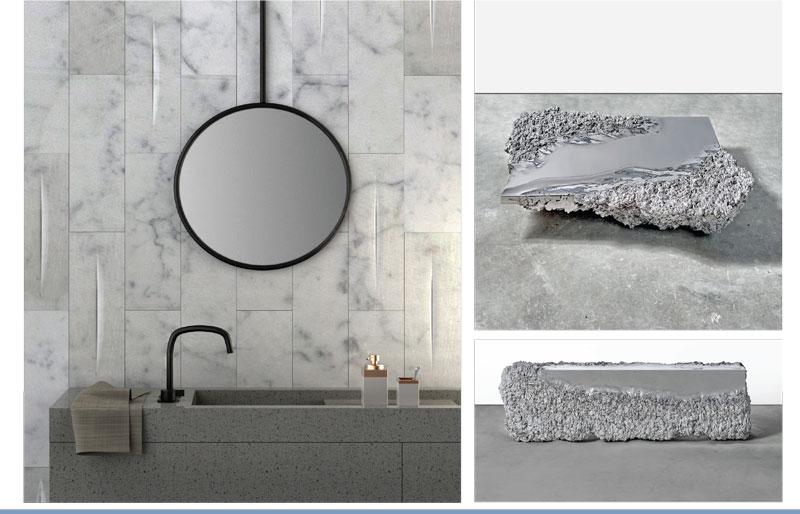
Hongjie’s products that look as if they are undesigned, virtually uses today’s technology so as to look natural. Designs that have the appearance of a remnant or a fragment of nature, comprise the coalescence of natural stone and aluminum. Hongjie’s products that he exhibited at Maison&Objet, reflect the relationship between human and natural formations. This relationship, which is both seemingly parallel and contrast to one another, can be translated into our time as the discovery of the “new antiquity”. Designs that seem like the pieces of an archaeological excavation, thanks to modern technology, allow for a natural stone structure that behaves like an animal constantly regenerating its skin and ultimately finds its most refined state in itself.
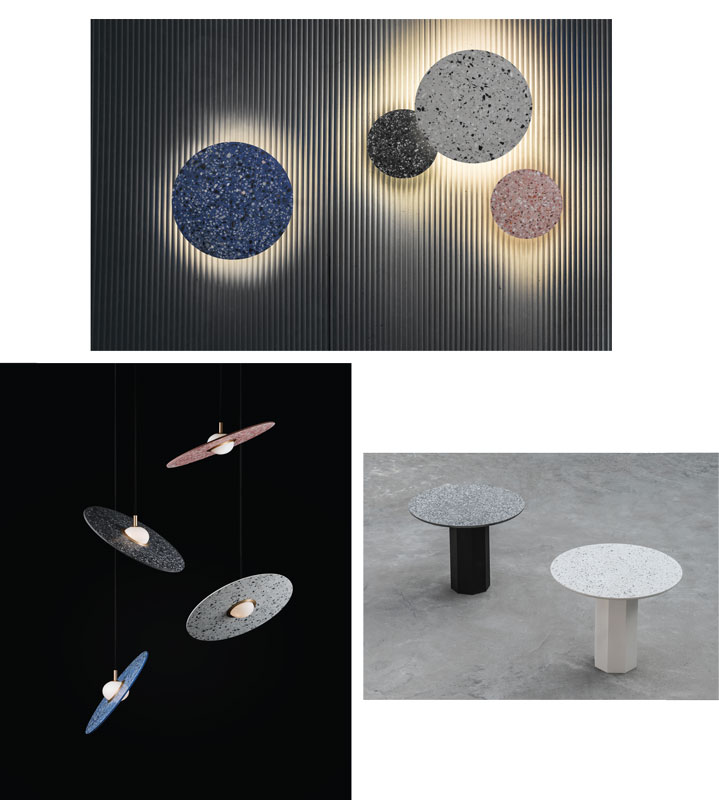
The Bentu design studio on the other hand reflects the ever-changing nature of society through a design process that corresponds to the reuse of materials. It transforms the ashes of burnt coals and the wastes generated by building materials and constructions into furnitures, lighting elements and accessories. We can say that it presents a new translation of natural stone through recycling.
The “Terrazzo” collection showcased by Bentu at Maison&Objet, with the reutilization of ceramic wastes in Foshan, the largest ceramic production hub of the world, hopes to create a sustainable furniture production industry for the city. According to Bentu, China’s image of being a production center, can be transformed through a design approach that focuses on environmental awareness. Surfaces that present the authentic Terrazzo texture consist of ceramic wastes as well as the combination of concrete and stone wastes generated from the construction sites.
Designed by Defne Koz for the Walls and Floors collection of Monitillo Marmi, the Italian natural stone manufacturer, PROFONDO creates a visual perception that softens the texture of marble, which is known for its hardness. “PROFONDO”, with its circular and curved form that looks like a slit on a wall, takes the finishing out of its twodimensional form and attributes it a third dimension.
Carrying on its practices in Switzerland, the Shibui design studio has showcased at Maison&Objet its austere and functional collection of desktop objects. Shibui is a Japanese term for simple, modest and humble beauty. Founded by the Thessalonian Athanasios Babalis and Cenoval Constantinos Hoursoglou, the studio translates this concept into a process in which every detail follows a purpose and every form follows a function, while being in search of establishing harmony with nature. Utilizing natural materials in this direction, the studio also works with artisans during the production process and accordingly designs products with continuous lifecycles by using minimum amount of resource and natural material. The desktop objects created by the studio by using natural stones, bring the natural forms of stones together with primitive forms.