Selin Biçer Mimar / Architect
Recognized by its name for a long time but lacking in proper research, the agate stone became an economic value throughout the district by the stone dressing studio launched in Ankara, Çubuk. As Natura Magazine, we received the opinions of the Çubuk Mayor, Dr. Tuncay Acehan about this issue in accordance with the support we give to spread the usage of natural stone materials.
Stating that the project was developed to protect the values of the district, the Mayor of Çubuk, Dr. Tuncay Acehan explained that they aspire to spread and develop the project. Owing to the fact that the Çubuk agate stone came to the fore lately, Acehan articulated that the future economic contributions which will be made by the agate stone for the district stand among his dreams and accentuated that the opening of the stone dressing studio and the initiation of the education programs are important steps towards this issue. Indicating that Çubuk agate stone will be used in the architecture field and health sector in the future, Acehan added, “I have never heard of the agate stone until learned from Dr. Mehmet Nebi 10 years ago. I learned that this stone is rather unique in the whole world and there are several scientific articles that are being written lately. One day, i wanted to initiate a study about this subject during my duty of mayorship. As a beginning, The Development Agency carried out a feasibility study. Following the approval from the Ankara Development Agency concerning our project, our studio came into service. Today, we made a beginning with this studio. Owing to this initiation, a road has been opened in this industry for our district. By building up this road, we aim to turn it into an industry that spreads over all of the region and transform it into a large income channel. We think that the manufactured products of Çubuk will be renowned worldwide. We can only produce ornaments at this studio right now but our goal is to ensure its usage as an architectural material in the coming years. I believe that the agate stone will become widespread as a decoration and insulation material. Only then we can say that we reached our goal. Çubuk agate stone is an economic source and it will gradually gain importance in each passing year as a tool for social structuring. Therefore we will continue our studies owing to the fact that this value is remained hidden under the lands of Çubuk and knowing that processing these stones, putting them into service and presenting them through an aesthetic fashion is out duty of loyalty.”
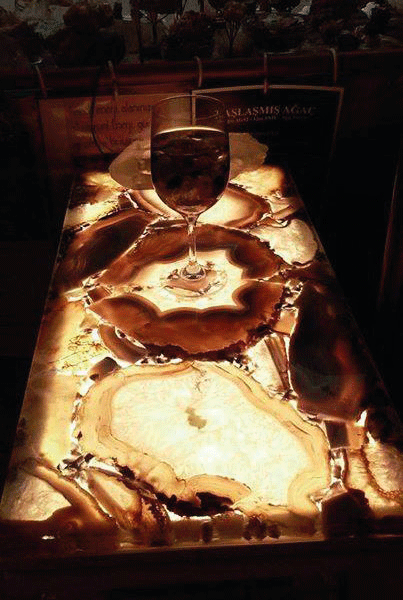
The agate stones of the Ankara region hold a rather rich potential of natural stones in terms of the industry. Utilizing these stones that majorly remain inactive as a decoration material in architectural projects is an additional advantage for the national economy. Agate stones are heavy, solid and competent materials and they are harmless to human health. Therefore they can be used commonly as paving materials for the interior decoration of buildings.

ABOUT THE AGATE STONE
The word agate pertains to the group of the former Greek minerals. The name ‘agate’ is derived from the “Achates” river which is currently known as “Carabi” or “Cannitello”. However, it was also used for many chalcedony and quartz types that are known with these names in ancient times and with different names in our day. Even though many writers state that the river which gave its name, is the exact location where the agate pebbles have been discovered for the first time; it can be realized by the agate objects found in the archaeological excavations that the first discoveries were made in India and Anatolia. This material is called “onyx” in Turkish.
GEOGRAPHICAL AREA WHERE THE AGATE STONE WAS FOUND
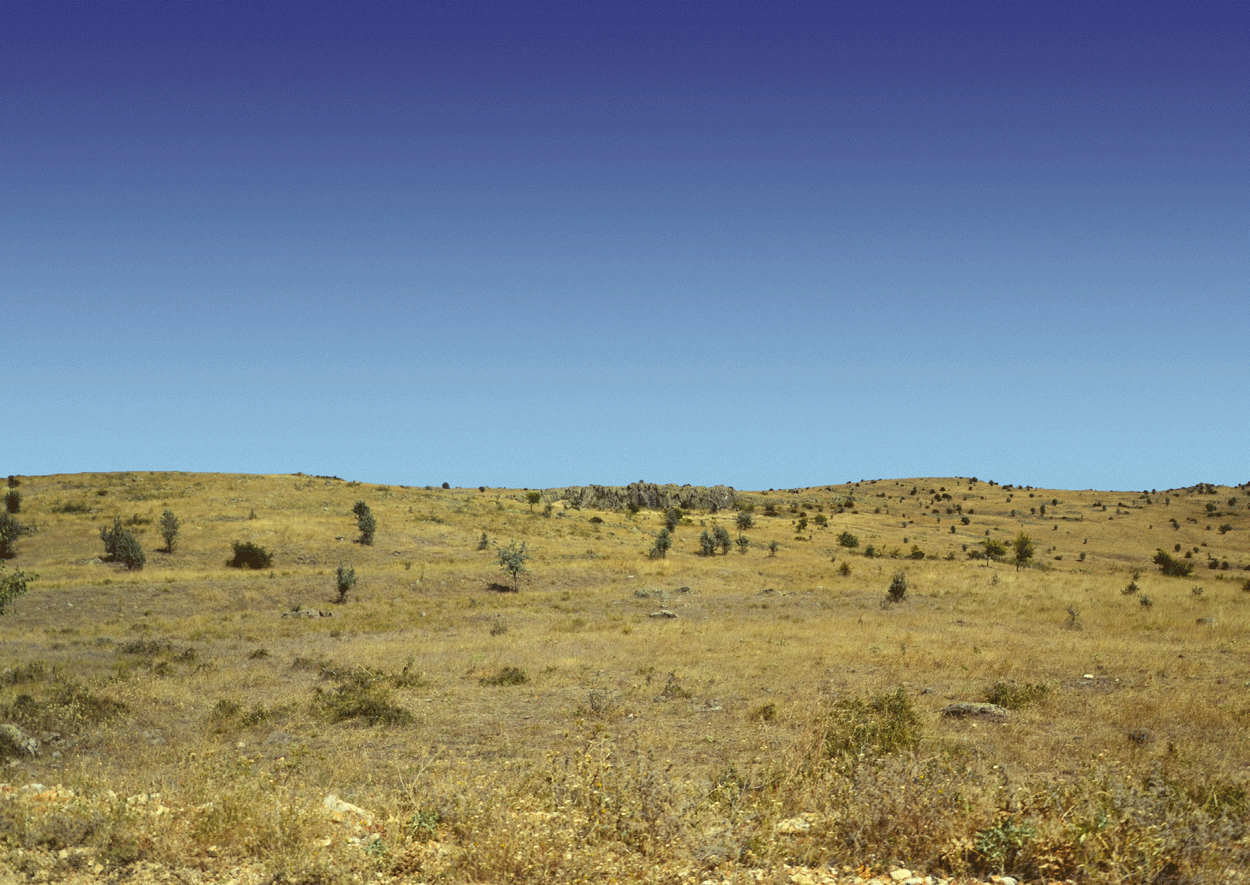
Even though it can be found in many places of Turkey, maybe the most beautiful and the richest reserves of the Agate stone is located at an approximate area of 100 sq. km at the southern part of Şabanözü and Eldivan districts of the Çankırı province and the northern part of the Çubuk district of Ankara province. However the Çubuk region has a unique importance from the point of both showing the greatest interest towards this stone and being the protectorate of the name in a way. Morphologically, this area is formed of flat and sparse hills, broad and plain valleys and partly forestlands. The average altitude is 1,200 m. During the summer, the weather is dry and the average temperature is nearly 25 oC yet it’s snowy and the temperature is 0-5 oC during the winter.
THE FORMATION AND DISCOVERY OF THE AGATE STONE IN THE REGION
Many theories have been established regarding the formation of the agate stones from the last two centuries to date. However, their certain formation mechanisms were yet to be revealed. These theories are not as diversified as the types of agate stones but one thing is certain: some of them reflect the truth. That being said, despite the large variety of agate stones, there isn’t a single theory that demonstrates all the types of agate stones. The most detailed geological survey of the northern part of Çubuk district of the Ankara province, where the agate stones are sizably underlying, was completed in the phd thesis of Murat Hatipoğlu in 1996. According to the thesis, the oldest unit of the region is designated as “basic rocks” which stand for paleozoic-aged, basic shists and metagranites. These are accompanied incongrously by Mesozoic-aged, sedimentary rocks having melange features that are named as “mixed series”. On top of them, the- re are unconformably engrained tuffs, pyroclastic materials, intermediate rocks and basic lava (andesite, basalt) and the Miocene-aged (Neogene)
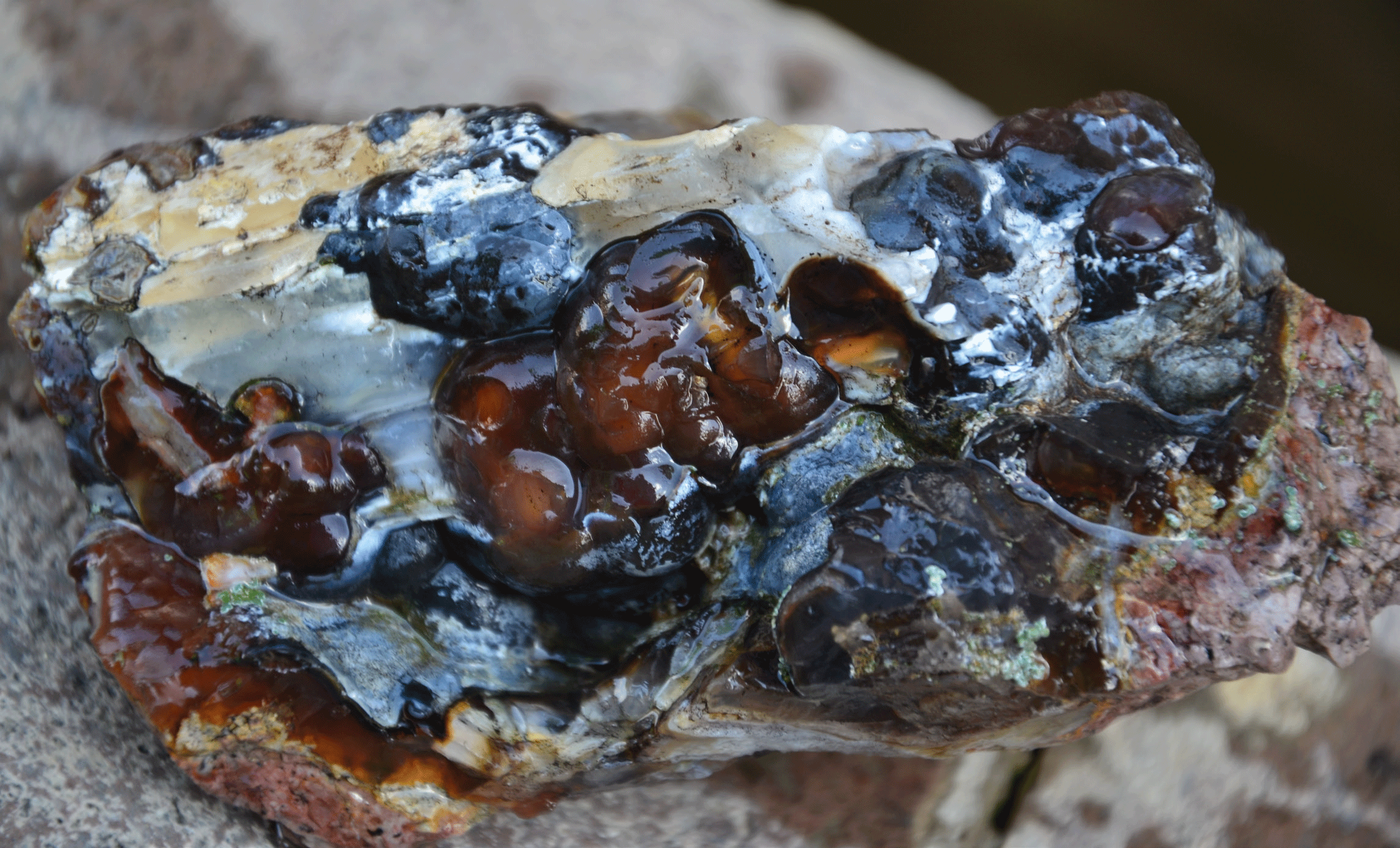
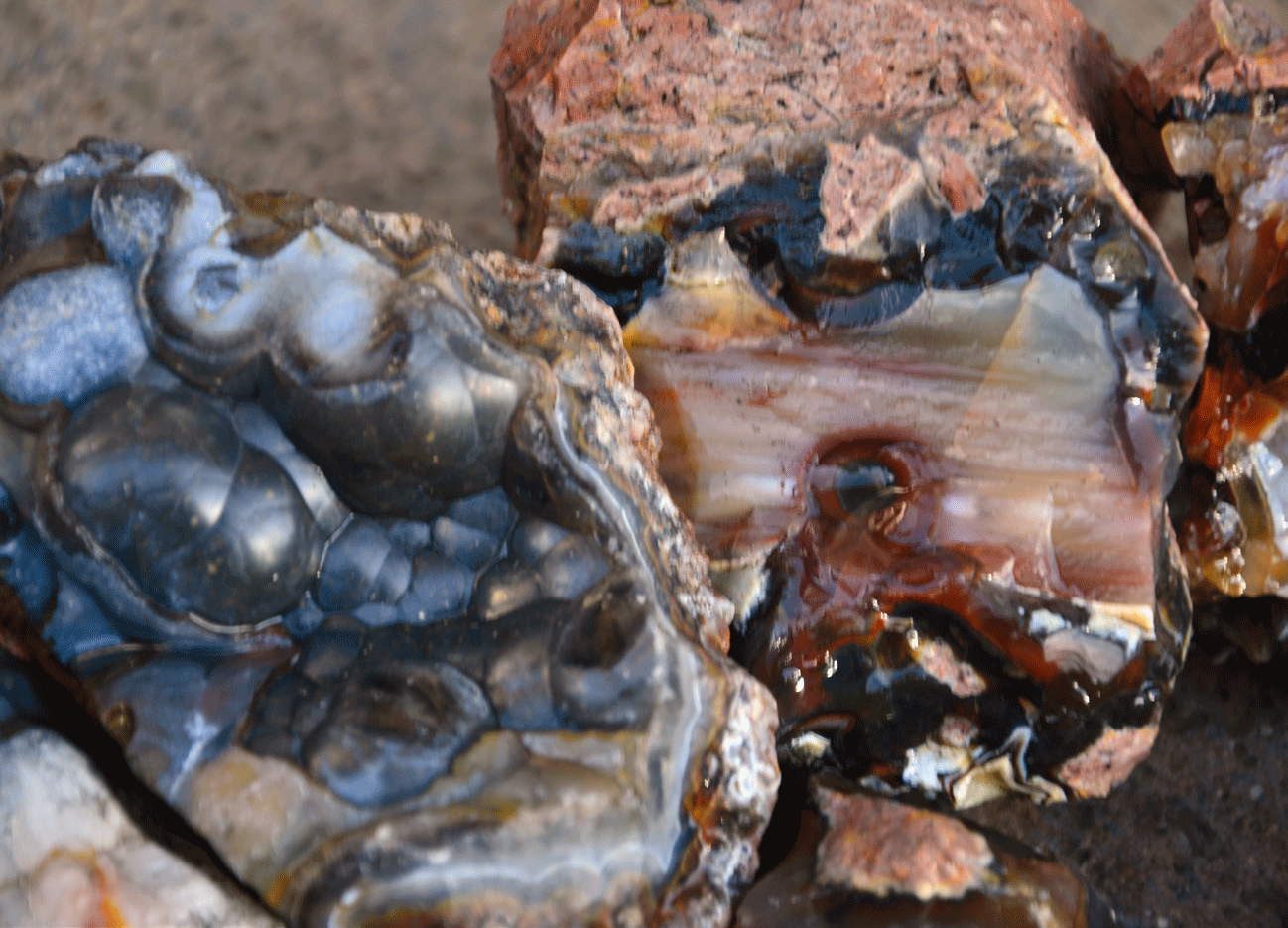
“volcanic series” which are the acidic volumes (rhyolite, dacite) cutting these rocks. Another series that congrously repose on these, is the Pliocene- aged “sedimentary series” which contains lava, limestone and lightly hardened pebble stones that contain sandstone pebbles, chalkstone and sandstone. Finally, the Quaternary alluviated cover congrously remains on top of these units. The agate stones in this area are found in mainly two types of rimrocks: andesite (basalt) and rhyolite. After andesitic and basaltic lava gets solidified, tension cracks in the NW direction and shear cracks in the NESW and NW-SE directions have evolved in these rocks as a result of the tension created by the acidic intrusion, released by the magmatic activity. This crack zone harbored layer-like agate which has radiational, pseudomorphic, crystalline bars and various other siliceous formations. These agate stones have been named specially and for the first time by Murat Hatipoğlu as “barred agate” as its scientific title and “Çubuk agate” for aiming the industry. The agate stones that embody these kind of unique
closures can only be found in the Ankara region. Gaps and cooling cracks which hold different directions at the contact zone of the rhyolites, harbored nodular and round or irregular shaped agate stones, seaweed agates and crystallized void aggregates. In this region where the agate stone is formed, geochemical alterations and replacements have taken place. The minerallization of tremolite-actinolite, chlorite and zeolites at the crack zone of andesites through hydrothermal activity, has developed from the membrane to the center. The zeolite mineral has grown inside a vein as in radiational bars. Additionally, during the formation process of the agate stone, these crystals have been replaced by the silica without damaging the original endoskeleton. Following these studies conducted to define the zeolite, the conclusion pointed out that this mineral was probably a “scolesite”. During this process, textural features of the two main bandings (concentric and Uruguay) and closures found in the agate stones were revealed by macroscopic, petrographical and ultramicroscopic
observations. It was learned that explaining the banding formations through macroscopic and even polarizing microscopic
observations can be misleading and the best results can only be obtained by the observations of electron optics. When the geological formation types in the Ankara region are considered, the theoretical morphologic features that are formerly expressed as the hypotheses of various agate formations for the examples in different parts of the world, paved the way for lightening the formation origin of these stones in the region. Given the structures in these agate stones such as various bandings and closures, we can assume that agates were formed in a similar way in the colloidal silica system, during the phase following the geochemical hydrothermal alteration. Along with the disintegration, replacement and accumulation of the silica during the agate formation, the principles of colloidal chemistry have played an important role. The hydrothermal
circulation ensured the siliceous solutions and electrolytes that are essential for the agate formation to move. Besides
the hydrothermal activities, heat, pressure, concentration and pH are also important instruments in the agate stone formations. The agate stones in this region were formed in 100-200 oC heat and pressure values which are close to surface conditions. As for the pH value, it is usually between 6-9 for the agate stones. The concentric banding in the agate stones embody globule or parallel radiational fibres and these fibres were formed during a jelly phase. Due to their inclined appearances, these fibres are not single crystals. The Uruguay banding can be briefly explained as the horizontal sedimentation of rough silica grains caused by gravity. The unique closures in the barred agate stones found in the crack zone of andesites in the Çubuk region are without a doubt caused by the replacements. The tubular closures inside the agate stones that are found between the gaps of rhyolitic rocks are rooted in unique growth. This algoid or ramiform growth was formed by a silica gel that contains alkali-silicate.
ECONOMIC RESERVE OF AGATE STONE IN THE REGION
Containing the most significant agate stone of Turkey, this region certainly has a rich agate reserve. During the detailed studies conducted in this region by Murat Hatipoğlu, it was appraised that both the nodularbodied quantity in rhyolitic rocks and the lamellar-bodied number inside the andesitic rocks of the agate stones are above 1 million tons in visible reserve and with the unknown sources, the number of reserves can reach above 2 million tons. Taking into account that the minimum price of agate stone in the world market is 5,000 dollars per ton, it’s a fact that the agate stone reserve in this region can worth above approximately 15 Billion US dollars along with its surface area of 100 sq.km, 1 meter depth and 30 kg/CBM grade.
AREAS OF USAGE OF THE AGATE STONE
Agate stones are representing a type of the appealing quartz mineral that has unique physico-chemical features. Therefore its usage has become popular in several industries. These industries and the areas of usage regarding the agate stone are:
Jewelry Industry; This industry represents a field where the agate stone is the oldest and the most widespread. With regards to the fact that using a naturally colored object as a jewel glorified people’s impulse of beautification, their social
status in the community and the ritualistic expressions in spiritual activities, it has been used just like any other ornamental stone and is still being used. Chemical Industry; In terms of its mineralogical structure, the agate stone is inert to chemicals and has high levels of hardness (Mohs scale 6,75). Therefore it stands out as one of the optimum stones for “mortar” and “pestle” which are used in the grinding process that take place before the chemical analysis of any kind of metallic and ametallic materials. However, the formation of agate stones in layer-like and large sizes is really rare in the world. For this reason, these layer-like agate stones which fill the gaps of crack andesites in the region have the optimum requirements for this purpose. The mortars and pestles built from this material are absolutely not manufactured in our country and the needs of all the chemical laboratories are supplied through importing.Besides, considering that the marketing prices of these products are at least 15,000-20,000 TL, it becomes evident that a large economic asset is yet to be evaluated in this region. Construction Industry; The agate stones of the Ankara region hold a rather rich potential of natural stones in termsof the industry. Utilizing these stones that majorly remain inactive as adecoration material in architectural projects is an additional advantage for the national economy. Agate stones are heavy, solid and competent materials and they are harmless to human health. Therefore they can be used commonly as paving materials for the interior decoration of buildings. Agriculture Industry; The mud liberated from the processing of agate stone has in fact rich content of elements. This slurry which is especially rich in silicon, calcium, sodium, aluminium and iron, makes the most natural and organic fertilizer for any kind of plant. It’s a great loss that this fertilizer material which is really rich in terms of elements is yet to be used in our country.