

The winners of the Aga Khan Award for Architecture were announced today in a ceremony in Abu Dhabi. The venue for the winners’ ceremony, the Al Jahili fort in Al-Ain, was also announced by His Excellency Awaidha Murshed Al Marar, Chairman of Department of Municipal Affairs and Transport and a member of the Executive Council of Abu Dhabi.
The winners are:
BANGLADESH
Bait Ur Rouf Mosque, Dhaka (Architect: Marina Tabassum) A refuge for spirituality in urban Dhaka, selected for its beautiful use of natural light Friendship Centre, Gaibandha (Architect: Kashef Chowdhury / URBANA) A community centre which makes a virtue of an area susceptible to flooding in rural Bangladesh.
CHINA
Hutong Children’s Library and Art Centre, Beijing (Architect: ZAO / standardarchitecture / Zhang Ke) A children’s library selected for its embodiment of contemporary life in the traditional courtyard residences of Beijing’s Hutongs.
DENMARK
Superkilen, Copenhagen (Architects: BIG – Bjarke Ingels Group, Topotek 1 and Superflex) A public space promoting integration across lines of ethnicity, religion and culture.
IRAN
Tabiat Pedestrian Bridge, Tehran (Architect: Diba Tensile Architecture / Leila Araghian, Alireza Behzadi) A multi-level bridge spanning a busy motorway has created a dynamic new urban space.
LEBANON
Issam Fares Institute, Beirut (Architect: Zaha Hadid Architects) A new building for the American University of Beirut’s camhaberler pus, radical in composition but respectful of its traditional context.

The Venue for the Award Ceremony
Ceremonies to announce the winning projects and mark the close of each triennial cycle are always held in settings selected for their architectural and cultural importance to the Muslim world. In 2016, the ceremony will be held at the Al Jahili Fort, a World Heritage Site in Al Ain, Abu Dhabi. Construction of Al Jahili Fort began in 1891 under Sheikh Zayed the First. Completed in 1898, it remained a residence of the Al Nahyan family for many years. It underwent a comprehensive rehabilitation between 2007 and 2008 by the Abu Dhabi Authority for Culture and Heritage with the collaboration of Eike Roswag, an Aga Khan Award for Architecture winner in 2007. The Fort was declared a World Heritage Site in 2011. Previous venues for Award ceremonies encompass many of the most illustrious architectural achievements in the Muslim world, including Shalimar Gardens in Lahore (1980), Topkapi Palace in Istanbul (1983), Badi’ Palace in Marrakech (1986), the Citadel of Saladin in Cairo (1989), Registan Square in Samarkand (1992), Karaton Surakarta in Solo (1995), the Alhambra in Granada (1998), the Citadel of Aleppo (2001) and the gardens of Emperor Humayun’s Tomb in Delhi (2004).
About the Aga Khan Award for Architecture
The Aga Khan Award for Architecture was established by His Highness the Aga Khan in 1977 to identify and encourage building concepts that successfully addressed the needs and aspirations of communities in which Muslims have a significant presence. Prizes have been given to projects across the world, from France to China. Architects and planners from New York to Dhaka have received one of 116 awards. During the nomination process, more than 9,000 building projects were documented. Over the course of the last 39 years, most of the great architects of our time have either won the Award or served on its Master Jury or Steering Committee, from Zaha Hadid to Norman Foster, Charles Correa to Frank Gehry, Jean Nouvel to Hassan Fathy. The Aga Khan Award for Architecture selects projects – from slum upgrading to high rise “green” buildings – that not only exhibit architectural excellence but also improve the overall quality of life. Because these achievements typically involved successful collaboration between many people, the Award recognises mayors, builders, clients, master craftsmen, engineers and end-users –as well as architects.
The 2016 Master Jury
The Master Jury was completely independent in the selection it made from the 348 nominated projects in 69 countries. Projects commissioned by the Aga Khan or any of the institutions of the Aga Khan Development Network were ineligible. The nine members of the 2016 Master Jury are: Suad Amiry, Founder, Riwaq Centre for Architectural Conservation, Ramallah; Emre Arolat, Founder, EAA – Emre Arolat Architecture,Istanbul; Akeel Bilgrami, Sydney Morgenbesser Professor of Philosophy, Columbia University, New York; Luis Fernàndez-Galiano, Editor, Architectura Viva, Madrid; Hameed Haroon, Chief Executive Officer, Herald Publications, Karachi; Lesley Lokko, Head, Graduate School of Architecture, University of Johannesburg, Johannesburg; Mohsen Mostafavi, Dean, Graduate School of Design, Harvard University, Cambridge; Dominique Perrault, Founder, Dominique Perrault Architecture, Paris; and Hossein Rezai, Director, Web Structures, Singapore.
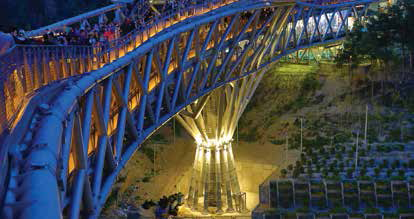
Tabiat Pedestrian Bridge, Tehran, Architect: Diba Tensile Architecture / Leila Araghian, Alireza Behzadi “A multi-level bridge spanning a busy motorway has created a dynamic new urban space. Download high resolution images”

Issam Fares Institute, Beirut, Architect: Zaha Hadid Architects “A new building for the American University of Beirut’s campus,radical in composition but respectful of its traditional context.”