
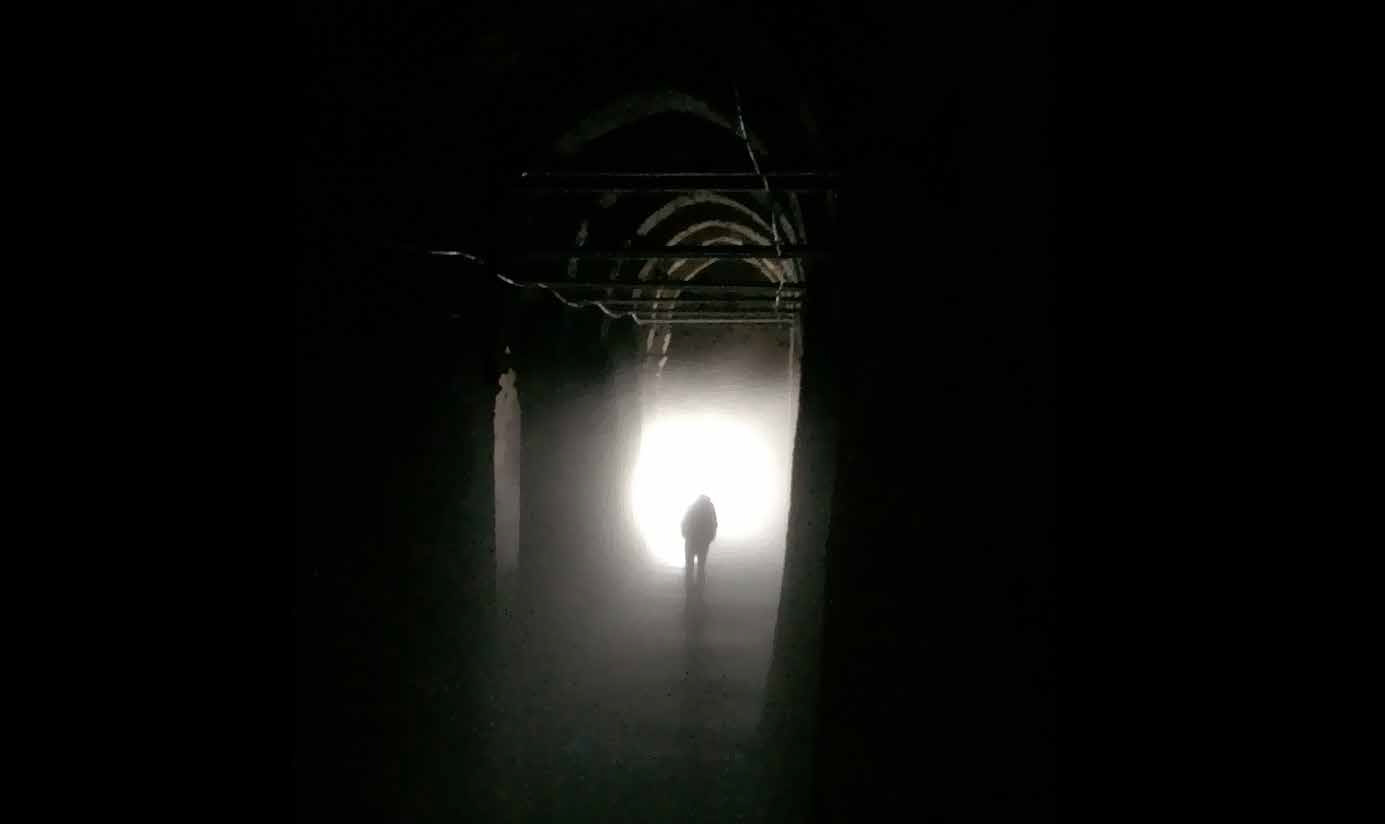
The first exhibition of YOĞUNLUK Initiative was held under the title
of AXIS MUNDU in the basement of Adahan Hotel distancing our
soul from time and space in the midst of the whole hustle bustle of
the city. With its second exhibition YOĞUNLUK, once again made
us go through an interesting special experience. For the exhibition
entitled SURUHU, one of the cisterns lying under the historic peninsula
was picked as venue Nakilbent Cistern in Sultanahmet; a cistern
dated to 1500 years ago with no more water in it so where one can
walk on its floor, allowing it to be used as an art gallery with a lit interior.
We talked to Architect Nil Aynalı Eğler, one of the founders of
YOĞUNLUK, which addresses the venue not as a sterile place where
art work is exhibited but as an object of artistic production itself,
concentrating on the relationship of the art event with the venue.

“There is a light screen we call ‘infinite light’ at the end of the space. This light makes the boundary
of the space unclear, perhaps destroys it and reminds us that actually, at a time this cistern, together
with all cisterns underneath ancient Istanbul, lived as an infinite network connected to each other
with countless canals. The space has a boundary but no end.”
Considering the collaboration of art and architecture, could you tell us
about this phenomenon?
The basic concern of YOĞUNLUK is the relationship of the art event and
the venue experience. One cannot say that an art work does not set up a
relationship with the venue. Art work, when designed as an object in the
studio, and hung on a wall, even when they are placed in a space for exhibition,
create a difference in the experiencing of that venue. They too are
affected by the qualities of the space they are in. Our intent is to be aware
of that interaction just from the beginning, going further to render the
space as a starting point for artistic production. To trigger the revelation of
art work through a quite dense relationship with the space it will be in. And
lastly, to offer an experience where the space and works are integrated
with and enhance each other.
YOĞUNLUK is a non-profit art initiative. Its basic concern is as I said is
space. This concern has two aspects:. First to find a space, to develop a
conceptualization for that venue and to allow the art work to be
revealed through as dense a relationship possible with that venue.
The second aspect is the revelation of the ar tistic act itself as a
special experience. I mean not just to produce works dedicated to
that space but at the same time, ensuring that those works have a
potency to unearth the existentialist qualities the space they are in,
allowing them to create a spatial experience embracing those who
enter the venue when combined with the space. And lastly, presenting
an experience where space and works are integrated and enhancing
each other.
How did the idea of establishing YOĞUNLUK initiative come up and
how was the team formed? How does the initiative function?
I can say that all of us were involved with space in art in different ranges
as part of our previous endeavors. I studied architecture but I have
not been practising for a long while but I am involved in the conceptual
aspect of architecture. In that sense, I have had a few large exhibition
experiences including 1st Istanbul Design Biennial Musibet Show. Ismail
has studied design and for a while has been producing in the field of art.
He is focused in concept of time-space in his works. Elif has a TV and
media background and deals with organizational matters in the team.
We can say that the trend of initiative has arisen from the time-space
issue which keeps showing up in Ismail’s works, and I am interested in
the onthology of space. To that end, we will be totally involved in new
spaces each time.
You say there will be a new space for each exhibition; but how will
they be picked?
Rather than picking them, we stumble upon them or they find us themselves.
The seller in Adahan Istanbul appeared before us on recommendation
of a friend. The atmosphere we faced when we entered the cellar, the 3D
effect and articulation of the venue, the layering formed by time on walls,
traces and textures were allvery impressive. We felt that the location had
its own time. We think that the subsequent venues will also come out in a
more intuitive manner through what they make us experience at the time
of the initial encounter. Rather than spaces known at present, the ones
which are not involved in day-to-day life much but which impress us profoundly,
thanks to their spatial qualities when entered in, are more attractive
for us. One of the qualities which made the cellar at Adahan special was
its being still sort of undiscovered despite being in the middle of Beyoğlu.
YOĞUNLUK picked a cellar in its first exhibition and a cistern in the
second one. How do you pick the places, can you tell a little bit about
it?
The first and the most important phase of exhibition of YOĞUNLUK is picking
the place. Maybe it’s not fully a selection but we can say the appearance of
the venue we are looking for. Because as they say “You don’t find by searching
but seek and ye shall find” we almost set out on a journey with an unknown
end when we start saying with which venue we can do the next exhibition.
Sometimes thishappens with us walking the streets, looking behind each door
and sometimes picking the brains of the people we talk to. We heard about
Nakilbent cistern during a conversation with Pera Museum coordinator Zeynep
Ögel. We first found it interesting that there was an enourmous cistern
under a carpet store in Sultanahmet. We wanted to go and see it. When the
moment we descending into the cistern, going among carpets which are art
works themselves, we felt that the place had a sense of time different from
the world above. Therefore, we hoped that the venue could be carrying an
experience of the type YOĞUNLUK wishes to produce.

Are the works scheduled ahead?
We can say that when we start an exhibition process, we have nothing in
our mind.. Until we face the space… If the moment we enter the space it is
whispering us something and if we feel that certain feelings that cannot be
voiced are formed between the venue and us, then we decide on that venue. This
decision is quite intuitive. Once the decision is made, then the process of approaching
the venue starts. Trying to go back to the time the venue was constructed
to understand its reason d’etre, to search what it has so far accommodated, what
kind of time it has had until the time of its construction, layers the relationship set
up with that place. I believe this relationship is started to grasp a type of essence
giving that space the reason to exist and later, forming its memory, lying in the
core of the space. When we look back at it, we notice that each time, we searched
an “invisible” hidden at the core of the venue. This essential component for Axis
Mundi was the well at the center of the space, for SuRuhu (Water Soul), it was in this regard?
We also find it difficult to call it an exhibition. If we have to give a definition,
we would like to say spatial experience” but this terminology has not yet found
a place in the language for itself. Actually, the basis of special experience
lies in the might of architecture. Powerful architectural products created through
history, the examples of which we can find today, carry similar experiences
in themselves. Each time we enter Hagia Sophia, we can feel that the light,
the sound and the qualities of space surrounding us take us to some other
time space or sometimes when we enter a yard, the sudden dimming of light,
some water running in the middle, the aroma of trees once again addressing all
our senses surround us. The basic source of inspiration of YOĞUNLUK is this
might of speciality. What we are trying to do is using sometimes physical and
sometimes intangible channels to be part of space or to unearth the special
might of spaces.
Collective work is quite a warranted definition. Here what is important is that
YOĞUNLUK, which forms the conceptual framework of the project and artists
creating it share similar sentiments. So far, all participating artists not only
share these sentiments but took them well beyond the point we started at.
The selected “location” is very important architecturally. A columned
cistern, the layout of which is known. Did you intervene in the cistern?
You said that teh source of the mist created inside came from the neighboring
mosque? Could you tell us a little about these details?
We did not intervene with the historical structure of the cistern. Our more
important intervention was with contemporary additions. After a careful
restoration, the cistern was open to visitors in 2005. A space visited by tens
of tourists everyday. It also hosts exhibitions few times a year. Therefore,
the floor was covered with wood. A lighting system was installed on the
ceiling. Quite a well-lit space this is of which each you can see on a daily
visit. Yet, the cistern, thanks to its nature, is a dark venue with no light,
only containing water. Our first intervention was to deactivate the lighting.
The source of the mist was water borrowed from the neighboring mosque.
The water accumulated by itself albeit a little inside the cistern was used
in reflective pools. Physically, the largest addition is the 6-meter screen
forming the part we call “infinite” light in the end of the venue.
The cistern is at the lower floor of Nakkaş Halı Sultanahmet store and
exhibitions are held there. It sounds very nice, we celebrate them on
this occasion because of this contribution. We wish these types of
locales increased in number, these valuable spaces are made use of.
Could you tell us about Nakkaş Halı’s contribution to you?
Before discovering this place, we got the chance to see other cisterns
under other stores in Sultanahmet. Unfortunately, not all of them were
so lucky. Some of them are used as storage spaces and some have
gone through main changes in the name of utility. There is a network of
cisterns under the historical peninsula. Perhaps a more integral project
the the water which does not exist today inside the cistern.

Then can we say that projects are formed depending on the space?
Indeed. Actually sometimes it becomes quite difficult to make the distinction
of the project and space. At Axis Mundi, a lot of people had asked “Did you
build this pool? Was it not here before? In SuRuhu, there is something even
beyond it. A cistern dating back to 1500 years ago, in which there is water no
more, so you could walk on its floor, which can even be used as an art gallery
lighting its interior. Our basic purpose was to call back the water which was
the reason d’etre of the venue and by that means, to open a gap through
which the memory of the venue would reflect itself. It was not possible to
bring the water itself back to the venue because it is not possible for the cistern
to collect water because of its structural weaknesses. We wouldn’t opt for it
anyway even it was possible. Instead the basic idea for the project became calling
back the water droplets we call “soul” of water and to convey the memory
by light reflecting onto these droplets. The different types of relationships set
up between light and water droplets, created surfaces one could go through
fullnesses in which you could breathe. This took within the darkness which was
the natural state of the underground cistern. I mean, a transition was made
from a space well lit all over, each part of which was visible to a space which
one could see to the extent the images inside the water was illuminating. The
cistern became a space which one could not see by eye and control its every
point but one which could be perceived together with the experience set up in
it, actually only because of it. In that sense, it is almost impossible to separate
the space and the project from each other. The project creates an integral
experience also containing the space.
In both of its exhibitions, YOĞUNLUK managed to distance our souls
from the whole confusion of the external world. What does YOĞUNLUK
exactly seek in that context?
Yes, this became appealing which was common for both exhibitions. On the
part of YOĞUNLUK, it is not possible to talk about any objective articulated
previously in that sense. It can be said that in each artistic action and in some
lucky situations like it’s possible in architecture that the overall atmosphere
of the project is relational to the inner world of the person/persons creating
it. One of the wishes YOĞUNLUK could articulate at least internally was to
form specialities which could draw one into them without having to make a
great effort to set up the relationship which can embrace one allowing him or
her to experience both a physical and also a mental experience. This type of
a concentration takes place in a more difficult manner within the day-to-day
flow we call “confusion”. The venues we take to hand, on the other hand, date
back to well before the present time because of their ages and also they create
a time flow different from the outside world in terms of space. So, we wish to
reveal and deepen and add new layers to this potential
in them. I think looking at the comments of
viewers, the experience at SuRuhu is quite dramatic
in that sense. There were times we heard that
beyond distancing fm the confusion of the world,
there was distancing from the time and spacing
perception of the world in association with even a
type of after-death experience.
I find it difficult to use the word exhibition
when asking these questions and preparing
the article. Because for me, your second collective
work, beyond an exhibition, is like a
performance. It is as if you have set up a film
platform and you’re taking the viewer away to
another world, detaching him from reality albeit
for a short time and when doing so, the
viewer does not have to make a great effort;
I mean, setting presents all conditions. Light,
sound, water… All of these together carry the
individual to another world. Can you assess Nakkaş Halı was using this space very carefully at the time. Starting from
the wooden floor up to the concern indicated in previous exhibitions, had
made us feel that the place was in good hands. Managers Cengiz Korkmaz,
Cengiz Kara ve Mesut İnceoğlu, when they first heard of the idea, were quite
excited and agreed on our proposal right away. They left the space to us
free of charge for three months including the preparation period. Especially
during the last month, the team was working there until late hours. Using
a location toured by tens of groups of tourists everyday as a work area was
quite difficult and this could not have been possible without the support
from the heart by Nakkaş Halı. In fact, to ensure that the artists are not
disturbed, they didn’t even come down to look at what’s going on below.
How did you bring together works transcending to the other world that
are sort of hypnotizing?
In fact, everything developed in its own natural process. Once we set
the main approach as “calling water back to the space as water droplets”
and setting out with the intention of awakening the memory of the
locale by light and sound, we started some trials. There is a three-person
team setting up YOĞUNLUK but Nezih Vergeloğlu, one the artists
at Axis Mundi, was always close to us. He was part of the process right
at the beginning of these trials and at a time when everyone started to
pursue his own curiosity after the team created as a result of our conversations
with Ismail, saying actually “What kind of experiences can be
created within mist” rather than a question like “Whom shall we invite”,
there was the Waves exhibition and we saw the works of Büşra Tunç
whom we found very close to us in terms of approach, whom we knew
before, has studied architecture, working in an interdisciplinary field
in recent times. We thought that she could be the right person for this
exhibition where the basic substance would be light. Her ideas and approach
were truly transformative. Sergen Tertemiz, doing the technical
setup of the exhibition system, coordinator Elif Tekir and graphic design
trainee Julia Schafer were indispensible parts of this project. In short, it
was a process where needed people came together in a natural process,
speaking the same language, carrying similar feelings.
The cistern is a sort of surreal location, like a world of dreams. Darkness
is dominant and there is light at the end of that darkness. How did your
visitors find it? What was the main feeling you wished to pass on?
There is a light screen we call “infinite light” at the end of the space. This
light makes the boundary of the space unclear, perhaps destroys it and
reminds us that actually, at a time this cistern, together with all cisterns underneath
ancient Istanbul, lived as an infinite network connected to each
other with countless canals. The space has a boundary but no end.
Adahan Hotel cellar, which was your first venue, was not actually an exhibition
space before. It became so later. Just like the cistern. Today, it is used as an
exhibition venue and there is a store above it. In contrast to the sterile “White
cube” logic, ancient locations with unending whispers are used as exhibition
locales. What would you like to say about spaces which were not constructed
with cultural purposes but which are used as exhibition venues today?
Our concern is more with the venue itself. We try to see it more than
an exhibition locale as the starting point of the artistic action. When we
consider the space as an exhibit ion locale for the art work to
be ins tal led in it , then the unavoidable relat ionship of the space
and those object s come up. Somet imes, the space is so powerful
that it almost swal lows the object s, making them invisible.
Yet somet imes object s overcome the space, making some of it s
qualit ies disappear. I think it ’s best to hear the sound of the
space once more before holding any exhibit ion in those types
of locat ions.
Thank you for this information