
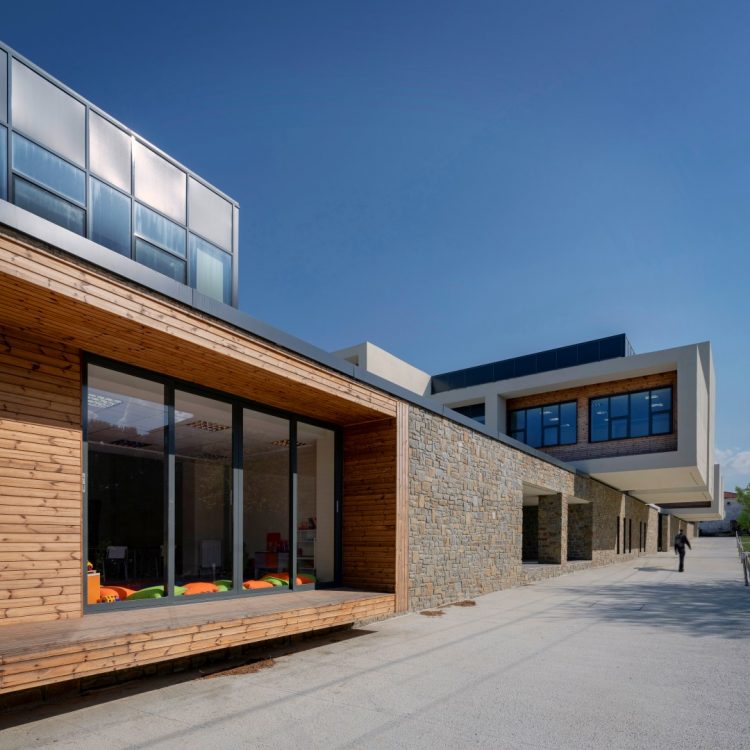
The painting and music classrooms, laboratories, studios located on the ground floor propose an interactive learning environment as being transparent with an easy flow through courtyards for students to observe the artistic and scientific activities around them and for townspeople to interact with these learning activities. For instance, a passerby islander can listen to the melodies coming from the music room which acts as a stage opening towards the public street, or a student can observe the artworks through the transparent glass façade in the courtyard. A transparent and accessible learning environment that triggers a sense of curiosity is established. The cafeteria and canteen on the ground floor can be accessed from both sides (street and courtyards side) and serve both students and townspeople. The facilities of the campus become a part of the daily life of the island and act as a catalyst to transform the urban environment. Gökçeada’s small-scale masonry houses in organic urban patterns have affected the decision of fragmented and low-rise construction with the local stone texture selected as the material decision. Bigger volumes such as sports center and conference hall are half-way embedded with the help of the level difference to sustain a human scale environment in relation to the natural surroundings and relate with this context both physically and conceptually with its scale and material choice. All the arrangements on the land are in harmony with the surroundings and local structural character. The compact master plan uses the former building footprints for the new blocks (except for the dormitory) to preserve. In an attempt to preserve existing trees in harmony with the settlement, only a small number of trees have been moved in order to make better use of natural light. The existing trees and the new woodlands are planned to surround the north of the buildings and east of open areas intensely by forming a sheltered wall against tough hubs. The rich natural landscape that the land already has form the main landscape character. Special arrangements such as hobby gardens, sports fields and event meadows are planned for specific areas.
In the project, basalt coating for floor covering is used partially. Local sandstone, which has been found in the architectural texture of the island for centuries, is used in areas such as building walls and retaining walls. The ground floor and the outer walls of the buildings are formed with load bearing masonry wall technique. Later, a thermal insulation layer and interior walls are built. Other walls that hold the soil in the courtyard walls or support the levels of landscape are also built with the same technique. The main goal of the competition proposal was to build a campus which can be used by two schools and the people of the island and throughout the implementation process it was tried to reconcile this aim with conventional management habits and offered to MEB (Ministry of National Education) as an innovative education model.
CREDITS
Architectural Design: PAB Mimarlık
Project Team: Pınar Gökbayrak, Ali Eray, Burçin Yıldırım,
Çağlar Yılmaz, Sinem Yardımcı, Ekin Aytaç,
Arzu Meyvacı, Serkan Polat
Client: Çanakkale İl Özel İdaresi
Project Date: 2016
Construction Date: 2019
Total Construction Area: 17.500 sqm
Photographs: Yerçekim