The quality of being local is something we specifically look for in architecture. By respecting the local, adding to it all the benefits of modern life, Teomida Hotel has become a good model. How did the idea of this hotel come up? In the beginning, there was no hotel idea. Our first wish was to create a Mediterranean garden in a large lot. This was how we star ted in 2004. In time, an idea developed in our minds and we wanted to create and share with other people a nature-friendly space where we could express ourselves and reflect the lifestyle we love. Nature is ver y impor tant for us. Nothing is as generous as nature and right now, it needs to be protected a lot. When building the main hotel building, we made sure it was built in the section of land with fewest olive trees and we replanted all olive trees in other parts of the land. We wanted Teomida to be a place of leisure, a refuge for people. We want the same thing for nature, too. Teomida is a shelter for birds, squirrels, hedgehogs, swallows, doves and countless other living things. We used absolutely no chemicals in our garden. Our vegetable gardens are totally free from chemicals and our seeds are as organic as possible. We are the guests, not owners of nature. This shouldn’t be forgotten.
 Teomida’s messages are wonderful. Who is the design architect of this environmentally friendly building? What are the number of rooms of the hotel, its size and
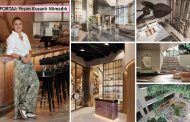
services offered? Architectural design is by an architects from France; Pierre Gourvennec. Myself and my husband Christian Bastide described to Pierre Gourvennec the living spaces we wanted and the large terraces in these spaces, the high ceilings and the antique style pillars in common elements, the layouts of rooms and public spaces and the desired and required orientation of the building against the sun and the scenery. Pierre designed Teomida under the guidance of by husband Christian. The moment you enter the building, you can see Mount Ida and the sea, thanks to the courtyard providing the transparency in the center part of the building. Our garden is 15 donums. Our hotel has 10 rooms. The smallest is 28 m2, the largest 45 m2. Our hotel features a bath with a cooling down pool and a 22-meter-long swimming pool posititioned in the shape of garden we use outdoors.
 The pool makes one think that you are swimming in the sea. It is beautiful… The hotel has become a good blend of Turkey’s nature and Europe’s style. We can see the influence of your living in France and knowing Europe, in the hotel. What would like to say about this?
In the hotel, we created a joyful living space in the warmth of a home, thanks to the vivid colors we used comfortably. Of course, the influence of the setting we live in, the trips we take frequently is visible there. 
The pool makes one think that you are swimming in the sea. It is beautiful… The hotel has become a good blend of Turkey’s nature and Europe’s style. We can see the influence of your living in France and knowing Europe, in the hotel. What would like to say about this?
In the hotel, we created a joyful living space in the warmth of a home, thanks to the vivid colors we used comfortably. Of course, the influence of the setting we live in, the trips we take frequently is visible there.
These days, large buildings are appreciated. You have set up everything in a small building instead of a large one. As if the concept of “Less is More” was implemented. What would you like to add to this?
Yes… We were inspired by minimalism in Teomida, especially on the exterior. By using straight lines on the exterior, the building gained elegance and simplicity. In the interior, on the other hand, we were inspired by minimalism using geometrical forms facilitating the use of spaces.  We observe that great specimens emerge when the concept of architecture is combined with crafstmanship. Care was taken in the design of furniture and rooms. Who prepared and implemented the drawings of interior design?
Interior design and selection of furniture were entirely by my husband Christian and myself. Neither of us is an interior designer. Natural materials are very important for us. Our tables, coffee tables are made of old oaks of close to 100 years old. We drew them and had them made in Ayvalık. We brought our favorite objects and some of our lighting fixtures from our travels and France where we lived. We mingled a few antique objects and furniture purchased from Horhor with modern decor. We picked our carpets, the paintings and posters on the walls one by one depending on the color of each room. No room is the same as another in Teomida. We took great pleasure in doing all this.  Where did the stones in the bathroom come from?
The marble in the bathroom is from Afyon. The craftsmen who built the bath went to Afyon himself and picked the stones he would use carefully. Where did you get the natural stones on the exterior? The natural stones on the exterior are from Kozak mountain nearby. Kozak granite.
The designs of the bathrooms in the rooms are quite special. Where did the natural stones there come from?  “The marble in the bathroom is from Afyon. The craftsmen who built the bath went to Afyon himself and picked the stones he would use carefully.”
The rounded and smoothened stones we used on the floors of some showers are from Anatolia Taş near İzmir; the stone of one of the bathroom is processed lava stone and the other one is slate. We used some local s tones and some we impor ted from France. And some of the bath stones we got from Adnanlar in Izmir.
What kind of a place you had in your mind when you first started to think about the project? Did you eventually get what you wanted?
Christian and myself are highly per fectionist people. I can’t say we exactly got we wanted and the reason for it is cer tain problems we had in execution.
I a sked ever yone we inter view, their favor i te local or global designer s and/or a rchi tec t s. I ’l l d o the same wi th you . . .
Le Corbusier and Frank Llyod Wright.
Thank you for the informat ion, I wish you cont inued success.
I thank you.