
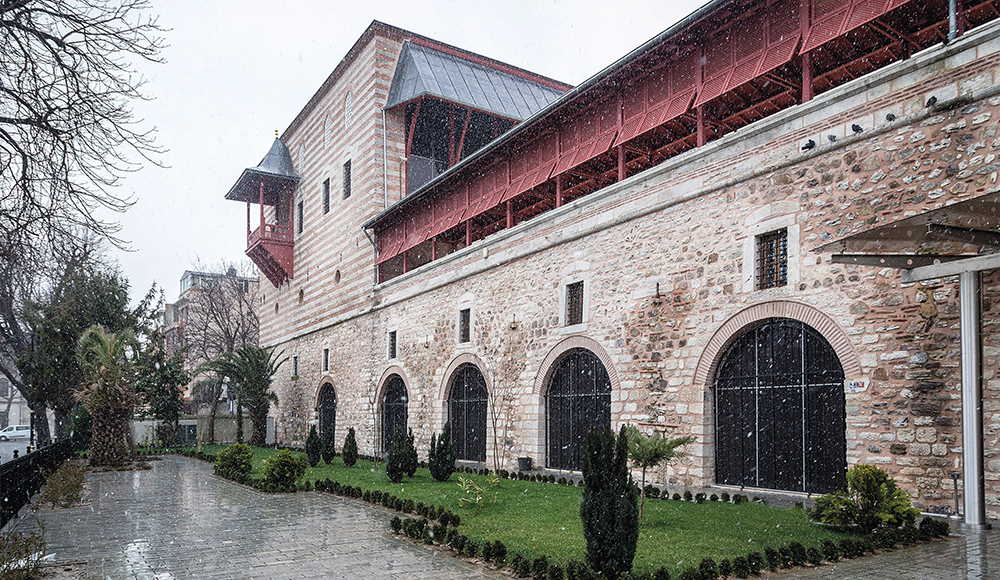

Turkish and Islamic Works Museum, besides being one of the recognized museums of the world with its wealthy and diverse collection, comprising 45,000 works from the various periods and geographies of Islamic culture and art, also has the distinction of being the last museum opened in the Ottoman Empire period.
Efforts for establishing Turkish and Islamic Arts Museum started in late 19th century, to avoid taking out of the country of works donated to mosques, türbes and libraries all over the country to ensure that the works are protected, and to carry this treasure of culture to future generations.
The commission, set up chaired by Royal Museum Director Osman Hamdi Bey, completed its studies in 1913; with the museum opened to visitors under the name of “Islamic Foundations Museum” in 1914 in the imaret building of Süleymaniye Mosque complex, one of the masterpieces of Mimar Sinan.
The museum took the name of “Turkish and Islamic Arts Museum” after the Republic was proclaimed, moving in 1983 to its present location; Ibrahim Pasha Palace. The palace was gifted to Sadrazam Ibrahim Pasha by Suleiman the Magnificent and is one of the important works of the Ottoman civilian architecture of 16th century. Rising above the layers of the old hippodrome of Istanbul, the palace was built as a masonry complex in contrast to the Ottoman tradition where old civil buildings made of wood; became witness to numerous historic events like wedding festivities, uprisings, etc. in the brightest periods of the Empire, being used as the palace of sadrazam; and was also used as for functions like barracks, embassy, defterhane, mehterhane, sewing house, and jail.
The construction of Defterhane in the 19th century, and Land Deeds and Cadaster Directorate building on the first courtyard of the palace which was originally built around 4 large courtyards in 1908, covered the overall view significantly. An important section of the palace which survived for centuries was torn down during the construction of Justice Palace in years 1935-1947. The second courtyard, which hosts Turkish and Islamic Works Museum today, was repaired in years 1966-83. The building, restored for two years starting from 2012, reopened its doors to visitors on December 19, 2014, as a result of a detailed display design project which was part of the restoration work.
A spacious hall greets the visitors at the entrance level from the square. At this level of Turkish and Islamic Arts Museum, there is an approximately 400 sqm temporary exhibition hall, a 200 sqm 25 person capacity multivision area among historical Byzantine hippodrome remnants and the museum store.

The 10-meter-long marble bank; accommodating entire ticket sales, information, storage and security functions, is designed to allow visitors to be directed to the entrance in an orderly manner without waiting. Hence, the historic form of the venue stays intact, serving as an example of the union brought about by the plainest form of history and modernism. The horizontal linear mural behind the counter reflects clues on the identity and collections of the museum. Preliminary information on the collections is provided to visitors via screens using a plain composition.
The remnants of the hippodrome unearthed during the operation workand made part of the museum display, may be viewed at from its own level or from the garden level, thanks to the glazing on the ceiling.
The visitors are provided information on the story of the building and its architectural features through miniatures and multi-layered graphics hierarchy before entering the museum collection. The visitors may access on a screen to Prof. Nurhan Atasoy’s article on the subject for further details.
At this level of the building, which takes the visitor to the garden level via broad and magnificent stairs which play an important role in the architecture of the palace, are an inner yard and viewing terrace overseeing the awe inspiring Sultanahmet scenery. From the garden level, one can access the Ethnography Section and museum cafeteria which will be launched in the upcoming months. Once again, at this level, are storage halls and conservation studios supported by functional designs and technological equipment. Also, the last wooden structure left in the garden is used as the administrative building of the museum.
The U-shaped top floor situated around the inner courtyard was designed in groups of 13 different civilizations and periods chronologically. Efforts, which started for displaying a collection comprising extremely valuable objects in a period space, made it necessary to execute the design in such a way that the building would support the works, making them more visible. Display systems, resolved observing the basic design principles like composition, form, color, texture, sound and light, on neutral and dark colored glass showcases and background; are also supported by graphic elements recreating the institutional identity of the museum. The differences between periods are pointed out through the motifs on information panels.


In the story outline, it was sought to convey the history of the century-old museum to the viewers in an understandable and impressive manner, under the title “From Islamic Foundation to Turkish and Islamic Works”. In this section hosting the past memories of the museum of hundred years ago, the initial founders committee of the museum greets the viewers; taking them to 100 years ago, accompanied by first equipment of the museum, by black & white photos.
The section where Rakka and Samarra excavation artifacts are on display under the title of Islamic Archaeology; architectural references like the archaeological excavation area and the walls of the city display the works to viewers in a time period from sunrise with rooster sounds and to sunset in Rakka, under the framework of a reanimation. The display technique provides a different experience to the guest supported by light, sound and visual effects.
A section of this size was dedicated for the first time in the museum display for Damascus Papers, a major treasure for the Islamic world and the development of Islamic book art where the first copies of Holy Quran are kept. The inspiration for the showcase of this area was the hexagonal treasury department in the yard of Emeviye Mosque where the works come from.
Sacred Relics of Hz. Muhammed and Kaaba of the museum collection are in the Sacred Relics Section. A quite dim atmosphere was created in the design of the venue ensuring a spiritual journey for the visitor, with the aid of a Salavat-ı Şerif sound coming from the deep and a dramatic lighting focused on the works.
Anatolian Seljuki and Ottoman periods are in the summer and winter divanhane veneus, the two largest areas of the palace. A special exhibition platform was designed for the carpet collection including extremely valuable pieces from these periods. The carpets displayed using a sloped mirror solution allows the visitor to capture surprising perspectives in the world of designs, colors and motifs.

CREDITS
Project Location: Sultanahmet, Istanbul
Architectural Office: Tasarımhane
Curator and Project Director: Güzin Erkan
General Coordinator: Oben Karatepe
Collection and Content Consultants: Seracettin Şahin and Sevgi Kutluay
Interior Design Team: Güzin Erkan, Seher Caba, Eylem Ece and Elif Çentik
Graphic Design Team: Irem Düzgün, Burhan Efeoğlu and Cem Mert Çimen
Film Production and Digital Software: Çiğdem Yavuz, Burak Öge and Hakan Efeoğlu
Interior Design Application: Mustafa Coşkun, Adem Coşkun, Atilla Kızılşafak and Ayhan Karataş
Showcase Application: Goppion
Audio, Video and Computer Systems: Astel
Digital Prints: Printo
Islamic Archaeology 3-D Animation: Reskon Restoration Architecture
Interior Design / Display and Application: Tasarımhane
Client: Republic of Turkey Ministry of Culture and Tourism, and General Directorate of Cultural Assets and Museums
Project Supervision: Directorate of Surveying and Monuments
Project Date: 2014
Total Construction Area: 7,000 sqm
Restoration Project Application: Aksan Construction
Photographs: Servet Dilber

Selin Biçer / Architect