
Ipek Baycan Magriso, who was deemed worthy of many awards on a national and international scale thanks to her design approach that goes down to the level of refined detail in many different scales and typologies, has been continuing her own practice since 2021, following various projects she developed with the founding partnership of Slash Architects. Seeing design as a tool to improve conditions, conventional systems and the environment, İpek Baycan Architects is an architectural collective that aims to rewrite the conditions and change the built environment for the better. We talked with İpek Baycan Magriso, who believes that the power of design thinking to change the environment by feeding from the context should be reflected in works of all sizes, and that design is more of a right than a luxury and that it should be accessible.
You have decided to continue on your
way as İpek Baycan Architects from the beginning of this year. How has your
professional career changed with this decision?
İBM: The process of
emergence of İpek Baycan Architects arose partly with the feedback given by
their practical work experience. Since 2014, as a young architect, I had the
chance to build my architectural practice, since there was no ancestral
infrastructure, I drew my own path. I have experienced many different ways of
doing business on this path, however; As a designer architect, I have seen that
it is important for me to integrate my own added value into architectural
practice by revealing different ways of thinking each time, without losing its
core values. If I open a little bit; The triple combination of context, topic
and user differs according to the nature of each project. At this point, I
wanted to bring the architectural thinking into action and to produce an
unusual or specific solution for the subject studied, to continue to be the
main subject of my work, while bringing my own company to a more medium-sized establishment.
I decided to continue this practice with my own company in January 2021, as I
am of the opinion that creating this boutique production style can be achieved
with the correct determination of the scale and business model.
How would you describe your design line and perspective on architecture?
What are the qualities that make your projects different?
İBM: In addition to
understanding the demands of the space, the common backbone of our projects is
to answer the question of what can be added to the brief as added value,
keeping it in the back of our minds. This way of thinking can create surprising
spaces while diversifying solutions and initiates a more enjoyable intellectual
process for us. The most important character constituting the common language,
besides a simple understanding in architectural language, goes through projects
that have a single strong word.
It is seen that office and clinic designs occupy a larger space in your
project portfolio. What are the elements that you base on while shaping your
projects like this?
İBM: The typology
clinical buildings and office projects that follow each other the most among my
projects. The common feature of many of them is to be interior design projects.
In other words, creating spaces that belong to an existing space and create its
own concept (identity) is the basic infrastructure of our approach to all
projects. The common denominator in all of my works is the clues provided by
the current context (space) and meeting the demands of the space with the
purposes of the user (sometimes the business) is a very sensitive setup in our
opinion. The reason why I especially like working on office projects; I can say
that by rewriting the working styles of groups that have a different office
operation and working on fundamentally different subjects each time, to create
the most appropriate cover for them. When the solutions we created as fictional
meet the space; Uses that the user does not think of at first appear, and all
these interventions increase productivity in the big picture.
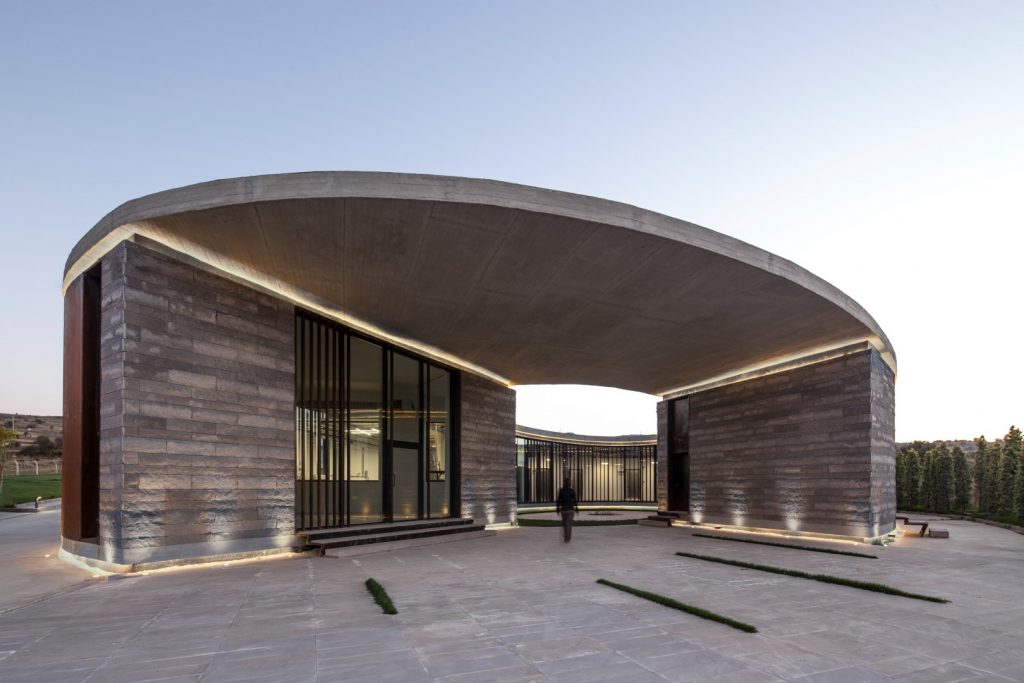
You have received iF Design Award, Architizer A+ Award and WAF awards with
38°30° Farm Cheese Factory. You have also won Arkitera’s Young Architect
Awards. What was the significance of these awards for you?
İBM: All these
awards came to us within the first 3-4 years of establishing our own practice.
This is a very proud achievement as a young architect. The structure of the
38°30° Farm Cheese Factory, where we have the opportunity to present a
qualified structure, also drew a general framework that the structures we will
reveal from now on should be of the same sensitivity and maturity. This is
actually not a simple task. For this reason, I always approach my work with the
awareness of the achievements of this period. For example, we received feedback
that it is important that the project is almost “a diagram embodied” among the
reasons why it is included in the WAF award group. Winning the Arkitera Young
Architect Award is an award that I care about, as it is an award given in
relation to the general identity of our work. Being aware of the same detail
and sensitivity in all architectural and interior architectural applications
and providing this skillfully are among the reasons for this award. The
satisfaction of all these awards gives us excitement in the sense that the
identity of our work can be read from the outside.
What kind of new demands and trends do you observe in office projects under
the pandemic conditions that cause great changes in our lifestyles and habits?
İBM: We have heard
many different approaches these days when we have reached the point where some
large offices have closed their offices completely. In particular, he was
talking about the fact that computer-aided and day-to-night office structures
did not make much difference in their lives. Another group longed for the
synergy and efficiency created by being together and the office environment. I
think we are closer to the second group, even though we find this remote
working experience positive for a while. In office projects, there have been
trends such as infrastructural changes suitable for rotational work in general,
and a tendency towards less frequent settlements in the design of the space in
order to be better prepared for the possibility of encountering such a
situation (pandemic). In this respect, the old open office logic began to be
questioned and office setups with more compact interior systems came to the
fore.
Can you talk about your Pupa Technical Office project, which was completed
recently? What kind of solutions did you develop in this project for new trends
after the pandemic?
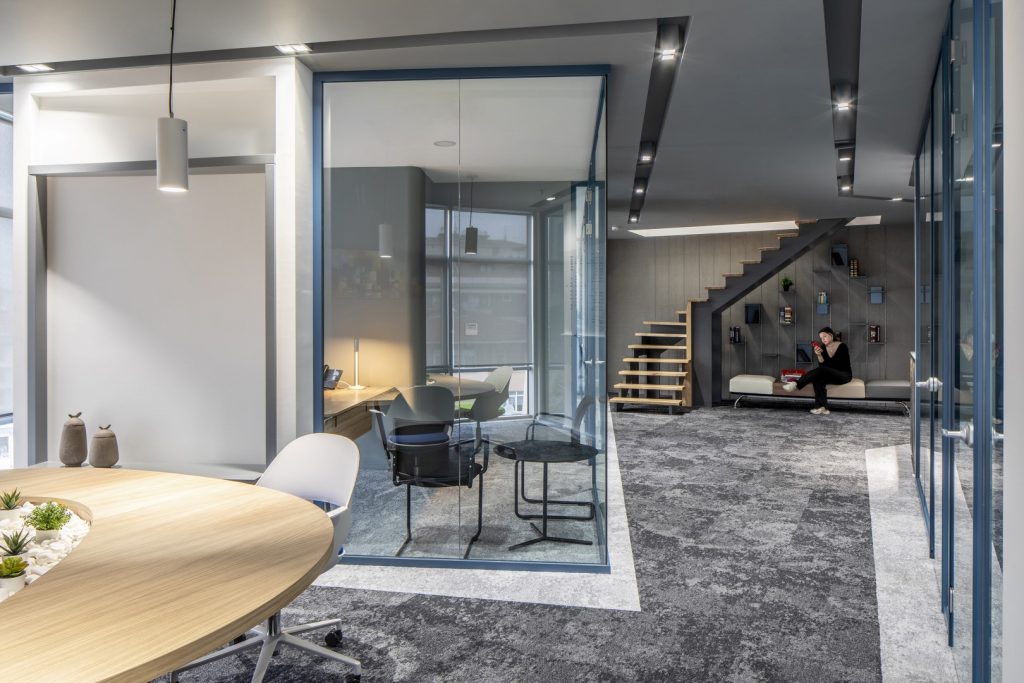
İBM: Pupa Teknik is
an office with a very sparse staff capacity, where three equivalent partners
work in their own defined areas. In this sense, the separate compartments
contain distant reception areas. One of the main reasons why we kept the
waiting area with a low capacity in planning was the pandemic period. For
example, they stated from the beginning that they will be in a setup that does not
accept long-term visitors, except for instant waiting. In addition, the
circulation in the middle axis of the office rooms we placed on the periphery
of the space; In our definition as a common and, more importantly, an open
meeting point, there is the motivation to meet in the common courtyard rather
than in closed areas. Circulation within the two main walls (interior); it
turns into a space that opens up perspectives and increases the potential of
the space, ending with a bright, expanding space.
What kind of place does natural stone occupy in the material selection of
your projects? Which type of natural stones do you prefer?
İBM: Especially the
use of local materials is something we intend a lot in projects. In the
structure of the 38°30° Farm Cheese Factory, we obtained all our facade stones
by taking the andesite stones on the plot to the quarries and sizing them. The
blast stone finish was important to our design for the raw and natural effect
of that building. We have achieved a contemporary structure by blending this
raw natural stone look with contemporary corten details and mechanically
assembling the stones. Similarly, we aimed to create a strong contrast in the
Elazig ADSM structure, the construction of which has already started. In the
facade systems of this building consisting of glass and natural stone, we used
white-painted glasses in different densities as much as possible and limestone
with joints (limestone) for the clinical sides. On the contrasting anthracite
dense facade, we preferred basalt stone in harmony with it. Thanks to the
honing surface treatment of both natural stones in the project; We aimed to
obtain a natural, raw, matte facade.
How important is it for you to use Anatolian natural stones in terms of locality and sustainability? İBM: The widespread use of locally produced marbles and natural stones in projects in Turkey is absolutely crucial. We prefer natural stone as a facade cladding material and present it to contractors and customers with convincing arguments. At every opportunity, we convey the importance of the feeling, perception and longevity of living natural stone compared to porcelain-based equivalent materials.