
The “Graves of Istanbul Design Contest” announced its
winners at beginning of December (2020). Hosted by the City of Istanbul’s
Department of Cultural Assents and the Istanbul Planning Agency, one aim of the
contest-held this past September-was to emphasize the fact that Istanbul’s
graves, even if a cultural asset, haven’t received attention they deserve by
Turkey’s design programs. Therefore, it invited designers-i.e. the architects
of our collective memory-to ponder over this issue, take responsibility for it,
and bring esthetic to death. Likewise, asked all of us to pause and think about
why cemeteries are important, and to heighten-as a societyour awareness those
who have passed away.
Come phase one, contestants were asked to re-design the graves/ environs of the
graves of figures who represent different strata of Turkish society. Most
notably: Adile Naşit, Ahmet Mete Işıkara, Aşık Daimi, Cihat Burak, Didem Madak,
Elmalılı Muhammed Hamdi Yazır, Eremya Çelebi Kömürciyan, Halide Edip Adıvar,
Halil Kaya, Hilmi Ziya Ülken, Lefter Küçükandonyadis, Mes’ud Cemil, Naim
Süleymanoğlu, Neyzen Tevfik Kolaylı, Optik Başkan, Orhan Kemal, Turgut Uyar, Ali
Nezih Uzel, and Cevdet Kılıçlar-Necdet Yıldırım. Out of 375 submissions, many
walked home with first prize. We wanted to tell you about those who used
natural stone.
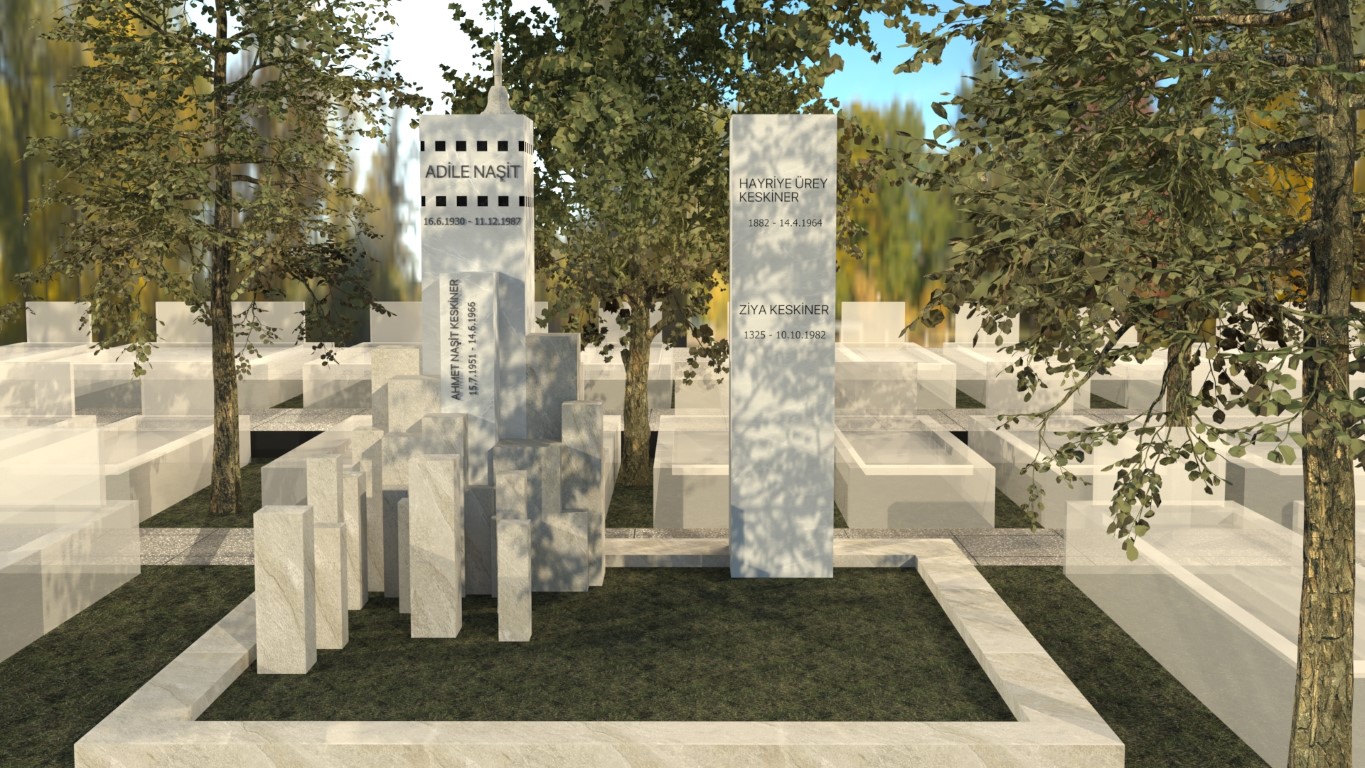
Adem Şahinoğlu and his team took home first prize for their design of Adile
Neşat’s grave. Fondly remembered for her role as Hafize Ana, the recess
bell-ringing schoolmistress (in the Turkish classic Hababam Sınıfı), Adile and
her husband Ziya Bey’s grave bed feature a long marble block. A series of small
and large marble blocks of similar dimensions surround gravesite. Atop Adile’s
grave stone sits a hand bell, again craved from marble. The team chose light
colored marble for Adile and Ziya’s grave bed, alongside one tone of dark
colored marble for the surrounding blocks, each symbolizing Adile’s
“kuzucuklar” (i.e. children). Deniz Uygur won first place for two gravesites,
those of Aşık Daimi and Hilmi Ziya Ülken. Aşık was one of Turkey’s prominent
humanists with a heightened understand of unity, which he internalized whole-heartedly.
Feeling that Daimi was not a product of his geography, Uygur chose to feature
two plain boulders brought directly from Daimi’s birthplace of
Erzincansuggesting that a stone’s place of origin is more valuable than its
type. One of the boulders carries a bronze plaque inscribed with Daimi’s name.
Uygur’s other project is the family gravesite of Professor Ordinarius Mr. Hilmi
Ziya Ülken. Uygur approached it as a heterotopia, because the site harbors more
than one time slice and space. Uygur disagreed with Ülken on many a topic.
Nevertheless, he opted to feature a set of travertine cubes/slabs, one for each
family member. Alper Derinboğaz won first place for Cihat Burak’s gravesite. He
and his team described their design as a stop to pay homage to the artist-a
Renaissance man in painting, architecture, literature, and ceramicand his
family. The grave has two sections, one for the Burak family, the other for his
bother’s family, the Ergüvens. The Burak side has four stones on it, each
honoring one aspect of his artistic legacy. The tallest stone is Marmara marble
and symbolizes architecture, to which he dedicated his life. The second stone
is Afyon sugar marble, and symbolizes Cihat’s passion for painting. The third
stone, symbolizing literature, features Rhapsody marble. The fourth stone,
symbolizing ceramic, is made from Uşak marble.
Capturing Symbolism with Natural Stone
Rumeysa Zeynep Kurtuluş came home with first place for her
design of the gravesite of Emalılı Muhammed Hamdi Yazır. The current grave is
short, and therefore suffers from a lack of visibility. Rumeysa and her team
were surprised by there only being a tall, wispy tree at the head of the grave,
and a grave stone at the foot. Known for his pioneering [Turkish] translation
of the Qur’an, his new grave is meant to reflect his accomplishment via a more
pronounced structure. The team therefore designed a 15 x 20 x 200 cm vertical
gravestone made from Marmara marble that runs alongside the tree in order to
make the site more visible from afar.
Çağhan Keskin and his team won first place for two projects that bring out the
best of natural stone: the gravesites of Halide Edip Adıvar and Optik Başkan.
Halide’s gravesite is shared with her spouse of 38 years, Abdühak Adnan Adıvar
(who pre-deceased her). The new grave is comprised of two platforms, atop which
sit two gravestones, one of which-while it honors Halide-was deliberately
designed not to be mausoleum-esque. Both platforms are made from grey andesite
from the quarries of Uşak. At the beginning of the platforms where gray
andesite stone extracted from Uşak quarries are used, there are tombs head
stones that are made of black Basalt stone extracted from Diyarbakır quarries
and again complement each other.The Keskin team’s other prizewinner, Optik
Başkan’s gravesite, has a black/white-striped form with arms on either side
that open outwards, lending it an iconographic feel. The design considers the
entire Başkan family. There is one central gravestone made from black
Diyarbakır basalt. In front of that are three sections, two for Optik’s
parents, both sharing a 20 cm tomb. Optik’s own grave is separated by a basalt
frame and quilted with white pebbles.
Yusuf Burak filled and his team preferred massive and not very streaky white
marble in the grave, which was awarded the first prize for Halil Kaya, who is
still unknown and who is the pioneer of one of the most painful events of the
90s. The grave, which is thought to use Marmara marble, is completed with bird
motifs flying from the soil to the bedside.
The Dolu team chose a massive slab of white Marmara marble, with as few veins
as possible. Finished the site is a motif of birds flying towards the head of
the grave from the ground. Nihal Konar Naş walked home with first prize for her
re-design Neyzen Tevfik Kolaylı’s grave. Referencing the nine segments of a ney
(a Turkish flute-like instrument), the new 10 cm-tall, white Afyon marble grave
is composed of nine steps. At the same time, it hints at Neyzan’s humble
character that cared little for anything worldly or for authority. At the
center of the steps is a ney with six blow holes. The intended vortex-like
visual effect is akin to a person returning to back to their essence when they
die. Alican Tüfkenoğlu took home first place with Orhan Kemal’s gravesite.
Conceived as a piece of the cycle between death and life, the team describes
their project as a cycle between visitation and memory. Within that cycle is a
simple, if not modest design that considers different scenarios in retrospect
to the space. It more over accommodates a kerf wall, a sprinkler, a fragrant
flowerbed, both multi-person and single person seating areas, a pedestal, and
narrowly gapped stepping stones that surround the site like gravestones-all of
which complete the cycle. The headstone and kerf are made from Mediterranean
limra, alongside kandıra and limestone from Turkey’s Marmara region, because
they are easy to work with. Cream-colored Denizli travertine-or possibly
marble-was thought of for the sprinkler.
The tgrave, which won the first prize, designed by Havva Yetkin and her team,
was built in a relationship that was aware of the environment of the cemetery
and was in contact with it, based on Turgut Uyar’s poetry understanding that
feeds on the immediate flow of life. While the cemetery interacts with its
surroundings and lives with it over time, exhibits an open stance open to
transformation, creating veins that nature can penetrate into and using limestone,
a material that is partially susceptible to corrosion, has been a decision
taken in this direction.
Last, but not least, is Talha Girgin’s prize-winning gravesite for Cevdet
Kılıçar and Necdet Yıldırım. Instead of two graves side by side, as currently
exists, Talha proposes creating a single gravesite in which both graves united
by a single stone block beneath which is open ground. The block is intended to
be humble and on the same plane as the ground, thereby emphasizing oneness. A
narrow gap running down the middle implies that two people are resting. The
grave strongly emphasizes the two martyrs, with two masses of stones rising
towards the sky at the end of the ground stone and almost touching each other.
In the design, for the purpose of durability, color, texture and visual
integrity, near white light gray, less perforated travertine stone was
preferred.