
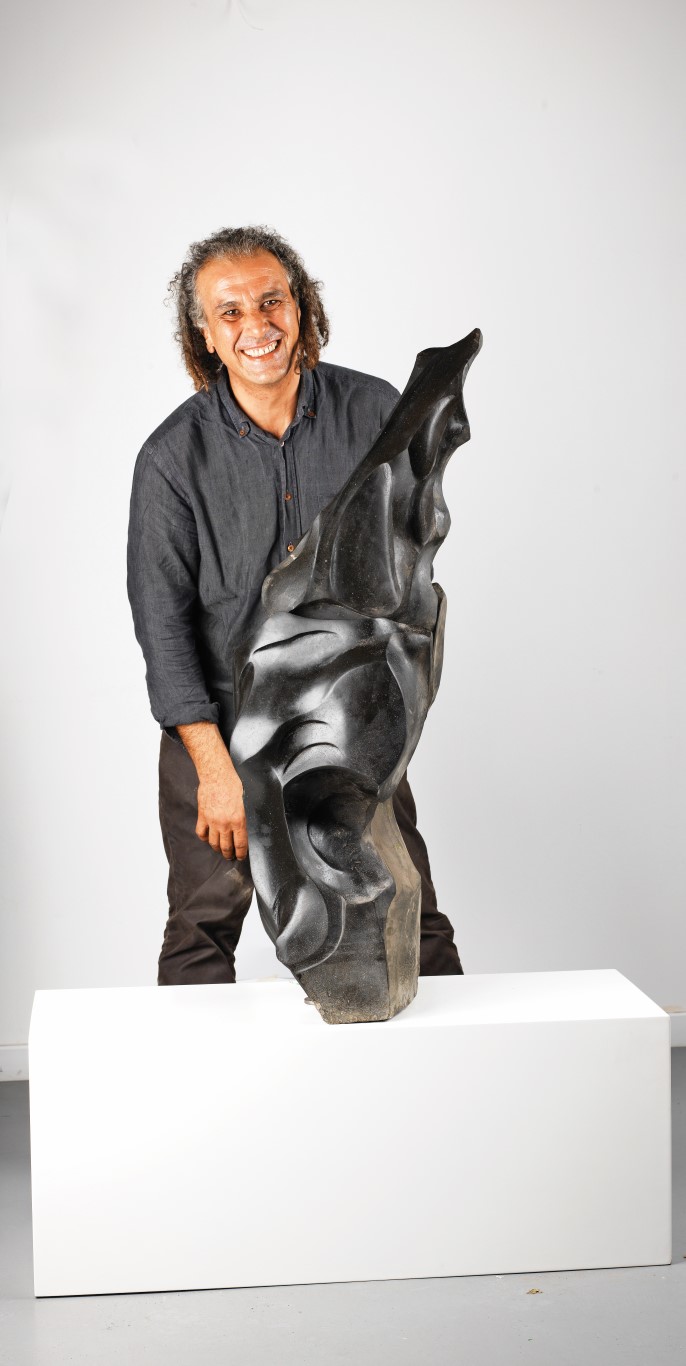
Kazım Karakaya, one of the leading figures of contemporary sculpture in Turkey, works looking at the possibilities of the material, which examines the relationship between form, material and integrity of a sculptor. While the artist aims to return to the essence of the material in a way that allows for multiple readings, sometimes he focuses on natural stone and sometimes he creates different material combinations. We talked with Kazım Karakaya about sculpture, which he defines as material and form art, its relationship with material, its sources of inspiration and the book named “Kazım Karakaya: Living for Sculpture” published by Bozlu Art Publications.
How did your interest in sculpture begin? What is your story?
Kazım Karakaya: My interest in art began when I was wandering around the bookshops and bookstores on Karanfil Street, Ankara, when I saw a book about Mesopotamia. The influence of Assyrian, Hittite and Sumerian art came before me with the Sun School in Ankara Sıhhiye Square and the sculptures in the Anatolian Civilizations Museum. I said I should sculpt. It was an exciting feeling that I felt my own presence and wanted to be in. I also started the Sculpture Department by taking the Hacettepe University Fine Arts Faculty exam.
What concepts inspire your works?
KK: First of all, the concept of art itself, the modifier and converter power of art, are concepts that affect us in our lives as an individual living in this world, question our existence, and determine our view of nature, human beings and animals. Concepts such as human, animal, machine, change, transformation, alienation…
How would you describe your relationship with your material as a sculptor looking for possibilities?
KK: A mutual relationship… Sculpture is ultimately an art of material and form. The first thing we encounter in a structure organized for the eye and the first thing that impresses us is the material. Its structure and texture determine our view. As you touch it, you approach it with your equipment, technical skills and precision. Your relationship is determined by the way you treat what he offers in size. You are traveling together.
Your works aim to return to the essence of the material, allowing for multiple readings. In this sense, what does natural stone mean to you?
KK: Stone, which has existed since the beginning of history and has been used in different periods and different cultures, is the first material of human beings. It is a material that has been entered into and made a tool, became a temple object, used in architecture and art, and has been formed layer by layer. A historical space from the period when stone was carved with stone to today when it was processed with technological tools; stone is an incredibly diverse world.
We witness different materials together in your work. What would you like to say about this topic?
KK: Its structure and texture of a material are very different from each other. The purpose of creating a new structure by making different additions with the question of why should not the crystal structure of the stone and the technological effect of the metal come together created these works.
What natural stones do you use in your sculptures? Are there certain quarry that you prefer?
KK: Anatolia has a very rich variety of stones. You can find whatever you want in this geography. I generally use stones such as marble, granite, basalt, diabase, serpentine and onyx. In addition to the stones I find while wandering in nature, I buy basalt from Istanbul Riva, diabase from Gemlik, serpentine from Hatay, marble from quarries such as Kemalpaşa, Afyon, Marmara Island and Milas. I choose stone and stove according to the color and crystal structures I will make.
Can you tell us a bit about what you’re currently working on?
KK: The relationship between human and animal has always attracted me. I think about the recent return from cave paintings, the relationship between the surfaces reflected in architectural structures today, with the outside we live in, constrain us, and the outside.
What awaits readers in the book titled “Kazım Karakaya: Living for Sculpture” from Bozlu Sanat Yayınları?
KK: Bozlu Art Project General Manager Oğuz Erten, in the first part of the book, offers a chronological reading of my life and works starting from Ankara until today. The second clue is an in-depth analysis of a theoretical article by Zeynep Sayın.