

The use of local materials, which is one of the indispensables of sustainable and low carbon emission construction processes, in terms of natural stone in villa type residences designed in the Aegean Region.
Although these modern Aegean houses, designed by Turkish architects by utilizing the construction techniques and local materials of the region, are shaped by different living habits, they are the indicators of the extent to which the use of natural stone can be diversified in contemporary residential architecture by commoning the harmony they provide with the natural environment they are in and the strong relations they establish with local materials.
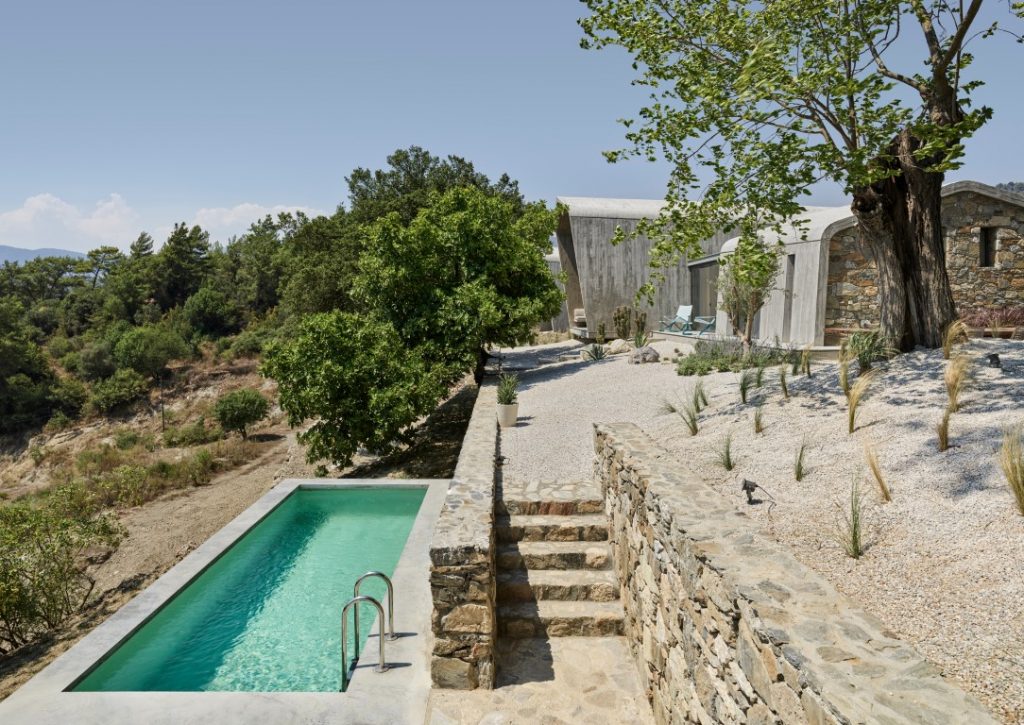
U House
Architectural Design: URAStudio
Building Date: 2020
Area: 160 sqm
Location: Ula, Muğla
Photographs: İbrahim Özbunar
Natural Stone: Conglomerate Stone
Place: Facade
U house consists of two turned over concrete shells that create a multiple array of spaces. While the larger shell contains the main living area, kitchen and a mezzanine work space the smaller shell consists of two identical bedrooms with ensuite bathrooms. The central connecting space opens to both front and back of the house to create a multifunctional covered courtyard with an open counter bar.
The larger volume cantilevers over the country plain, not only lightening the concrete mass but also provides a flying effect over Yılanlık Plain. The crafted proportions of the building create a sensitive, almost sacred relationship with the human scale.
Three main materials have been used in the composition: concrete, local conglomerate stone and oak.
The broken layout of the building mirrors and pays respect to the traditional vernacular structures of the region.
The building mainly uses natural airflow for ventilation, a hybrid solar system for electricity and natural water from an artesian well.
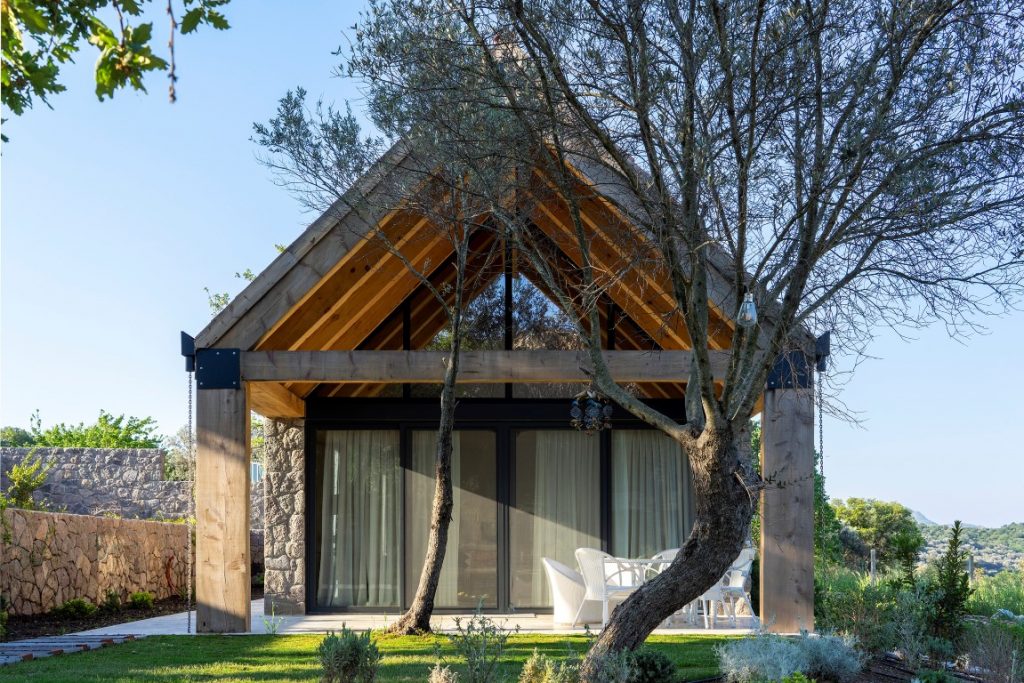
Seciloglu House
Architectural Design: Mehtap Kocaman
Building Date: 2019
Area: 340 sqm
Location: Bodrum , İzmir
Photographs: Arne Hendrik Uebel
Natural Stone: Hekimköy Stone (Andesite)
Place: Main building facade cladding, guest house walls, garden floor
The design process of Seciloğlu House, located in Bodrum, Gürece, started in August 2017 as a single building on a 5000 m2 plot, and then continued with the “guest house”. The placement of both buildings on the land has been determined to dominate both the land and the view. The land has a magnificent tree at its entrance, olive and lemon trees and vineyards with the calmness of the creek just on the southwest border.
While the plan typology of the house proceeds through the open plan type, the user’s desire to see a natural wooden roof has been one of the important parameters that shape the design. One of the most crucial points of the project for Architect Mehtap Kocaman was to design the upper floor by separating the bedroom, the dressing area and the bathroom wall, due to the open roof and open plan operation.
During connecting the lower and upper floors of the house with the open staircase design concept, the fireplace serving both floors has thus undertaken a binding task for the railings. The gallery space left between the floors makes the open roof visible from the living area. In the main building of approximately 225 m2, there is no room partition except for the cellar/storage and bathroom area under the set. Thus, the interiors have been made an inseparable part of the architecture of the house.
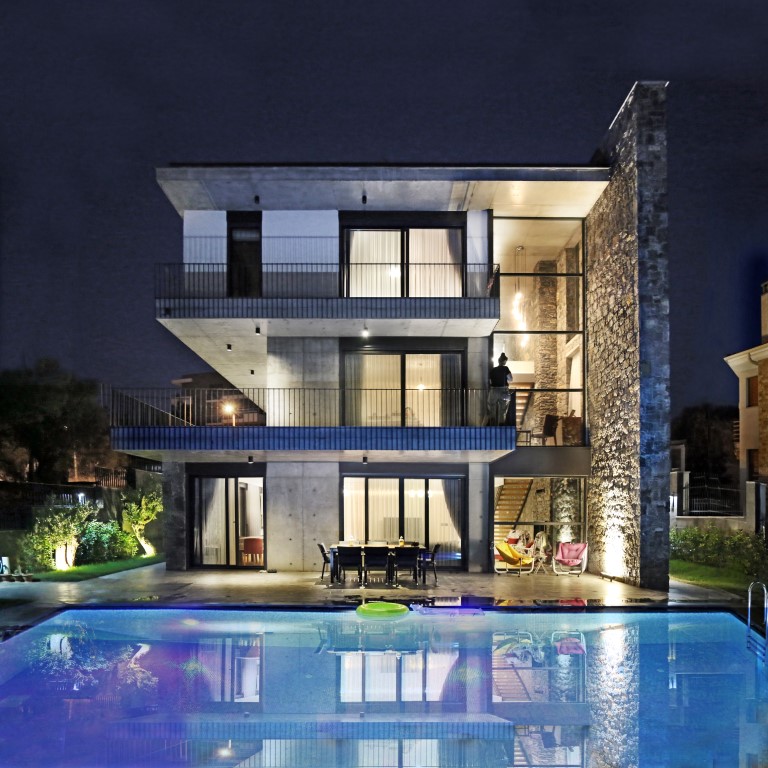
NÖC House
Architectural Design: Mert Uslu Architecture
Building Date: 2019
Area: 350 sqm
Location: Güzelbahçe, İzmir
Photographs: Mert Uslu Mimarlık Archive
Natural Stone: Urla Stone, Basalt
Place: Facade, Floor
The Nigar-Özcan Canpolat House, which differs from the surrounding buildings with its plain architectural style in İzmir’s Yelki district, is aimed at turning the disadvantage of the region’s sunbathing and heating potential into a positive direction, based on the fiction that the family will spend especially the spring and summer seasons in Turkey. In this direction, the 9-meter-high stone wall, which will perhaps be considered the backbone of the project, is articulated at the beginning of the intuitive process.
The building, which is located on a sloping land, is planned as three floors: upper ground, lower ground and first floor. Basalt stone was used as a floor and garden wall covering in the exterior. The combination of this stone with exposed concrete, which spreads throughout the building and reinforces the three-dimensional reflection of the pure geometrical formation, gave the building a holistic color and texture interaction. On the other hand, the green texture surrounding the hard ground covered with basalt stone was preserved by changing the positions of the existing olive trees, and mostly local plants were integrated into the green texture.
The wooden staircase that connects all the levels by leaning against the stone wall in the interior and the volumetric space it is located in are displayed behind the opening that rises along all the floors on the garden level facade. The wooden staircase connecting the ground floor and the first floor defines the circulation in the gallery space and unites with the stone wall and the bridge on the first floor. The two-storey-high space has formed its own identity within the building by integrating with the stone wall and the openings extending over 3 floors on the garden façade. Lighting hanging from the ceiling appeared as reinforcement elements that define this space vertically.
In the building, which has a simple architectural language, the traces of pure geometrical formation are completely read. This attitude has been the main factor that ensures the integration of the building with the natural environment in which it is located and a common dynamism and balance. The structure that emerged in this direction is the embodied product of this entire design philosophy.
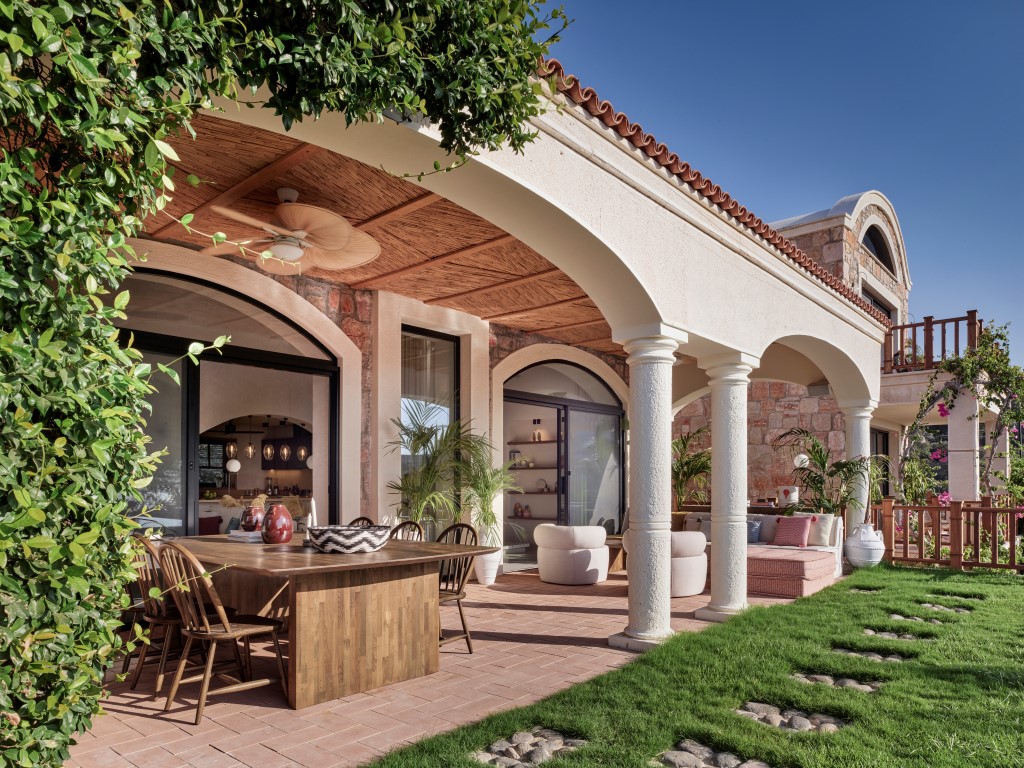
GKT Bodrum House
Architectural Design: Beril Khalaf
Building Date: 2021
Area: 470 sqm
Location: Bodrum, İzmir
Photographs: İbrahim Özbunar
Natural Stone: Çilek Stone
Place: Facade
This beautiful stone house is in Bodrum Yalıkavak on a land of about 4 dunam which is equivalent to 1 acre, a building structure of 470 m2 that was built in 2008. A 3-storey stone-covered house sitting on the mountains, built with local stone called Çilek stone, found only in Bodrum. This house also has an extension building for the housekeeping staff.
The living room is located on the main floor, and the master bedroom on the top floor, the house has high arched ceilings. By walking inside you would realize how spacious it is, this spaciousness provides peace and tranquility. The open kitchen, guest room, and living room are located on the main floor of the house. The guest room on this floor has an extension of 30 square meters terrace, where guests would be hosted, and it has a sea view of Bodrum. On this terrace, there is a wood firepit positioned in the middle of the seating arrangement to enjoy the view in any season, warm or cold. Also, this terrace is equipped with a home theater set up for outdoor movie nights. In parallel to this terrace, outside of the main living room, there is another terrace designed as a comfortable living space. This area has been designed with pergola and has been made suitable for summer and winter use too. Adjusting a minor part of the original structure of the house, we made openings in the walls to allow for more sunlight and installed insulated windows to keep the internal climate under control.
Seferihisar Villa E
Architectural Design: CKMY Architects
Building Date: 2014-2016
Area: 380 sqm
Location: Seferihisar, İzmir
Photographs: CKMY Architects
Natural Stone: Slate Stone
Place: Facade, Interior Wall Cladding
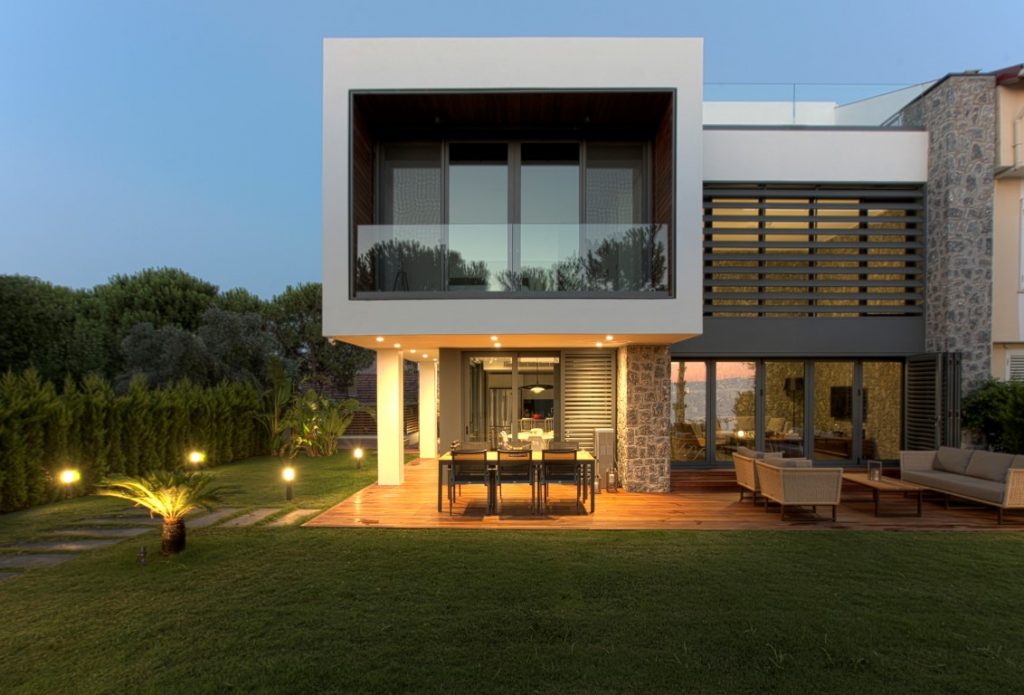
Designed by CKMY Architects Villa E, is a project in which the old residential structure, which was built adjacent to one side, was completely demolished and reconsidered according to the needs of the user. In the structure, which consists of two floors and a roof terrace, the space programs are divided into floors. Daily activities are located on the ground floor and bedrooms are located on the upper floor.
The building receives its entrance from the rear. While the user is greeted by a high ceiling at the entrance of the building, a bridge connects the staircase to the bedrooms between its and the double-storey living room. CKMY Architects opened windows on the wall to let light from the staircase façade, but opted for thin horizontal forms to preserve the privacy of the house since this wall faces a busy street.
Outside the building, the application of white plaster and natural stone is mixed in harmony at times and used alone to make the masses appear well. As a general principle in the architecture of the house, the walls, in which stone is used, are always made of stone on the back and front. This detail was chosen to create the perception of a stone wall and to completely forget the feeling of cladding.
According to CKMY Architects, the architecture of the building has more modern lines thanks to the roof terrace. The design of this place as a usage area has enabled its owners to adopt it as a place where the sunset is watched to the fullest and 360 degree views are enjoyed.
Villa Draman
Architectural Design: ACARARCH
Building Date: 2019
Area: 750sqm
Location: Bodrum, Muğla
Photographs: İbrahim Özbunar
Natural Stone: Slate Stone
Place: Garden Walls
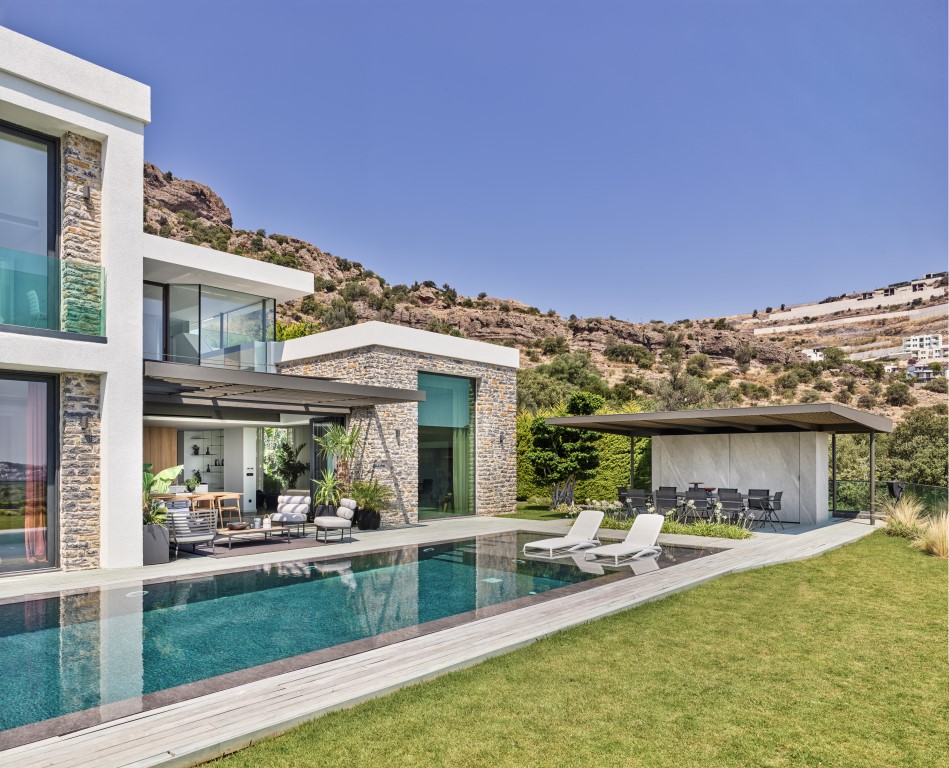
Villa Draman is a place that welcomes its guests with intense plants and water sounds coming from the small waterfall. The Interior and Landscape project was designed by architect Emre Acar, owner of Acararch architecture firm, and Çağrı Helvacıoğlu Aydoğu from his team. From the beginning of the project, blending the serenity of minimalism with special materials such as wood and linen with bold colors, a useful and impressive architectural language was aimed.
By not using dividing elements in the living area, the kitchen area, lounge area, and dining area are in a holistic flow. While two bedrooms on the upper floor are considered as a children’s room with their bathrooms, the master bedroom with bathroom is added to design later. The new bedroom was built without the addition of external walls to the existing walls. Just eaves and glass facades were used to create a new simple and transparent bedroom.
In the exterior dining area which is separated from the pool area with flowers, a functional cabinet that hides the pergola columns for aesthetic reasons and also includes a kitchenette and a bar was designed.The cabinet appears like a stone mass that provides the desired calmness The bar area was made the focal point of the invitations with the contrasting wine-colored glass and lighting used in the hidden bar section.