
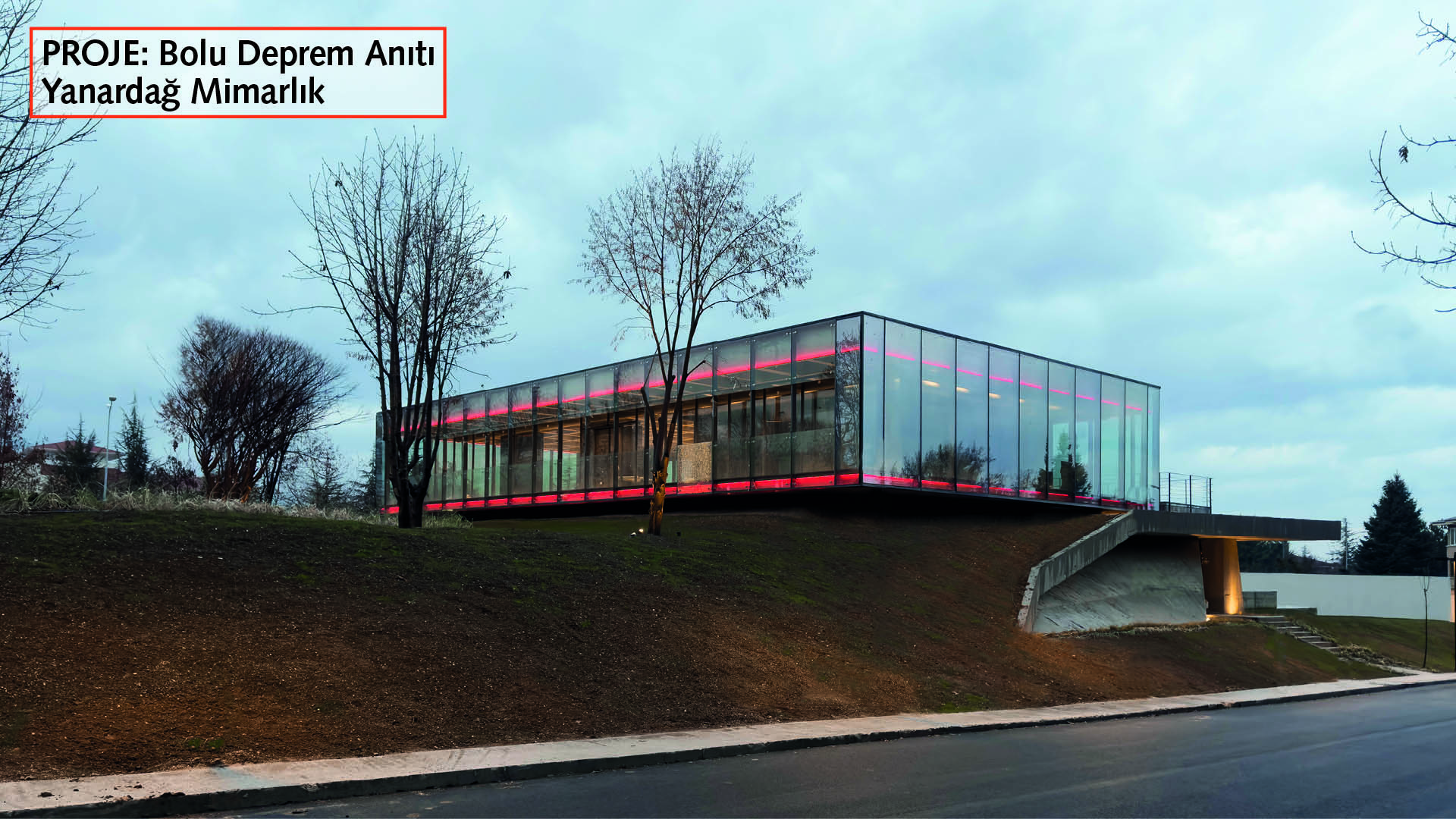
The Bolu Earthquake Monument project, designed by Yanardag Architecture, was handled with the vision of transforming the park area it is in into a lively public space. The project was reconstructed on a sloping land, with a topographic interpretation, a kind of surface that turns into an intermediate layer. From the pedestrian point of view, the building is perceived as a shell formed by the park surface, the irregular volumes under this shell, and a mass that sits slightly on it, creating tension. An urban monument and exhibition spaces are located on the ground floor, while the cafe is located on the first floor.
.

.
The solid concrete walls of the ground floor take on almost all functions: They support, insulate, protect, and define the interior and exterior spaces. The irregular concrete walls also refer to the city’s past devastation. It provides different views inside and outside the building by changing the floor plan; It supports the exhibition areas and activity rooms it houses.
.


.
The horizontal volume, defined by a concrete grid, has a reflective façade that gives lightness to the entire cover from the outside and is lost in the landscape. This volume becomes a beacon for the park, emphasizing the presence of the new public space. Along with the open and semi-open terraces, the cafe on the first floor creates a public space for socializing and dialogue. Basalt stone is used on the floor where interior coverings are minimized, while all vertical elements on the upper floor are lightened with reflective painted glass surfaces.
NATURAL STONE:
FLOOR COVERINGS
BASALT
.


.
Architectural Design: Yanardag Architecture
Project Team: Öner Demircan, Burcu Semizoğlu, Ali Burak Yanardag
Employer: Bolu Municipality
Contractor: EMÇ Construction
Static Project: Kozca Project
Electrical Project: Barel Engineering
Mechanical Project: Artu Engineering
Landscape Design: CAPS
Completion Date 2022
Total Construction Area: 732 sqm
Location: Bolu
Photography: Öner Demircan