
Heval Zeliha Yüksel Mimar / Architect

The owner of numerous successful projects, Mdarch Architects, lastly designed a restaurant embellished with natural materials at the heart of the city; which makes one feel relaxed, having left the whole hustle-bustle of the city behind. We asked Mdarch Architects’s founder Görkem Volkan about the details of the project:
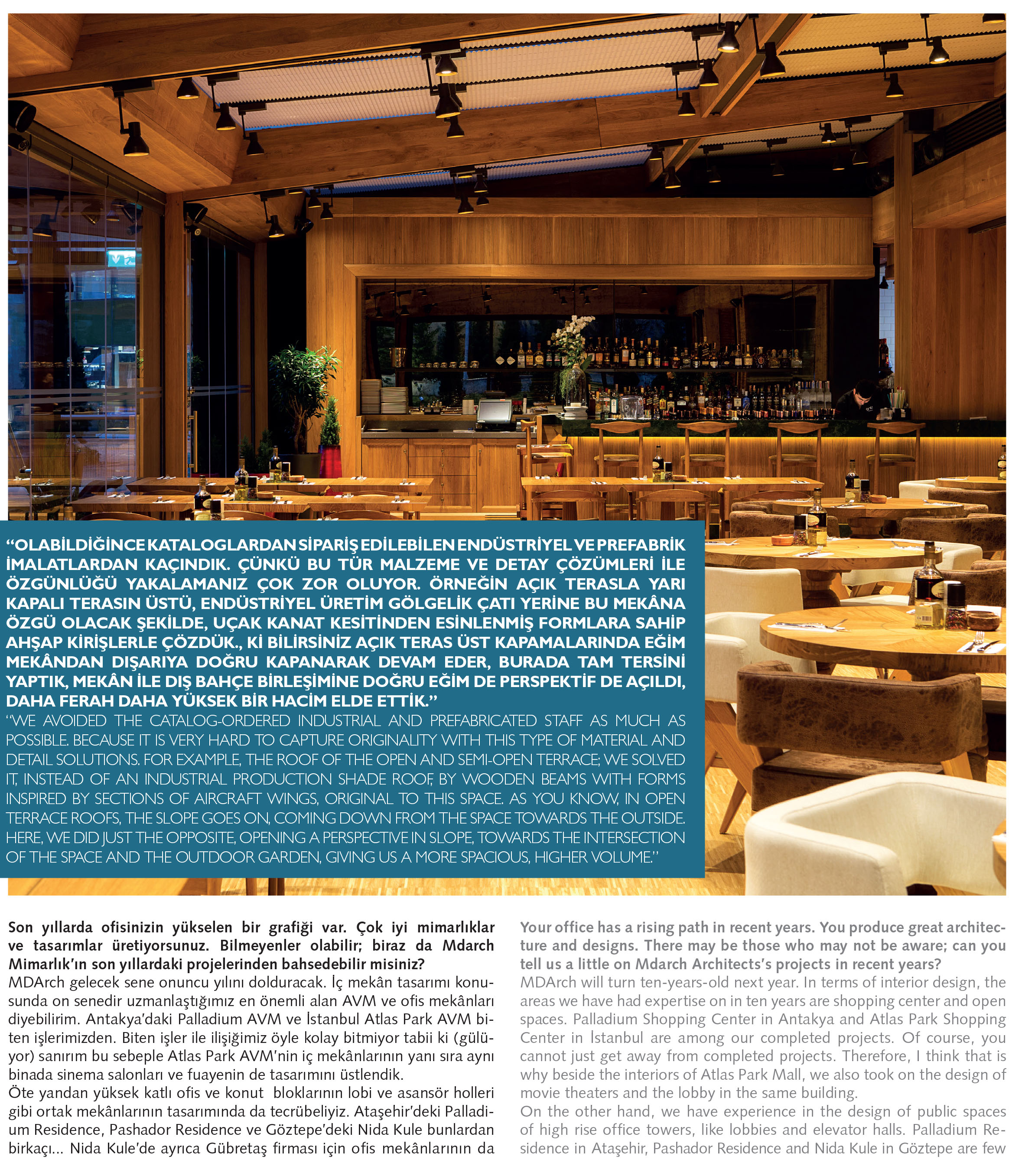
We see the wonderful consequences of the combination of the concepts of architecture and craftsmanship and like it. I think your latest project is a good combination of design and crafts too. Could you tell us about your project in this context? Grill Polonez is a new generation meat restaurant spreading over 800 m2 with an open kitchen – which is quite popular these days. It was very important for me that the restaurant in the lobby floor of the Palladium Tower Office building in Ataşehir, which also has a direct entrance from the Street served as a calm and refined stop within the daily speed of traffic for the users. Maybe it was mostly a personal choice as an architect, by me. Because I must say that I find it important that the venues where I dine outside my home are refined locations. In this sense, it was a very enjoyable project where we could capture the right empathy not only with the client but also with the user. Instead of spreading this single function space under different concepts, we kept the concept the same, dividing the space into different functions; the butcher’s section, the fireplace lounge, the closed private dining room, bar, the indoor-outdoor restaurant, etc. Therefore, with similar approaches all around the space, in a sense, we managed to preserve the common memory. I’d like to thank once again for the correct observation on design and craftsmanship because running design through the sieve of craftsmanship to be able to stand – I’m trying not to say against – in another corner of this whole Fordist style of production today at the humbleness of craftsmanship forms my office’s perspective on producing design and this perspective is so rooted that actually, we love to swim in these waters to take off from this point regardless of the magnitude/process of the project. However, in today’s conditions, especially in the environment of fast moving consumption, quality unfortunately comes down. Yet, in this space, a totally opposite feeling is emphasized. What did you do to promote quality and craftsmanship? First of all, we were lucky that we were looking at design and production from the same vintage points with the client. Honestly, we avoided the catalog-ordered industrial and prefabricated staff as much as possible. Because it is very hard to capture originality with this type of material and detail solutions. For example, the roof of the open and semi-open terrace; we solved it, instead of an industrial production shade roof, by wooden beams with forms inspired by sections of aircraft wings, original to this space. As you know, in open terrace roofs, the slope goes on, coming down from the space towards the outside. Here, we did just the opposite, opening a perspective in slope, towards the intersection of the space and the outdoor garden, giving us a more spacious, higher volume. Instead of an industrial suspended ceiling or acoustic panel, in the interior, the ducts and profiles of the technical functions on the ceiling were covered by the light roof cover made of ropes and a softer and warmer space was created in the interior, lowering the high ceiling to human scale. This soft texture, made up of ropes on the ceiling was a design decision, relaxing the space also acoustically. Again, all furniture were designed and fabricated specifically for this space. When a fabrication dedicated just for this location is used instead of commonplace furniture, the users feel this diligence in the design process indirectly and this brings the sentiment of af filiation which is a highly valuable feedback for a business today.  What kind of a space were you craving for when you first started the project As I said right at the beginning, I strived for it to be a refined and serene place and to remain at that sentiment. Besides, we wanted to create a calm atmosphere on the interior after dividing the high ceiling and spacious volume into sub-segments of different scales and sentiments; setting it up in an easier, perceptible and ownable manner. Therefore, the objective was a feeling of existence of having been there before instead of a brand new and smooth space. How did you manage to integrate these thoughts and feelings with architectural ideas? First of all, to be able to conver t these ideas and thoughts into feelings to convey them to the other par ty requires hard word. We provoke feelings with the ideas and thoughts we create; actually there is no feeling we can create from scratch. Briefly, we used materials which carry the traces of time with memories to convey the feeling to the other par ty. Raw materials with layered production like bricks, natural stones, ropes and wood were picked. We avoided shiny and smooth sur faces and materials as much as possible. We opted not for a physical relationship based on just function with the user but materials and colors addressing all senses; those which embody light and sound instead of reflecting them. Also, we chose materials with modules of small pieces on broad sur faces to reduce the large scale to ourselves. It took numerous mockups to capture the ideal in the ergonomic furniture and I think we managed to do that. Since human is the closest scale furniture, natural, easy to clean materials were picked to help both the business and also the user.
 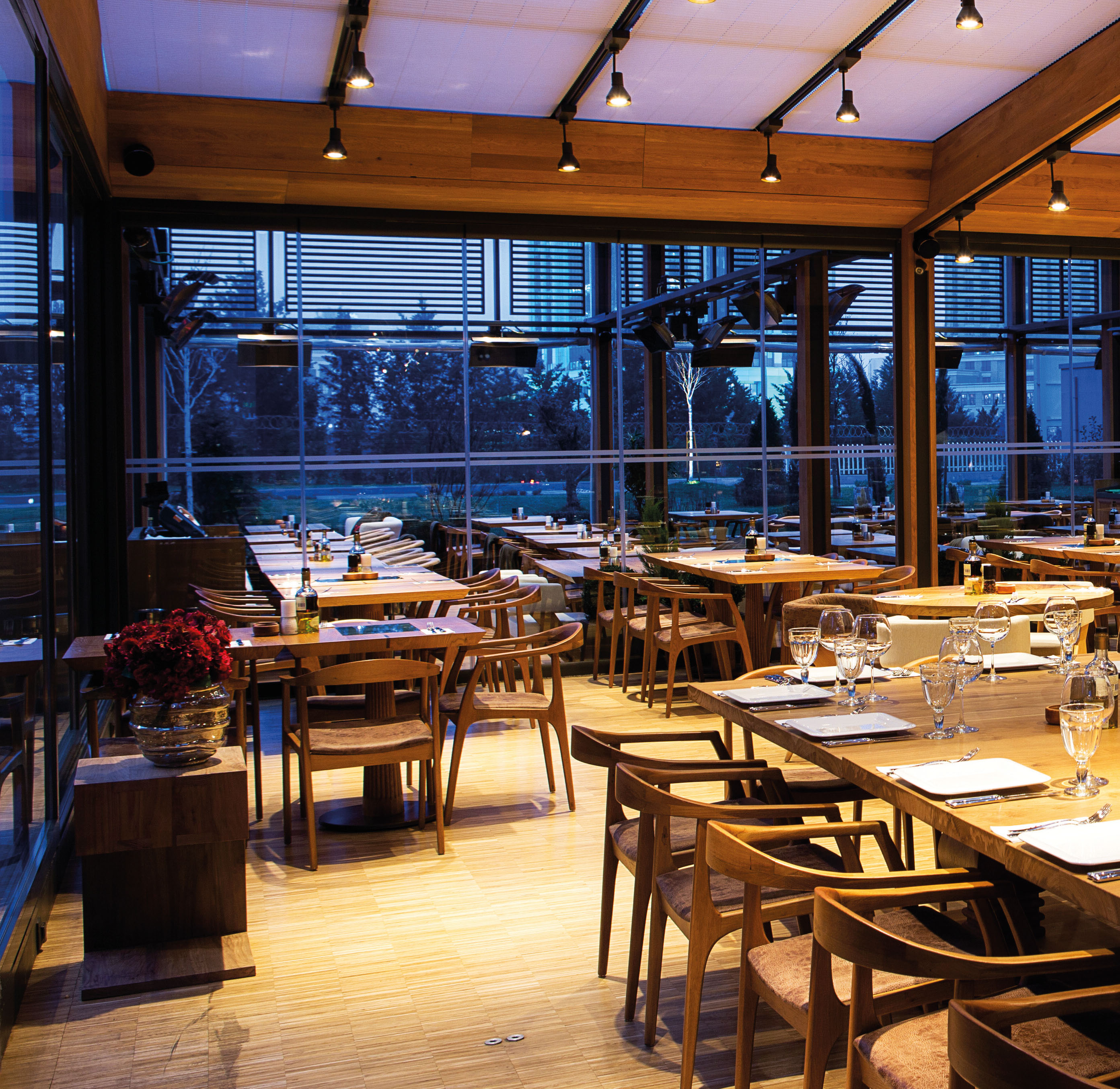 Why were natural products like wood and marble picked as materials? Wood was the best material for the controlled and warm atmosphere we wanted to create. Natural stone indeed is handy for sterilization. These two are actually highly compatible with each other because of the non-homogeneous linearity in their textures.
 Your office has a rising path in recent years. You produce great architecture and designs. There may be those who may not be aware; can you tell us a little on Mdarch Architects’s projects in recent years? MDArch will turn ten-years-old next year. In terms of interior design, the areas we have had expertise on in ten years are shopping center and open spaces. Palladium Shopping Center in Antakya and Atlas Park Shopping Center in İstanbul are among our completed projects. Of course, you cannot just get away from completed projects. Therefore, I think that is why beside the interiors of Atlas Park Mall, we also took on the design of movie theaters and the lobby in the same building. On the other hand, we have experience in the design of public spaces of high rise office towers, like lobbies and elevator halls. Palladium Residence in Ataşehir, Pashador Residence and Nida Kule in Göztepe are few of them we also took on the design and application of the office spaces for Gübretaş in Nida Kule Göztepe. Our latest project is the recreation and gastronomics focused Watergarden which started in Ataşehir. As MDArch Architects, we took on the entire interior architectural design concept and application projects of this 165,000 m2 space Besides these commercial projects, we are also designing the energy center building which contains the energy production and infrastructure command center and administration offices of the Expo exhibition to be held in Astana in 2017. There is a question I usually ask as our magazine is stone material based; our country is very rich in marble deposits. Do you think that this valuable material is used adequately and that what is local is appreciated? Do you use natural stone, what is the natural stone you use most? Honestly, I believe that it is used adequately and in fact, is well utilized by a lot of architect colleagues. I also suggest to my client s to use natural materials if conditions allow in my project s. This of course includes natural s tone and marble. Yet we usually use natural s tone’s state produced conventionally. I would like to use natural s tone more combined with craf t smanship in my project s. I hope the technology of new cut ting machines will help me to do that. I must add that the texture and colors of Iranian and Indian marble are those we like to use in a lot of our design. I ask every architect we interview who the designers and the architects he follows and likes locally and globally are. Could you please share your favorite ones… Peter Zumthor forever… It makes me feel so good that Peter Zumthor is working on a project coolly at some place in this crazy world. You may laugh at me but I have thought of Zumthor’s cool stance when when I am frustrated. Among other designers, Odile Decq inspires me a lot as an enterprising spirit. I also like the respectful but endeavor some relationship between the buildings of Bevk Perovic and the environment. Bernard Khoury has a very different style, a highly distinct style for Lebanon where I once worked/lived. Sometimes, I think that he takes architecture/design very seriously, yet sometimes I think he takes nothing seriously other than himself. His buildings make me feel very good, as an architect and as a user. I think that’s what’s important; to be able to convey the feeling directly to the other party. Thank you so much, I wish you success in your future endeavors. I thank you, thanks for your part in a publication of such high quality.
 MDArch Architecture has been specialized in creating residential, accommodation, office, retail and recreational spaces since it has been founded in 2006. MDArch designers believe that the foremost factor that enriches a project is the coordinated teamwork between the client and the architect while managing the requirements of each project and the priorities of the client. MDArch follows the path of creating “efficient and delightful” spaces and believes that a well-established spatial scenario will positively affect the human relationships and enhance the quality of life. In addition to giving consultancy on spatial organization on various scales, MDArch is specialized on architectural design, interior design, renovation, furniture design, application drawings, quantity survey and preparation of bidding documents. Since its establishment, design and coordination tasks of hotels, residential buildings, office spaces, shopping and retail centers as well as yacht design of having more than 600,000 m2 covered area has been completed by MDArch successfully apart from contracting more than 20,000 m2 building construction.