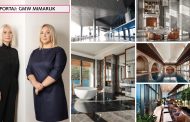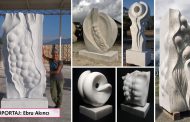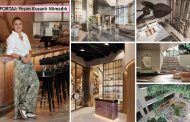

prepared a special article series that introduce the young architects
for the Architectural supplement of Istanbul News Art.
I mentioned about 21 architects who are in the prime of their
professional practice, their perspective to architecture and the
products which are the outcomes of all this process… And I go
on telling. If you are also a young architect and would like to take place in
this article series, you may contact me via selinbicer@gmail.com…
In this compilation I made for Natura, I intend to put the products or
backgrounds aside and mention about the thoughts of the young architects
and my own architectural concept…
The architects who have taken place in the article series to date are IbrahiEyup
from Eyusta Design and Architecture Workshop, SevinceBayrak
from SO? Architecture, Kutlu Bal from Ikikerebir, Abdurrahman Cekim
from Baraka Architecture, NurceDuzalan from NDAO, Murat Sahin from
Project Design Group, FatihYavuz from FREA, GamzeIscan from Halukar
Architecture, OnatOktem, OzelmAltinkayaGenel, GurayOskay, Nil AynaliEgler
from ONS Architects, BurakPekoglu, OzdenDemir from BINAA,
Cenk H. Dereli, ElifSimgeFettahoglu from NOBON, Hakan DenizOzdemir
from NSMH, NesimeOnel from GAD, ArifBiltir, LakertaElmasli and Dicle-
Hokenek from AtolyeKolektif.
The common features of the above mentioned architects are their participation
in architectural project competitions, their academic studies, their
background of master-apprentice relationship and most importantly the
fictive products they fictionalize regarding the physical environment.

İbrahim Eyüp
Ibrahim Eyup,tells about Eyusta Design and Architecture Workshop he established together with OlcayEyup in 2008:
“Our principle is to form and realize the design and determine the place we stand with our thoughts in order to completely
reflect the new and beautiful human life that will be established by reflecting the situation of the society. Our
target is to make the incoherent meanings attributed to design and complication of life understandable by arranging
and uniting them.”
Ibrahim Eyup realizes in his designs in EyustaDesign and Architecture Workshop being contextual in craft, perceiving
local sensibility, permanence and external factors, researching, learning, studying and applying an architectural
concept that prioritizes the dialogue with historical-contextual and cultural relations. He presents together with his
team a rich variety of products that consist of cultural structures, offices, residences, composite-usage structures,
educational and religious structures and interior design.

Kutlu İnanç Bal
Kutlu İnanç Bal,established ikikerebir in 2010 with Hakan Evkaya. ikikerebir is a formation that dreams, thinks and claims to realize the dreams.
Since the first day it was established, the team that adopted as a principle to feed its professional practice in different scales and different areas continues to participate in national and international competitions because they believe that it is the best method of getting jobs in the field of design while giving services in the fields of architectural and interior architectural design, project design and professional supervision.
Design for ikikerebir should be an emptied formalism and far from being identity-free disconnected with time and place. While genuineness is the most important criteria in their projects, innovative, exciting and dynamic designs meet with a sustainable and ecologic architectural concept.

Sevince Bayrak Göktaş
She established SO? Architecture and Ideas in 2007 together with Oral Goktas.
She attended the research made within the context of Urban Age by the LSE Cities program in 2009 in Istanbul. Besides her projects that won prizes in national competitions, the project called Sky Watch Stop was chosen the first and applied in the New Architectural Program YAP2013 that was arranged in cooperation with Istanbul Modern – MOMA PS1.

Murat Şahin
Murat Şahin who founded in 2015 a new establishment called Project Design Group expresses his design and architecture concept as follows:
“Experiencing all states of design… (How many states does design have?)
The design process is formed by the cessions more than the decisions. The effect of these cessions
on different disciplines/knowledge during the process of choice, the transformation of the ‘usual’
process of the designer into a ‘frame breaking’ fiction, the excitement of ‘product expectation’
even while the designer is excited due to the curiosity of the process formed by this fiction…
There is no need to repeat the sentences in our memories. We should break our own frames first by speaking about the gaps of cessions in the design process. But the most important thing in freelance architecture is that you should be able to sleep peacefully at the end of the day.

Nurçe Düzalan
She established NDOA Architecture together with Özge Acan in 2012 after working in various architecture offices in Istanbul regarding problems of relic preservation. They also are interested in problems of the modern architecture as well as the relics. NDOA Architecture puts emphasis on using theirown lightening and furniture designs in the projects they execute.
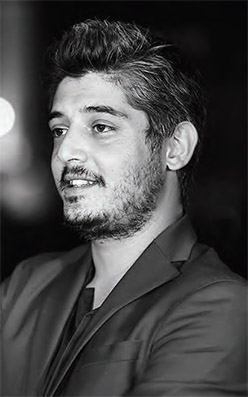
Onat Öktem
The architect who designs and executes projects in various scales carries on his professional life in ONZ Architecture. ONZ Architecture is a young and innovative office established in Ankara in 2007 by Onat Öktem and Zeynep Öktem. ONZ Architecture is a much disciplined office and executes projects of various scales. The team targets to take their architectural concept beyond the geographical borders since they attended many comprehensive projects inland and abroad by means of their international network.
ONZ Architecture believes that architecture contributes in a better environment and healthier cities. For this reason they take the sustainable design elements as a part of the production in their projects. The team applies the sustainability as an element that directs and forms the design rather than a product added after design and has many academic researches about this subject.
The team believes that no architectural product may survive without its context and produces projects by working with inter-disciplinary teams from various countries for this purpose. Within the context of this concept, ONZ Architecture recently got awards in national and international architectural and urban design competitions arranged in New York, Chicago, Belgium, Italy, Dubai, Moscow and Beirut.

Gamze İşcan
When she was elected to the performance group of the dance club she joined as a hobby, she danced for 1 year and skipped the lessons. The thought of ‘’Architecture or dance?’’, the option of being able to do something else and experiencing this situation in school life made her love her profession who chose architecture. She still thinks so.
She never participated in the architectural competitions but she says she may participate someday. Besides the fact that she does not like to compete personally, she expresses that doing the job together with the employer, the hours spent for work, knowing each other and each other’s requirements, the point where the project reaches are more exciting for her.
İşcan has many troubles regarding the city, the way architecture is applied in Turkey, formalism, professional ethics, weakening the urban memory so easily, the hostility against nature, solecism and consumption culture! But she still did not mention about them…
In 2012, she established Halükar Architecture with Bilge Kalfa. The intention of Halükar Architecture is very clear; never losing the excitement of ‘’experiencing’’ since its establishment.

Fatih Yavuz
After his experience as the founder of onbir41 in 2003-2013, he carries on his architectural endeavors under the roof of FREA together with Ömer Emre Savural in Ankara.
FREA targets to be a design office that concentrates on fresh ideas. It aims to solve each new problem with fresh ideas and creative solutions as a young and innovative architectural and urban design office. The team who won various prizes in architectural project competitions believes in the collective production power and that staying fresh depends on passing through the architectural competition. They adopted an architectural practice that considers customer satisfaction and the communication established by the environment in their various projects up to now. They believe that quality supersedes quantity. They concentrate on worrying about the problem rather than just solving the problem and on the quality of the process as much the resultant product.

Özlem Altınkaya Genel
She started her doctorate in the urban design and planning department of the Doctor of Design program in Graduate School of Design (GSD) in Harvard University in 2012. The doctorate research of Altınkaya is supported by the Aga Khan Program in Harvard GSD. She worked as an assistant here in the courses of Cities by Design and Urbanization in the East Asian Region. The thesis that Altinkaya is writing under the supervision of Prof. HashimSarkis and Prof. Peter Rowe studies the transformation urban formation around the Marmara Sea since the beginning of the 20th century taking it into consideration as “region” and reviews its interaction with the Mediterranean and Black Sea “hinterlands”. In her research, she is benefitting from various disciplines such as environmental history, historical geography, urban history, urban geography, GeoHumanities, critical cartography and geographical information systems. She targets to draw a relational frame of Istanbul’s urban transformation by analyzing the urban development around Marmara Sea with a multi-scaled (international, interzonal and interurban) methodology. She hopes to contribute to the the crossbreed urban theories that invalidate the urban-rural, built environment-landscape polarizations in the urban history.
Altınkaya works as a guest researcher in Kadir Has University Istanbul Research Centre in the 2014-2015 academic year and executes her field research in Istanbul. At the same time works as an assistant in Harvard University Mellon Initiative for Urbanism in the Humanities İstanbul Portal. Within the context of this project, she and Prof.Dr.Murat Guvencand Prof.Dr. Murat Güvenç and Prof.
Dr. Sibel Bozdoğan, evaluate the sources regarding the historical development of Istanbul (Goad and Pervititch Maps, Eastern Trade Yearbooks, Istanbul Encylopedia of Reşat Ekrem Koçu) with different materials (old photographs, movies, texts etc.) that portrays various layers of the city within an inter-discipline frame.

Nil Aynalı Eğler
Aynalı carries on her activities independently since 2013. She established the art initiative called YOĞUNLUK together with İsmail Eğler and Elif Tekir. The basic issue of the initiative is the relation between art activity and place experience…The inevitable interaction between the art product and place is taken one step further. Making the place itself the starting point of the artistic production begins atthe moment when the exhibition process team of YOĞUNLUK meets the “place”. A fiction is formed by trying to penetrate into the existential features of the chosen place and revive these features. The artists are invited to form their personal relations with the place within this fiction. The aim is to trigger the outcome of the art from the intense relation formed with the place it exists. And at the end, to present an experience in which the place and works become integrated and enhance each other.

Güray Oskay
His approach to architecture was shaped in the period he worked at the office İhsan Bilgin firstly, and then Yılmaz Değer.
He experienced projects of various scales in different offices. Since 2008; he works freelance in interior design and architectural projects in different scales such as residence, office, store, and hotel.
Güray Oskay also arranges contemporary art exhibition together with Sibel Özdoğan and Selin Feyzioğlu. The organization called Değiş Tokuş Sergi which is arranged for the third time in 2015 brings together various art branches and art groups. The difference of this exhibition where all works are for sale is that money is not used to buy them. The visitors should give a different offer to the artist in order to get the art work. Even the opening nights of the two exhibitions tat realized in 2011 and 2013 were visited by hundreds of visitors and more than 60 art works were swapped between the visitors and artists. In a world where any kind of conceptual surface becomes slippery, Oskay believes in positioning the approach to architecture far away of the environments that limit themselves or the “insincerity” of art movements. He tries to define the rules of that specific subject or place by refusing the previously determined rights, wrongs or rules when approaching to a new design. It is the indispensable of the design method to bring together inputs such as place, necessities, and physical conditions within the context of cause-effect.
In this regard, we can say that rationalism is the most important part he extracted for himself from modernism that he admired since he started this profession but thought that it brought lots of burden.
The main idea or ideas on which a project is based may not be based on the same source in every new design. While the “place” creates a structure, another may start from a material which is just obligatory to use.

Hasan Cenk Dereli
With his own expression, he started the NOBON blog as “an excuse of production and sharing regarding his interest in the fields of industrial products design, graphical design and creative idea besides architectural design”.
He realized design works and applications in different fields with the NOBON trademark which is a digital sharing environment in 2008-2012.
He arranged meetings by saying “Just designing is not enough for the existence of an inspiring creative environment, that environment should be reorganized”. In 2010-2012 he created a place called nobonLounge in Istanbul Beyoğlu Tomtom District and arranged activities and workshops that gather people who produce works in creative industries and hosted ideas with similar motivation. Some of these activities are “films for architects” which started with the information he gave about the production design of Saitali Köknar science fiction movies, “the dark side” where subjects that are not much spoken in the glamorous world of creative industries are discussed, “clothes swap” organized together with Nazlı Ödevci and Fulya Tekin.
In 2011 he was elected to the Creative Residency program in Paris-Parsons University which is a creativity oriented program. The same year in Açık Radyo (Open Radio), he started to prepare and present a radio program called Open Architecture that targeted to make “discussions about all states of architecture”, where İpek Akpınar, Hüseyin Kahvecioğlu, Volkan Taşkın, Yelta Köm and Yağmur Yıldırım were involved as program producers and that still continues. He created the KONTRAAKT project which is an independent design media trial together with Hayrettin Günç and Yelta Köm.
Since 2012 he is working in Izmir in order to provoke the creative environment. With the activity called PechaKucha which fights clichés such as “There is nothing to do in Izmir, nobody does anything interesting”, he looks for people who realize inspiring works in the national or international levels, finds them and has them meet with the public; he forms a data base where their profiles are seen. He runs together with artist Ekin İdiman the 37 Video Art Gallery where video artists from Izmir and the world exhibit their works and artist discussions are made with them. He organizes together with Tamer Varis and Fatih Uysal an activity called Rendezvous which gathers design, fashion and music in Izmir. He runs a project studio and workshop works in different universities inland and abroad. Since 2013 as the member and one of the coordinators of Association of Architecture for Everyone, he runs various design works, researches and application works of the association. He continues make researches and produce projects regarding different fields of art and design processes with NOBON.
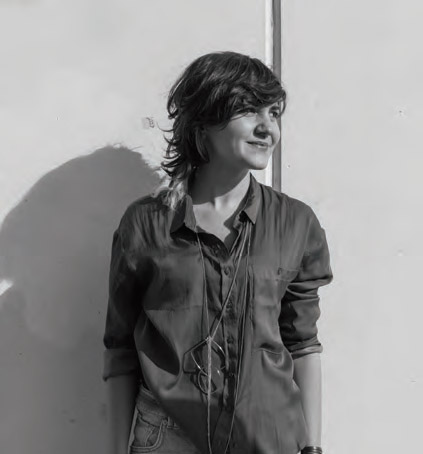
Özden Demir
Demir expresses his approach to architecture as follows:
“The idea of designing an educational structure for children was exciting. Colors, material, scale, each of them was a subject on its own. But I had to face the reality of being an architect in this country. Without faltering between the education and discipline you got and the realities you experience in the practice of work, the struggle begins here trying to do the best under specific circumstances. It is mentioned in one of Uğur Tanyeli’s article ‘disappointment is the normality of life’.
I am trying to find a balance in the conventional structure practice of this geography without taking the difficulties seriously but also without ignoring them completely. The level of quality in production, the material limits, expectations of quantities instead of quality, the weird limitations of the zoning law unite with the difficulty in communication with the employer (excluding exceptions). In addition, the ideological dimension of the subject gets into play. For instance the educational system, you cannot predict in what kind of system or alternative education a structure you designed as study center will exist in the future; because the government and dominant ideology want to exist in all fields. Rather than the form, a usage language and color we cannot foresee which is also expressed as life itself, supersedes the physical existence of the structure as always, and maybe it should…For this reason architecture is a field open to disappointments and surprises. But it is still very important to evaluate the reality in its content. Especially regarding the conventional practice structure in this geography, I am trying to find a balance without taking the difficulties seriously but also without ignoring them completely. I also need other fields in order not to be offended, to stay strong, to be fed and become free as an architect.”
This field contains various art works together with the video for a long time. The “Net 17950” film he shot upon invitation of EmreArolat for IKSV 1st Istanbul Design Biennale arranged in 2012 was an 8 minutes fiction of the protagonist Ali searching for his memory and recording in an excavation area. The film with an experimental fiction was about the city-memory relation after destructions made due to urban transformation projects. The film was shown in many national and international festivals and received awards in 4 fields in the 24th Ankara Film Festival.
“The place of Ali is an unidentified one between the museum and the house. Each point was designed to be perceived as if undersigned. This work was also a piece of architecture in fact with all the disciplines that it contained due to its process of thinking-writing about the city, art design and fiction. The video seems to me like the right field where I can express myself freely since it contained the time-place, the motion and fiction.”
Since November 2014, he is working on two residential projects found in Bahcesehir and he designs for Atmaca Gayrimenkul
together with his partners and friends Architect İlhan Düz and Civil Engineer Oral Doğu in their workshop called ODA18 established in the address of Asmalımescit Sokak No: 23/18.

Burak Pekoğlu
Pekoglu, after the architectural education and experience of ten years he had abroad, tries to gather his local and global experiences together and actively carries on his activities as a trainer and designer architect in Istanbul. Pekoglu actualizes extraordinary projects in his studio called BINAA (Building Innovation Arts Architecture) and established in 2012.
Among the targets of BINAA; unify his international networks with the potentials open to be explored in Turkey, gathering the skillful and creative eyes in the design center he is establishing in Balat and enquire extraordinary projects with experience oriented education.
Instead of constructing soulless buildings in cities where architecture is almost extinct, BurakPekoglu thinks that most probably a regional rehabilitation will be realized by tending towards regions where design and aesthetics may develop and states that the main target in his project called “Argul Weave” in Bursa is to develop the local public and culture. According to him, the distribution of a building/design may have a butterfly effect and reflect the identity of that region as well as enabling various business lines to enter that region.

Hakan Deniz Özdemir
This young architect who is a musician at the same time had positive feedbacks to his presentations in the academic environment with his thesis stipulating that music is the closest art branch to architecture due to its production processes and concept that there are many common points between music and architecture in terms of architectural productions using an inter-disciplines method. During his postgraduate studies, he worked on an interactive and mobile music fair project for children called “Music Box”. In 2010 in the Music and Architecture Workshop directed by Aykut Köksal in Yahşibey, he designed together with the composer the musical area where the piece of composer Tolga Zafer Özdemir “Mandelbrot Cello” will be played.
Özdemir who works within NSMH since 2007 expresses his approach to architecture as follows:
“Architecture is simply the effort of transforming the data presented and determined by the time, place, necessities, rules and physical conditions into a place of living. I mostly think over correctly maintaining what has existed until today rather than innovativeness. I think that maintaining what exists in this rapidly changing world is more difficult than being innovative.”

Nesime Önel
Önel joined the GAD team at the end of 2008, worked as project leader and is the company partner for three years.
Önel thinks that architecture targets more than just a form production process; although designing a table is the same “thing” as designing a building in itself, she believes that architecture should add a different value to the place beyond its relation with “place” and quality of the physical thing.
She perceives architecture as the effort of creating the best places with the existing materials that meet the humanitarian functions such as “land, environment, function, program, expectations of the employer, budget etc.”.

Elif Simge Fettahoğlu
Fettahoğlu started to work as a research assistant in the newly established Istanbul Bilgi University Architecture Faculty in 2010. She has attended the courses that concentrate on the city such as the 2nd class studios coordinated by B. Deniz Çalış that concentrates on tectonic/place/content, Modern Zoning History with Prof.Dr. İhsanBilgin, Istanbul Landscapes with B. Deniz Çalış and Exploring the Historical Cities: Rome with İdil Karababa. She also carries on her doctorate studies in Istanbul Technical University with İpek Akpınar.
Besides her academic works, she deals with graphical design and photograph. She runs small and medium sized interior projects with Sinem Oymak.
Fettahoğlu says the following about her latest works:
“I enjoy experiencing, walking, photographing, mapping and investigating the city-Istanbul: While drawing a lesson from occasional urban meetings, I deal with extracting patterns from data and facts that are not occasional and visualize/archive them. It is a desire to tell the story of Istanbul while it is turning and spreading around us in a stunning speed.”

Arif Bıltır
Bıltır decided to become professional in the process after the Bolu Chamber of Commerce and Industry Service Building project competition won in 2006 together with the workshop team and established Atölye Kolektif in 2007 with Emre Torbaoğlu and Evrim Akcan.
Atölye Kolektif is an architectural formation based on the principle of designing and producing together. Its main approach is based on producing unique solutions for each design subject according to the contemporary architectural principles and taking into consideration analytical researches that evaluate social, cultural and natural data. He produced various projects until today in different scales about different subjects inland and abroad according to this perspective. Besides the accustomed subjects such as residence, hotel, office and restoration, he had the opportunity to work on unique subjects such as a dental clinic, spa, exhibition hall, graveyard, monument, climbing wall; lavender processing facility.
Arif Bıltır is the founder partner of Atölye Kolektif and says the following about it:
“Our approach to architecture can be explained as production without losing our focus. Regardless of the subject and scale, the bond between the designed structure and object as well as the subject and human who uses/experiences it forms the basis of this focus. We think that the interaction of the mentioned dynamics with the content they are found in should be sustainable. For this reason as an architect we need to evaluate and absorb the effect of each line in the sketch book on the earth. Maybe you cause interventions whose effects will last for years on an area that will have better potentials as long as it stays empty. This may be defined as a big chance or bad luck. But unfortunately, because the environment we live in does not have sufficient sensitivity towards this matter, it plays a role in the growth of the part considered as bad luck.
We see that the concepts are emptied in our ‘growing’ country and it is deviated from the focus. The fast circulation in the construction sector which is claimed to be the locomotive of the economy causes the quality to decrease and destruction of the natural habitat. While the design process is being minimized, everything new is being perceived as good or it is imposed to be perceived as good via tempting it through various publications.
The fact that the design which is the most important component of the product is not getting the value it deserves may be explained by the fact that the people appreciate the object more than the information. Everything is focused on starting to the construction as soon as possible and having a tangible object in hand and this logic is widespread in the sector. The fact that the person profiles who identify with themselves the ones they choose from the increasing image intensity work with teams who do not enquire, causes bad results to come out. We may stay alone with high rise iconic structures or eclectic façade buildings.
What we are trying to do at this point show in a way that architecture is limited by the vision of the society. We are trying to find and share the right architecture under these circumstances without losing our focus.”

Bahar Lakerta Elmaslı
Bahar Lakerta Elmaslı, staretd to work as an intern first and then as an architect in Nevzat Sayın Mimarlık Hizmetleri which she defines it as her 2nd university. She worked in various projects for 5 years. The she managed projects such as hotels, residences, offices, stores in Net Architecture, ARUP and Oğuz Cankan Architects.
She dealt as much as the projects with the solutions of drawing problems in computer programs throughout her career. She became an expert in solution techniques of CAD and BIM programs taking the road from the idea of “There must be an easier way”. The problems that her friends faced because of these programs lit a fire in Lakerta’s head; she thought that everybody needs this information and that they should spare time for design instead of dealing with these problems. She started to prepare the www.archiputer.com web site where she published the “Autocad Powers That Shortens Time/Drawing Techniques That like Revision” and the www.archiputerevit.tumblr.com blogfor her articles regarding utilization of Autodesk Revit Architectural. The articles that were written as answers asked by her companions at the beginning started to be followed by many people.
Lakerta says that there is no a basic drawing standard in Turkey and that offices form their own worlds of standards. She also states that those personal choices mostly do not fit a valid surface.
She says “Why do we still think about the section mark and font size in drawings? Should we spend time for these standards”.
From the questions and feedback she gets she understands that still lots of people calculate the bill of quantities by counting the doors one by one, use different fonts and measurements according to scales or spend hours ceramic coating and that they are not aware of the fact that all of these issues may be solved faster.
She started giving consultancy services to the companies regarding these subjects when she realized that she spends lots of time and enjoys look at architecture behind this numerical screen. She thinks that it is obligatory nowadays to start drawing in the BIM environment just as the world left drawing by hand and started doing the drawing routines in CAD years ago. The persons or companies who act fast and make investments in this field will be one step forward.
In this period where fast feedbacks save time and money, she carries on her researches regarding solutions for users, quality drawings, drawing standards in the world, document management and BIM issues besides research & development studies in drawing solutions and her sharing the information in the social media from her Archiputer Twitter account, Archiputer Facebook page and in Tumblr by the name of Archiputer.
mimar serisi | architect series

Dicle Hökenek
Dicle Hökenek won prizes in national and international project competitions during her studentship. She worked together with the archeologists under the guidance of Prof. Roberto Raccanello regarding the contemporary preservation principles of Cucagna Castle in Udine Italy, documentation of the cultural assets, analysis and preservation methods of the traditional materials, traditional structure systems and their problems, preparation of historical structures’ relief/restitution/restoration/re-utilization projects.
She worked during 2005-2011 with Bünyamin Derman and Dilek Topuz Derman and she was their student at the same time. She put aside the experience she had in design and coordination of big projects and decided to produce designs in different scales where she can generate herself.
Since 2011, she deals with interior architecture and product designs besides architectural project production via solution partnership with different disciplines in her office in Karakoy called Dicle Hökenek Architecture established in order to give good quality architectural project and design services. She says that she targets to continuously renew herself and produce design solutions in a contemporary language with her experimental approach open to development. She realizes different experiments regarding the modern utilization of natural materials in interior design.

Abdurrahman Çekim
He has been working since 2009 at Baraka Architecture that was established together with Sevilay Uğur Çekim.
Baraka Architecture realized many projects in its short span of 5 years: Maxx Royal Kemer, Acıbadem Pollenium Reisdences, Aziz Mahmud Hüdayi Social Complex, Suryapı Vitrin İstanbul, BurhaniyeSchool Project, TaşdelenPekarResidences, AntepiaSwimming Pool Project, Baraka ÜmraniyeResidences, Sinpaş Kağıthane Project, Etna Turkuaz Residence Project, City Ambiance Residence Project, SofistanbulResidence Project, Sinpaş Liva Turkuaz Project, Çekmeköy Business Center, Çorum Chamber of Trade and Industry, Mazar-ı Sherıf Greencity Campus, Sinpaş İş modern, HC House, Libadiye Offie Project, Mazar-ı Sherıf Mosque, Yenidoğan Cultural Center, Esatpaşa Residence Project, Penthouse in Switzerland, Çengelköy Villa Project, Hacı Bayram Veli Mosque, Washroom Façade Design, Iceberg Multi-Functional Building Complex and Istanbul – 2010.