
SALT VE KALEBODUR IŞ BIRLIĞI ILE MIMARLIK VE TASARIM ARŞIVI PROJESI KAPSAMINDA ARCENGIZ BEKTAŞ HAS BEEN DETERMINED AS THE LATEST FIGURE TO BE ARCHIVED WITHIN THE SCOPE OF ARCHITECTURE AND DESIGN ARCHIVE WITH THE COOPERATIONS OF SALT AND KALEBODUR. PRODUCING IN THE FIELDS OF ARCHITECTURE AND LITERATURE SINCE 1960’S AND MEDIATING FOR THE DEVELOPMENT OF THE PROFESSION ALONG WITH HIS MULTIDIMENSIONAL CONTRIBUTIONS TO ARCHITECTURE, THE ARCHIVE OF CENGIZ BEKTAŞ HAS BEEN LAUNCHED VIA SALT RESEARCH. GRANTED ACCESS FOR A PARTIAL SECTION IN JANUARY AT SALT RESEARCH, THE ARCHIVE WILL BE CATEGORIZED IN A WAY THAT ALSO INCLUDES ARCHITECTURAL DRAWING FILES BY THE COURTESY OF CENGIZ BEKTAŞ. WE HAD A CONVERSATION ABOUT HIS WORKS IN THE CONTEXT OF THE ARCHIVE, HIS EARLY LIFE AND PRESENT-DAY TOPICS…
How can you spare time for anything considering your interest towards various topics? Architecture, books, poems, translations, children’s books, lectures, papers… How can you get round to write so many books?
Distance wasn’t a problem for me between my home and my workplace. I never lost time regarding daily commute. Except for recent years, i slept 4-5 hours on average per day. Most importantly, i never worked arbitrarily. Instead, i worked fondly. These scripts you see in the shelf are the results of the last three years. Like i said, i’m not doing these for the sake of business and architecture wasn’t any different. I worked to earn my keep and get on my feet to avoid imposing myself upon someone. This covered 40% of my life considering my experience. I spared the residual 60% to become more human. I have more than ten thousand scripts. Most of them are “countersigned”. At the moment, i’m appropriating two or three thousand of them for myself and donating the rest to a library of a foundation that works for the children of Denizli. Plus my magazines to the Chamber of Architects…
An Architecture and Design Archive is being established with the cooperation of Salt and Kalebodur. In a sense, an archive also indicates the documentation of history. Why do you think that archiving is important?
During the Ottoman period, palaces used to keep incomprehensible amounts of records. For example, i saw a “signboard” in the Topkapı Palace and got really surprised. “Delousing was made on xx/yy/zzzz” was written on it. Now we highly benefit from the State Archives. Unfortunately, i heard that it was only like this for the palace. During the Ottoman period until 1927, literacy rate was 7%. Few people are aware of this thesedays. You need to learn and act responsibly. It’s a fact that if you don’t act this way, it’s inevitable to lose everything in ten years and go back to the era of Abdulhamid. Therefore archiving is extremely important…Especially we have so little information about architecture. For instance, what do we know about Sinan the Architect? Disconnection with the Anatolia is there from the beginning. The Ottoman Empire had never paid attention to Anatolia… In fact, the Ottoman Empire was a Balkan State. It had not endeavored enough with Denizli when compared to Skopje. There isn’t a single proper Ottoman work in Denizli. Do you think that replicating the work your grandfather had done 400 years ago is legitimate? One only mimics when he’s clueless.
Mr. Bektaş, you told me that you notably benefit from the State Archives and that the Ottoman Empire used to keep records strictly. Then how does the archiving process work nowadays? The Ottoman stands for the palace and around. Do you know the town life in Anatolia during the Ottoman realm? Do you know what condition was Diyarbakır in for instance?
So let’s get back to the archiving subject… You have visited Diyarbakır when you were young. Could you tell us about that period?
When i was 19, i have traveled Eastern Anatolia for one month with the company of a German professor. I had seen many places before Diyarbakır such as London, Venice, Berlin etc., however i fell in love with Diyarbakır. Do you know what was Diyarbakır like back in 1955? Your age makes it impossible… It was extraordinary. Life was also great. (The German professor used to drink raki with raw meat every evening). I almost begged him 7-8 years ago to execute an improvement program altogether for Sur to turn it into a paradise. Especially its condition thesedays tears my heart out. They were demolishing the Sümerbank in Diyarbakır and they called me to negotiate. Instead of demolishing, we transformed it into a cultural center based upon my proposal. When they asked me, i told them it was a foolish act to “demolish”. The Ottomans didn’t pull down a single church, instead they have transformed them into mosques. Thank god for that… Through such insight, Haghia Sophia, Ayia Theodosia and many more monuments were able to reach the present day. To get back to the main point, no one knew how to read and write even in 1927, except for a group that can be considered as intellectuals. In brief, there is a disconnection somewhere and it surprises us as the archives get opened up. We should read better. Disconnection with the community was intrinsic to the Ottoman Empire.
Why is generating an architectural archive is important today?
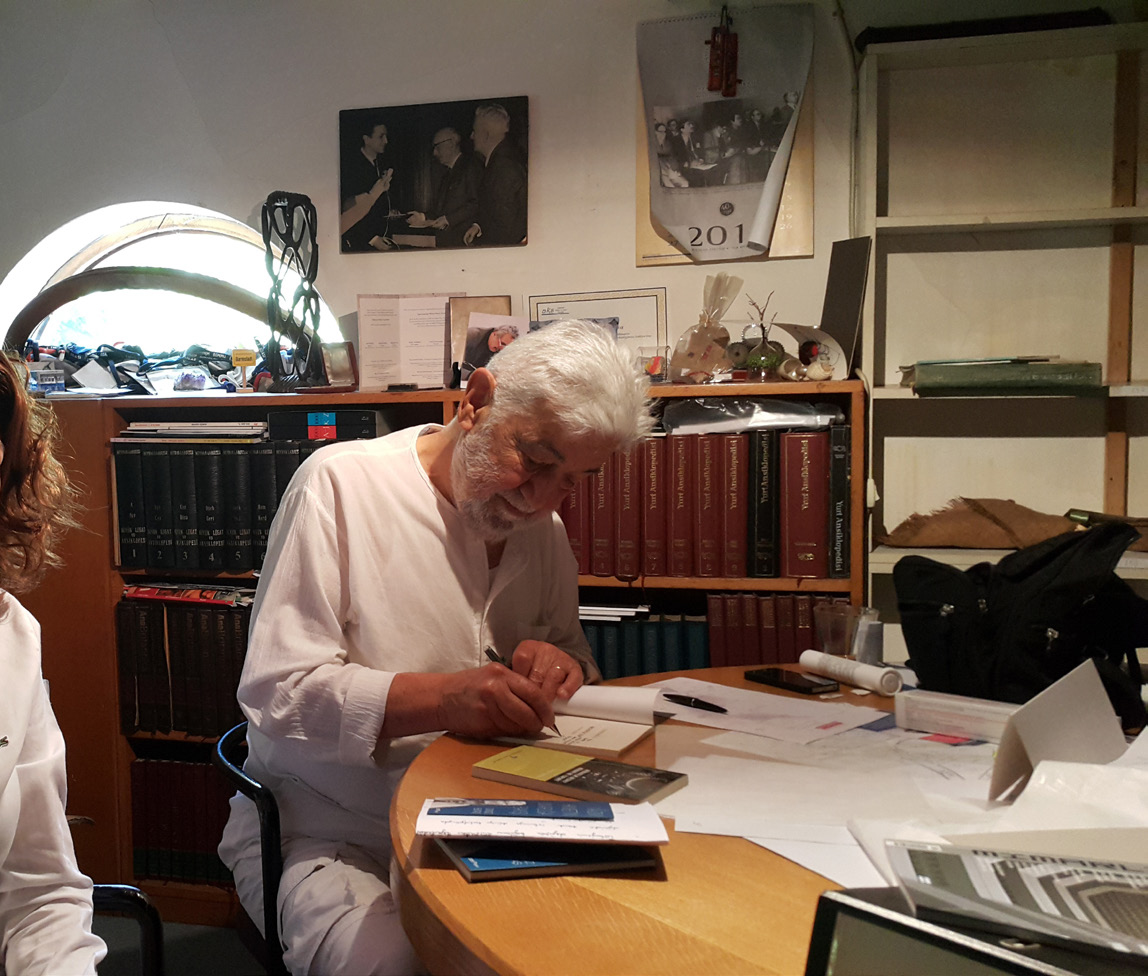
Because architecture is the only field where we can read history. When we look at a construction, we see human. You are able to read my history when you look at my constructions. Of course they do not only reflect my period but also my life. What i was seeking for there is obvious when my architecture is examined. When i proceed to my next design, i correct my mistakes in the previous structure through criticizing myself, it’s indisputable. This is what architecture is like… While growing up, your experiences lead you somewhere. If the end point is right, then your profession is also right for you. For example, a structure which has been designed 43 years ago (TLA Building) can get on the cover of an actual architecture magazine. If a construction can get on a cover after half a century, then it’s my history. There is only glass and concrete in this photograph, not “material fetichism”…Let me tell you a story: they called Vedat Dalokay and showed him the construction. Vedat asked: “Did Cengiz do this with his architect salary?”. They told him that i did and he said: “Cengiz made you a sculpture with his salary.” I studied middle and high school at İstanbul High School. I passed my classes with great success. Because if an achievement certificate didn’t reach my father, then i wouldn’t have the school tuition. In that period, i used to make drawings in magazines. For instance, i was an illustrator in the Panaroma Magazine which was being published by the late Hakkı Devrim. I loved him, he was always giving me jobs to work on. Those were the good days. If we hadn’t been in such a period, Turkey wouldn’t have lasted for 15 years against what we have been through and it would disappear in a couple of years. Do you think that it’s easy to raise the literacy rate to 80-90 percent from 3-4? My mother teached my father the numbers and how to sign. If my mother had the chance to study for one more year, she would have been a teacher but she got married off and i think she’s a lucky person considering that period. I used to even read the journal myself for my father.

“BECAUSE ARCHITECTURE IS THE ONLY FIELD WHERE WE CAN READ HISTORY. WHEN WE LOOK AT A CONSTRUCTION, WE SEE HUMAN. YOU ARE ABLE TO READ MY HISTORY WHEN YOU LOOK AT MY CONSTRUCTIONS. OF COURSE THEY DO NOT ONLY REFLECT MY PERIOD BUT ALSO MY LIFE. WHAT I WAS SEEKING FOR THERE IS OBVIOUS WHEN MY ARCHITECTURE IS EXAMINED. WHEN I PROCEED TO MY NEXT DESIGN, I CORRECT MY MISTAKES IN THE PREVIOUS STRUCTURE THROUGH CRITICIZING MYSELF, IT’S INDISPUTABLE. THIS IS WHAT ARCHITECTURE IS LIKE… WHILE GROWING UP, YOUR EXPERIENCES LEAD YOU SOMEWHERE. IF THE END POINT IS RIGHT, THEN YOUR PROFESSION IS ALSO RIGHT FOR YOU.”
You are one of those who ideally use the local and the modern altogether…
This is what happens when you only take the “human” sides. I graduated in 1959, when i went to Germany afterwards, they placed me through an exam. They substituted the courses i took here. It has happened for the first time. Usually, they weren’t considering the Turkish education valid. Back then, they wanted you to start from the first grade. Because some people like Sedat Hakkı Eldem and Arif Hikmet Holtay wrote letters to the college in Munich. Like i just told you, they tested me and i continued my education without hiatus…My math teacher in highschool, Fazıl Say was the grandfather of Fazıl Say, the well known pianist and he used to like me a lot. One day, he held an exam without notice and i handed in a blank piece of paper. He wrote “nine” on that blank sheet, signed it and gave it to me. That’s how much he liked me.
I understood some things when i came to İstanbul for the fifth grade. I studied the fifth grade in İstanbul and realized that İstanbul and Denizli are totally different. If we were to get in a fight with a friend in Denizli, the teacher would ask me during class, make me come clean and show my wound and i would tell him that i stepped on a stone and fell. Then, he would ask my friend Burhanettin who i got into a fight with: “ Did you step on the same stone?”. That was what friendship meant for us. However when a similar incident happened in İstanbul, i was leaning against the wall and watching my friends playing football. The ball came right in front of my feet, i kicked the ball and it happened to be a score. Some of them said it was a score and some of them said it was not. So i standed up for myself and talked like someone who just got back from Denizli. They immediately reported to the teacher. That’s when i realized that things were running differently in İstanbul. The math teacher i mentioned about suddenly died. I was 17 or 18 back then and they made me organize his funeral. It really affected me. Many Istanbulites attended the funeral because he was the writer of the best math books. His death touched me deeply. That year, i got away from all. I lost a year but i regained it back in Germany.
According to some, this award you see on my desk was given to me with 10 years of delay. This is what everyone stated when they called me to celebrate after receiving the 2016 National Architecture Awards Mimar Sinan Great Prize. In fact this award was given to me 3 years ago for the first time. The award included all of the Mediterranean countries. Spain, France, Italy, Greece, Tunisia, Tripoli, Syria, Morocco, Algeria, Egypt, Turkey…
Mr. Bektaş you are using Turkish effectively and properly…
I left the Middle East Technical University exclusively for the language issues. If one’s opinion and language does not function parallelly, the result would be inadequate. There is no need or possibility for you to speak English like British people do…
You had an archive before at Arkiv…
Before all these conversations, Pelin Derviş came to me and suggested to generate our own archive. The same was done before for Sedat Hakkı Eldem and Turgut Cansever. They offered me right after Turgut Cansever. There wasn’t any possibility for me to establish my own archive. I lived with a conscientious approach towards my money in order to avoid saying “yes” to something someday. For example Mr. Sedat Hakkı said “yes” to Profilo for an apartment block they wanted.
Currently, when we type your name in the search engine of Salt Research, we see approximately three hundred documents, letters and reports. We are able to even see your new year card you had sent in 1978. It’s a great service…So how do you adapt to the rapidly changing world? Lots of things have changed and they keep changing…
First of all, i have seen almost every significant buildings in the world. For instance, Venice was a must-see in terms of urbanism. After visiting Paris, i was too surprised because there were plenty of poor structures…When i saw Berlin, i said “how can you live in such geography?”. I thought it was normal for them to build that kinds of structures. Those who didn’t coincide with Berlin formed a really important group: The Bauhaus School. It’s crucially important. The student and future partner of Mies Van Der Rohe, Professor Weber was my teacher…Highly contributed to Neufert and the best hospital architect, Professor Hasenflug was also my teacher… Keeping up with the ever-changing world does not stand for adapting to the capitalist architecture that functions as a public enemy… Sometimes you have to resist change…
Can we talk about your latest book “Nazım Hikmet’s View on Architecture”? It really surprised me in terms of its topic. In the book, you’re stating Nazım as “The modern man of his era”. Your closure at the end of the book was also magnificent.
People are randomly reading Nazım Hikmet. Whereas Nazım Hikmet is a man who fought for the civilization. Even though he was an Istanbulite, he managed to address by grounding on Turkey at its entirety. It was extremely important back in 1930’s. He wasn’t denying Mustafa Kemal. I’m not evaluating him as a “poet”. He told the most valid arguments about architecture. That’s what culture is. Those who read him will know what i mean…
What can you comment on today’s world?
These days, when you ask your father for a kite, he just buys a ready-made one and bring it home. It wasn’t like this in my day. We used to sculpt it from a tree, we didn’t have glue so we made them out of dough. Therefore a kite would be our own design from start to finish…
So do you think that it’s necessary now to produce all on our own considering the easier life and technology?
No it’s not. But when you use that material, you need to produce that one day in Turkey. Because if you don’t, you will fall behind in my opinion. Everyone needs to reach to the easiness that you do.
When evaluated within the scope of the changing context of Turkey, what do you see when you look at your old works? Did any of your buildings get demolished?
Only one of my buildings got demolished and it was for fugitively changing the two-story building into a five-story hotel. It was in Güre… When an earthquake happened, not a single concrete crack was developed even though it was a land that was capable of causing liquefaction. A large committee came after the earthquake and congratulated me. After a year, a new client came up so they acquired five civil engineers and received a report from them, stating that the building was not earthquake resistant and they issued a demolition order. Why? To add three stories. So how is it possible for me adapting to the modern Turkey?

Which project are you engaging in these days?
I was in Muğla before this interview… I am the consultant of the Metropolitan Mayor of Muğla. There is a regional museum project that they want me to execute. I’m working on it. It’s a subject i like. You can tell children about history as it was in real life; directly with cold facts… A roman came here and built a construction but did the Roman architects or Roman workers build it? The answer is no. It’s in fact your building constructed under the Roman realm. This is obviously a distortion. In this respect, museum structures are really important… It’s a field that i am experienced on.
Which is the most pleasant structure that stuck in your mind?
All of them. Recently, we built a space of 38 sqm with a stonemason. I love living in that house. Unfortunately there are not any talented stonemasons left in Turkey anymore.
38 sqm? How?
Indeed. My place in Güre spreads over 52 sqm even when the wall thicknesses are included. (Cengiz Bektaş delineates his house plan on a drawing paper). All the coverings made within a single volume are composed of sitting and resting sections with a total of 38 sqm. I experience the whole house from my bedroom. That’s why i love to go to Muğla. The preliminary design of the project has been approved… I love the ratios of the Muğla Bazaar. It’s just like Suriçi in Diyarbakır. Believe me i’m walking like i’m dancing in the bazaar. With great joy…
Did you always use local materials?
I used joists made out of wooden elements for the first time as foreign materials for the school i have built for the autistic children in Denizli. Between letting people cut down trees in my hometown or choosing wooden joists that costs half the price, i chose the second one.
Mr. Bektaş, how many people work in your office?
Always 6… Now i see those which has over 70 employees. For me, they’re not doing architecture, they’re “cutting and pasting”. I chose to live like this, contemplated and made these decisions. That’s why i chose Kuzguncuk. I can not live in Nişantaşı. Believe me, as soon as i get on to a Bodrum flight, i feel strange… Kuzguncuk is comprised of my people. For example, today i will break my fast at a synagogue with all the Kuzguncuk community… There won’t be any diner food, instead the women coming to the Synagogue will be responsible for the cooking.
Back in your day, there used to be heroic architects, starchitects in other words. But now we see teamwork process in large-scaled projects. What do you think about this?
Those large-scaled projects are not what Turkey needs. They are the projects imposed with global capitalism… When the word “globalization” was used for the first time, i wrote in the Evrensel Journal: “Globalization of what? Money or culture?”
You are saying: “Architect is not a fashion tailor or a magician of form, architect has to work for people”. The curator of this year’s Venice
Architecture Biennale has come up with a theme that positions human in the first place. Is the architecture heading towards such social aspect?
No, nothing is evolving into anything. The only focal point is money… I don’t know how many times the western world has cheated us. Do you think that U.S. is in Middle East just for the laughs? Of course not! It’s only for the oild fields…
Thank you for your time.
HIS LIFE:
Born in 1934 in Denizli, Cengiz Bektaş completed his secondary education in İstanbul High School and his higher education in Istanbul State Academy of Fine Arts Deparment of Interior De¬sign and Architecture and in Munich Technical University De-partment of Architecture. He completed his higher education in 1959. He attended town planning courses in Germany in 1960. He worked as a freelance architect in Germany. When invited to METU as an academic, he returned to Turkey. He conducted the METU Department of Construction Works Stu¬dio of Architecture between the school years of 1962-1963. He launched his own architecture studio with Oral Vural at Anka¬ra in 1963. He designed buildings that are ranked among the examples of the history of architecture in the Republic Period. He received the National Architecture Award twice. He won the Aga Khan Award for Architecture in 2001 with the Olbia Social Centre in the Akdeniz University. The TLA Building in Ankara is respected by the architects as one of the twenty structures that symbolizes the Republic Period. In 2014, Inter¬national Mimar Sinan Award was given to Cengiz Bektaş for the first time. Bek¬taş received the Mimar Sinan Great Prize of the Chamber of Architects in 2016.