

Rem Koolhaas’ firm OMA has converted a century-old distillery in Milan into a new arts centre
for Fondazione Prada in May, featuring a “MAGICAL house” clad in 24-carat gold leaf, a “podium”
in travertine and a cinema camouflaged by mirror.
OMA and its research arm AMO renovated seven buildings at the complex in Largo Isarco,
southern Milan, and designed three new ones to accompany them – a cinema and gallery that
are already complete, and a tower that is still under construction. The old factory buildings
and warehouses were upgraded with new finishes and fenestration, while the additional
structures were designed to suggest a similar industrial character, despite being built using
modern materials and techniques.
The new Milan venue of Fondazione Prada opened to the
public in May. In conjunction with the Milan spaces, the
Fondazione venetian outpost will continue to operate in
the 18th century palazzo Ca’ Corner della Regina, where a
new exhibition launches on the same date.
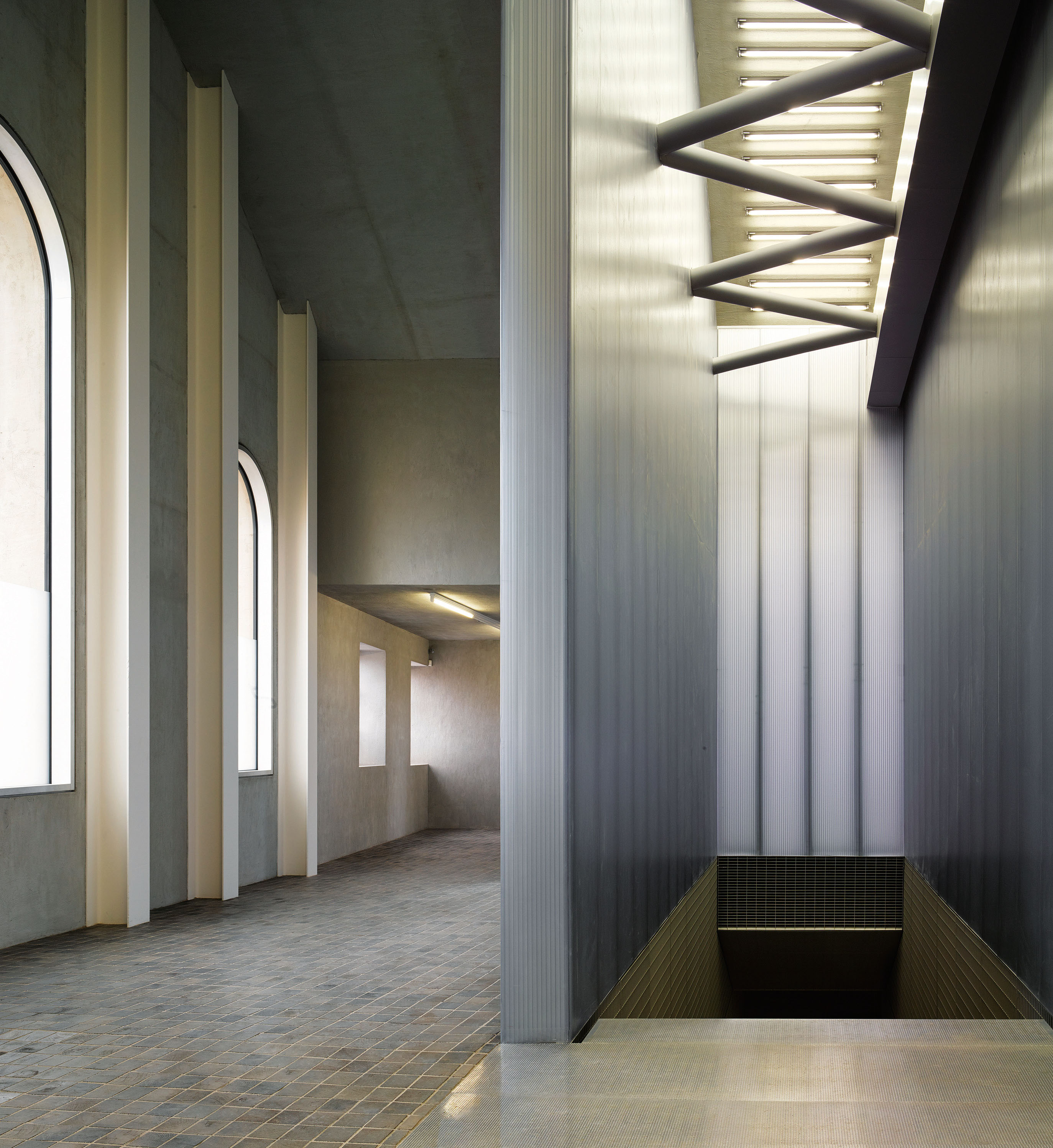
The architectural project developed by OMA, led by Rem Koolhaas, expands
the repertoire of spatial typologies in which art can be exhibited
and shared with the public. Characterized by an articulated architectural
configuration which combines seven existing buildings with three new
structures (Podium, Cinema and Torre), the new venue is the result of the
transformation of a distillery dating back to the 1910’s. In the project conceived
by OMA, two conditions coexist: preservation and the creation of
a new architecture which, although separate, confront each other in a state
of permanent interaction. Located in Largo Isarco, in the south of Milan,
the compound develops on an overall surface of 19,000 m2/205,000
ft2. Torre (tower), currently undergoing construction work, will be open
to the public at a later stage.
Fondazione Prada was created in 1993 as an outpost to analyze present
times through the staging of contemporary art exhibitions as well as
architecture, cinema and philosophy projects. The diversity of the new
spaces has become the incentive to develop an experimental, stimulating
program in which different languages and disciplines, though independent
from each other, coexist in order and activate an ever-changing
evolving intellectual process. Various interests and researches are pursued
and examined through a flexible approach, founded on the idea that culture
is an effective knowledge and learning tool.
The exhibitions “Serial Classic” and “Portable Classic” -conceived by Salvatore
Settis- ideally joined the two venues of the Fondazione throughout
the summer. The two exhibition projects, for which OMA has designed
the display, analyze the themes of seriality and the copy in classical art
and of the reproduction of Greek-Roman statuary on a small scale from
the Renaissance to Neoclassicism, respectively.
Exhibition “Serial Classic”, co-curated by Salvatore Settis and Anna Anguissola,
was open throughout summer and occupied the two levels of
the Podium. “Serial Classic” focuses on classical sculpture and explores
the ambivalent relationship between originality and imitation in Roman
culture and its insistence on the circulation of multiples as an homage to
Greek art. We tend to associate the idea of classical to that of uniqueness,
but in no other period of western art history the creation of copies from
great masterpieces of the past has been as important as in late Republican
Rome and throughout the Imperial age. The exhibition comprises
more than 70 artworks and opens with an in-depth analysis of lost originals
and their multiple copies, represented by two particularly renowned
series such as the Discobolus and the Crouching Venus. Two other important
sections are devoted to the materials and the colours of classical
bronzes and marbles. The Kassel Apollo, for instance, is presented in two
recent plaster casts which reproduce the original bronze surface of the
lost Greek original and the colours of its Roman marble copies. Another
section of the exhibition illustrates the technologies and methods used in
the making of the copies, presenting two essential moments such as the
creation of the plaster cast and the translation of proportions and measurements
on the new block of marble. Two famous series are also featured
in the exhibition, the Penelope, and the Caryatides, on the prototype of
the Erechtheion in Athens.
During september, the “podium” will host “Atlante del gesto” Atlante
del gesto is a series of choreographic actions conceived by Virgilio Sieni
for Fondazione Prada’s new Milan venue. One of the most representative
dancers and choreographers in the European scene, Virgilio Sieni is the
director of the Dance Sector of the Biennale di Venezia and of Cango, the
body language and dance production centre based in Florence.
Consisting of several actions – Origine (Origin), Rituale (Ritual), Annuncio
(Announcement), Gravità (Gravity) and Nudità (Nudity) – the project
unfolds on the two levels of the Podium building within the compound
designed by Rem Koolhaas.
Atlante del gesto is the first performing arts project to be hosted by the
Fondazione Prada with the intention of expanding the range of knowledge
and exploring other instruments of research beyond visual arts.
Atlante del gesto creates a dialogue with the traces of the Serial Classic
exhibition (9 May to 24 August 2015), co-curated by Salvatore Settis and
Anna Anguissola. The static nature of the classical works, displayed in a
set-up designed by OMA, is replaced with the dynamism and vitality of
the dancers’ bodies and of the people involved in the choreographic actions
in the project conceived by Sieni, transforming the exhibition space
into a “landscape of gestures”.