


AIMING TO MEDIATE BETWEEN REVIVING THE NATURE CULTS, ONE OF THE MOST SIGNIFICANT BELIEFS OF ALEVISM AND THE RITUALS RELATED WITH THESE CULTS IN THE CITY, THE BUILDING HOLDS NATURAL STONES USED IN CERTAIN AREAS WHERE “THE PLACE” MEETS WITH THE SPACE. BEYOND BEING A CONSTRUCTIONAL ELEMENT FOR THE RITUALS, THE STONE IS RATHER INTENTED TO BE A PART OF THE PATTERN, DESIGNED SOLELY FOR THE CONCEPT OF “GATHERING”. IT IS ALSO ASPIRED TO EMPHASIZE THE DUALITY AND THE UNITY BETWEEN WHAT IS NATURAL AND ARTIFICIAL THROUGH THE CONCRETE WALLS ALONG WITH THE SLATE STONE-WEIGHTED SURFACE, POSITIONED IN THE COURTYARDS. PEBBLES IN THE POOL FLOOR ARE ALSO A PART OF THE DESIGN CONNECTING WITH THE SEASONAL AND TEMPORAL EXISTENCE/NONEXISTENCE OF THE WATER.
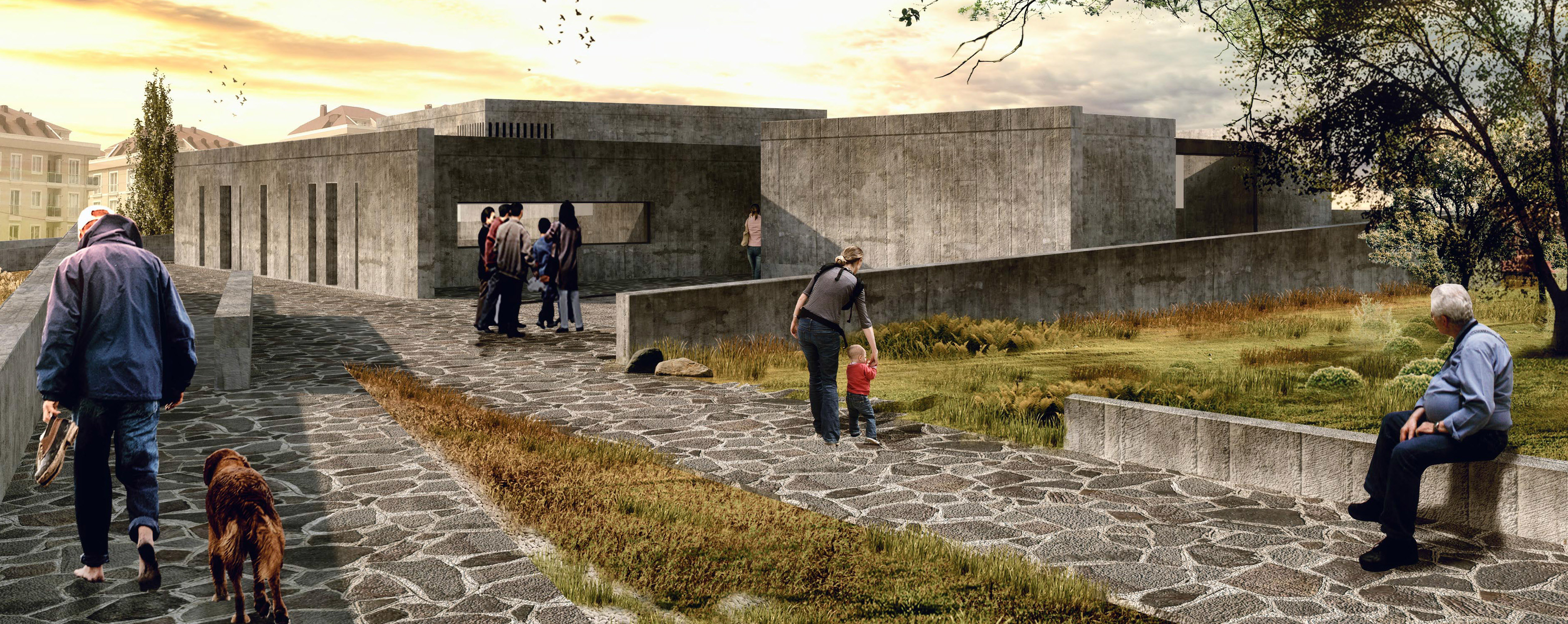
ecause of various reasons, the relation between space and nature of the devotional and religious traditions ever since the history of Alevism has slipped into a different direction in the city. The understanding between nature and human, subject and home for a unique motion and the consensus built within unwritten laws have been rejected. Even though the values dedicated to natural elements vary through different times, embracing the beliefs of people as a value and a motive in traditional values and literary works will remain still. Within this scope, forgetting and neglecting these values in cities not only caused to a loss of context but also led to a cultural erosion. At this point, nature cults partaking in the Alevi belief, have taken the major hit.
Therefore it is essential to reevaluate forgotten fundamental and ancient values, in an environment surrounded by dualities and inconsistencies, full of anxiety and alienation where it has been justified and secured its position. For these rituals, details and interpretations are the fundamentals of a belief system rather than the parts of an organization. These patterns generating the spatial construction, tend to lose their context in rituals if they become merely an “element”.
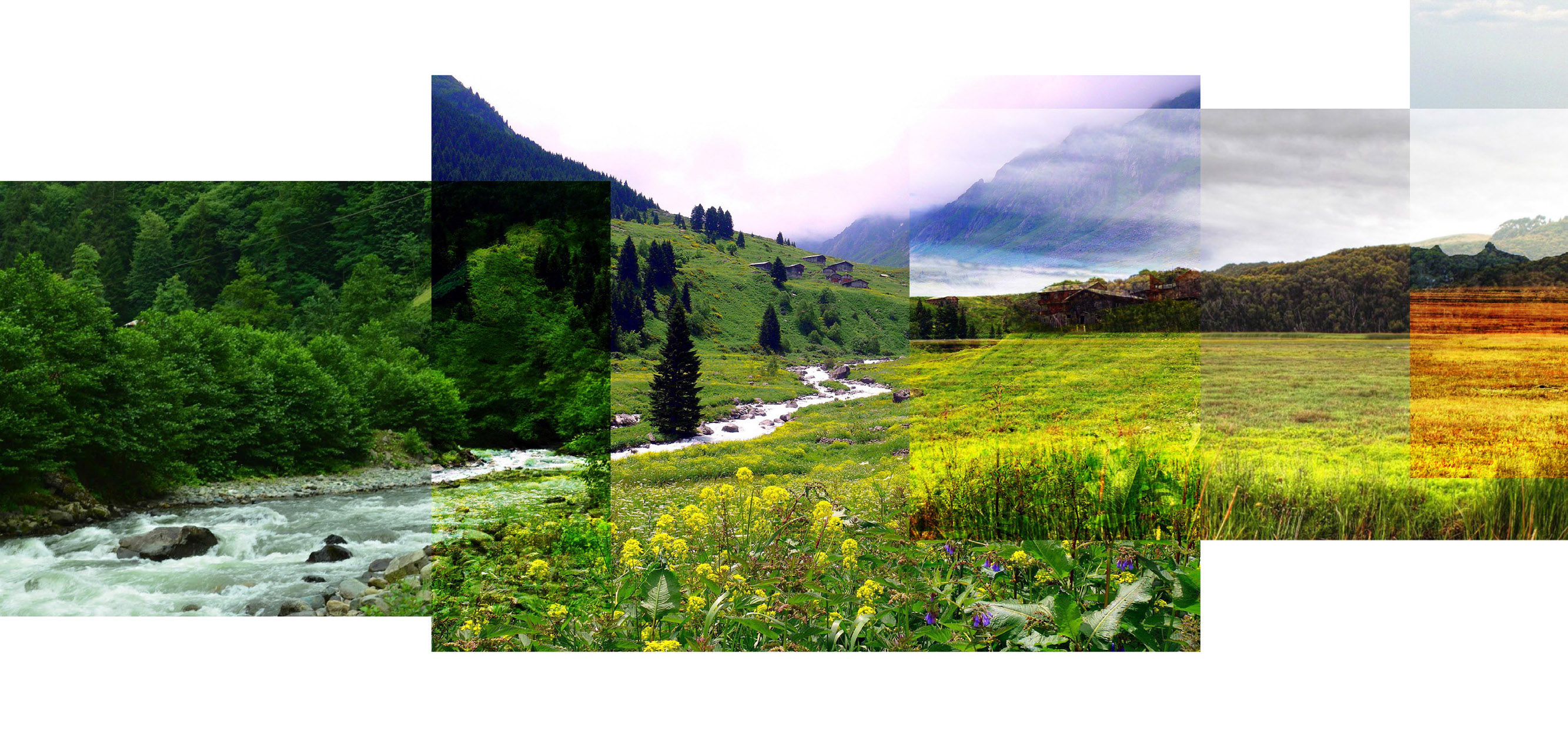
Tree and landscape as part of nature cults are inseperable. Especially in Rural Alevism, landscape is a major element that forms the manner of life. Originating from Central Asia and survived until now, the belief of “boldness and nudity” is a sign indicating the God’s existence. Boldness and nudity represent the sacred life force of God. For where he exists, nothing else is required. Thus, the green landscape thorougly covering the hills of Beylikdüzü is included in the design process when arrived at the sports area and dried out gradually throughout the Djemevi territory. This aridification also designated the spatial construction. While the djemevi block appears in the dryest and the most ethereal point of the area, the social complex resides closest to the sports area and the green landscape. Between these two complexes, the meal center is located. The courtyards of these 3 blocks, harmonizing with the current landscape, get privatized, become still and interconnect these functions altogether.
Nowadays, the Alevis migrating from rural to urban areas started to build djemevis in the density of the city, willing to perform their rituals in a city environment. Yet, this density caused lots of spatial organizations in the rural to be casted aside. The spaces grouped together upon their functions around a series of courtyards in Anatolia turned into open and semi-open spaces and into almost apartment-like djemevis compromised on quality. In order to regain these qualities (interrelations between courtyard-courtyard, courtyard-space, space-space) and for social functions like meal centers to be operating more efficiently, a yard-type construction is envisioned. Characteristics of the walls, originated from islamic-ottoman social complexes, not only seperating the different zones but also creating the spaces, are reminded yet again and this understanding is included in the design method. The djemevi and the condolence sites were positioned below ground level in order to be isolated and tranquilized, getting further away from the daily life activities. The courtyard for the meal center is supported by the djemevi block and positioned for connecting with the residents by leaning against the park and opening itself out. The courtyard for the social block is communicated with the park and sports area, aiming to create a visual and physical connection through the landscape. With the help of the densifying and arising vegetation throughout the north directon, prevailing winds are weakened. Being primarily the recreational sports(skateboarding, cycling, jogging), it offers outdoor sport activities in the intense arborical environment.
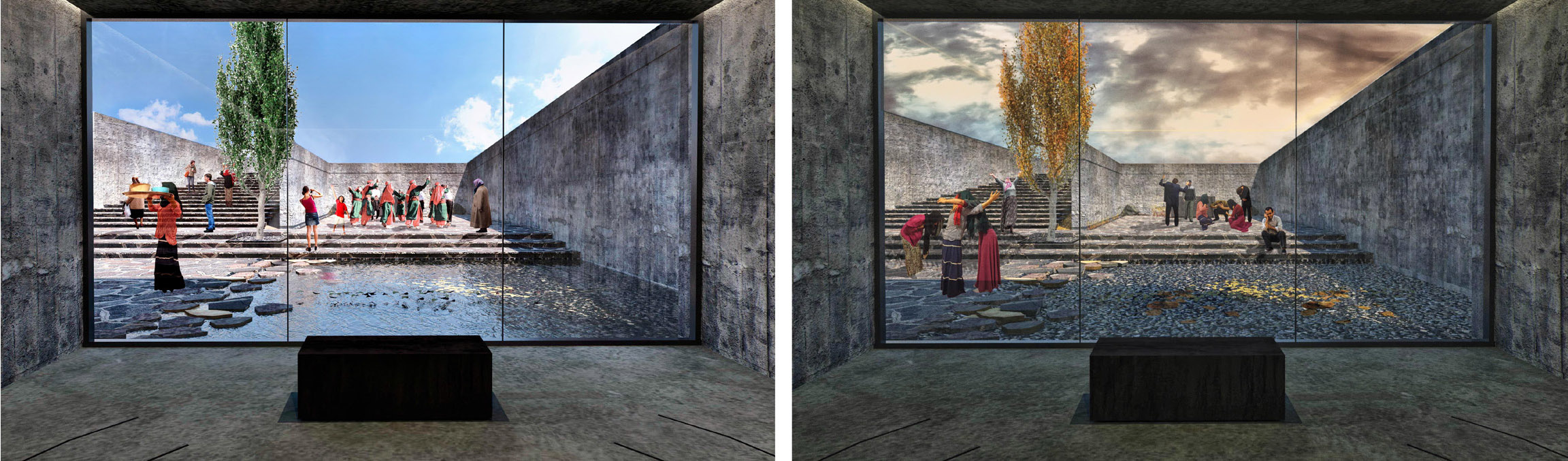
Originated from Central Asia, formed by the universe being a pavilion and carrying the sky with a tree or a pole located in the center of it, the notion of cardinal points and mandala are long forgotten now. Today, the most similar example to this notion is the Şah Kulu Dervish Lodge where axis mundi is represented with a “pole”. Another fictional example is the swallow roof symbolising the rotation of the universe and the wheel. This element has been used in the djemevis and can be seen as one of the earliest examples at the Onar Village Dervish Lodge in Arapgir. Using these two figures together which the Alevis are highly familiar with, have been addressed in the design process. Consequently, the swallow roof symbolising the four cardinal points, installed upon the ground with 4 wooden pole is positioned in the center of the hall of gathering. Along with the swallow roof reaching down the floor in a tightening form and concluding on the 4 poles, fictional vertical axis is aimed to be emphasized even more. The twelve layers of the inverted swallow roof represents the Twelve Imams.
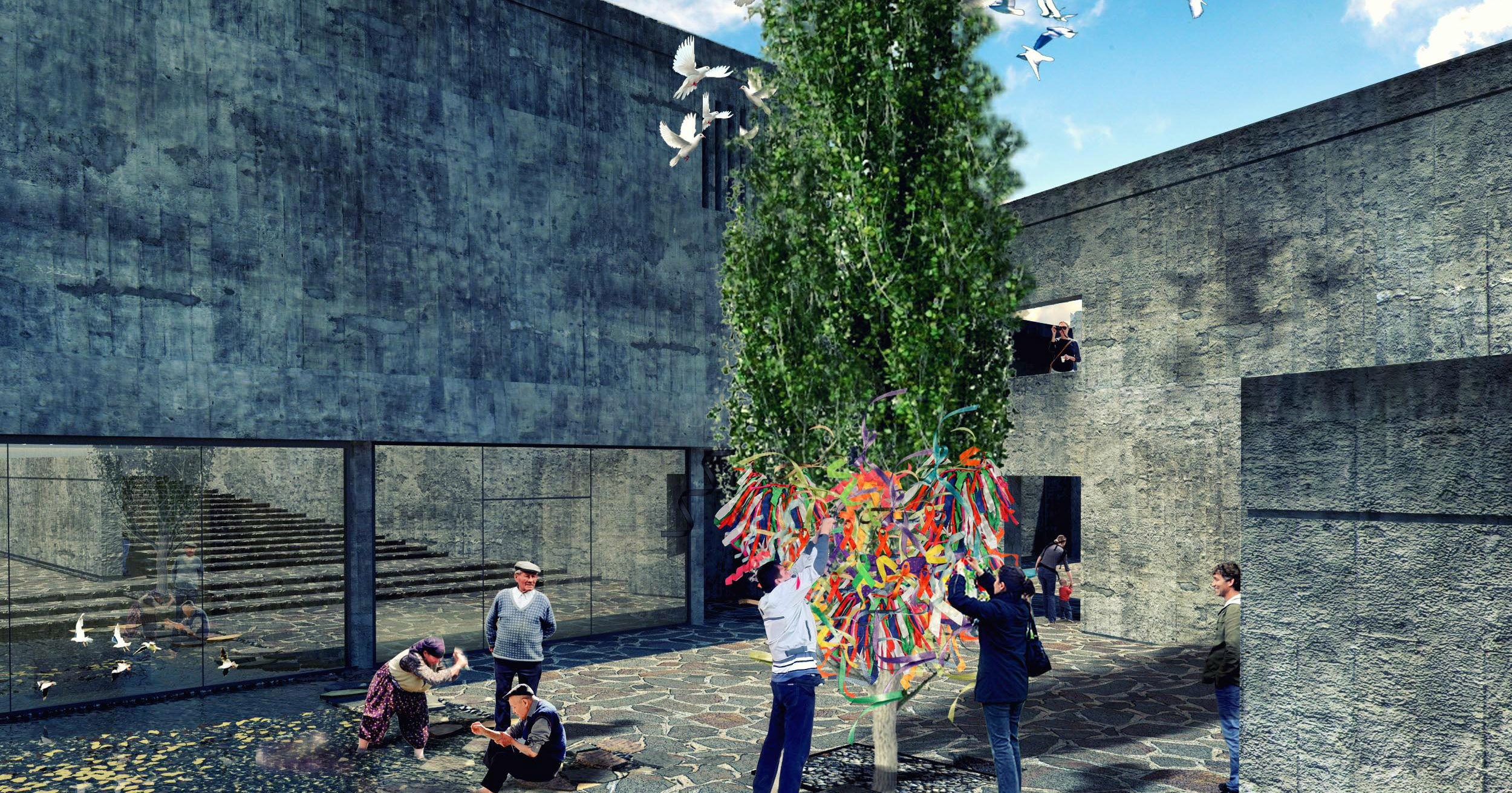
The only exception of the drought/nudity is the trees appearing on the arid land. It’s believed that they become green and come in existence as God’s manifestation. These trees also known as the Tree of the Worlds represent the paths to reach God. It’s esteemed that the sights of these trees reach through heavens. It’s also believed that these trees symbolise the figure connecting the three-staged understanding of the world which includes “underground, earth and sky”. For this reason their roots are as important as their leafs. They are the gateway between the sky and the earth. Like a human being, they come into the world, grow and die.
At this point, the species of the tree is significant. Attributing sanctity vary by region and sagas. Woodsmen venerate trees like scotch pine and spruce for growing in Mediterranean and Eagean regions while mulberry trees are sacred in the Central Anatolia and beech trees in Central Black Sea. Therefore the memory of the place and its inhabitants are substantial for the sacredness of the tree. It’s now forgotten that the former name of Beylikdüzü used to be ‘Kavaklı’(poplar) in reference with the species of the trees grew in that area. For the respect shown for the poplar tree by the Alevis and Bektashis of Anatolia after Haji Bektash (one of the most important figures in the Anatolian Alevism and Bektashism) met with Ahi Evren and stuck his scepter to the ground for a shade; resulting the scepter to be turned into a poplar tree and the veneration and attribution regarding the memory of the place owing to the former name of the area, the tree in the middle of the arid land is chosen as the poplar tree.
Yet another important point is the rituals taking place around the tree. It’s believed that the prayers and orisons reach God more quickly for the trees are the gateway to the sky and the manifestations of God. For that matter, the poplar tree is positioned in the courtyard where the seasonal rituals (Hıdrellez, Abdal Musa/gatherings of sacrifice) get performed, close to the coffin rest and the condolence site where it’s possible to perform minor gatherings, healing ceremonies and establish a visual bond in several areas for conversations.
The earth-water concept which is yet another nature cult, is a further belief associating with the “underground-earth and sky” triad. However, water can not be a one-on-one object for cleansing the soul, it’s just an instrument. The true cleansing can only be ethereal through its esoteric effect. While in Muharram ul Haram (the first month of the islamic calendar), people perform water fasting in remembrance of what had been done to Husayn ibn Ali and to his family in Kerbela and in Hıdrellez ceremonies, people wash themselves with the collected rain water, expecting to get refreshed just like the rain gives freshness to the trees. Different from direct contact with the water, the fluctuations in the springs are also considered as a divine sign. Considering all these reasons, water carries a meaning far beyond being an element in the landscape. Therefore its position and seasonal/temporal existence or non-existence are vital.
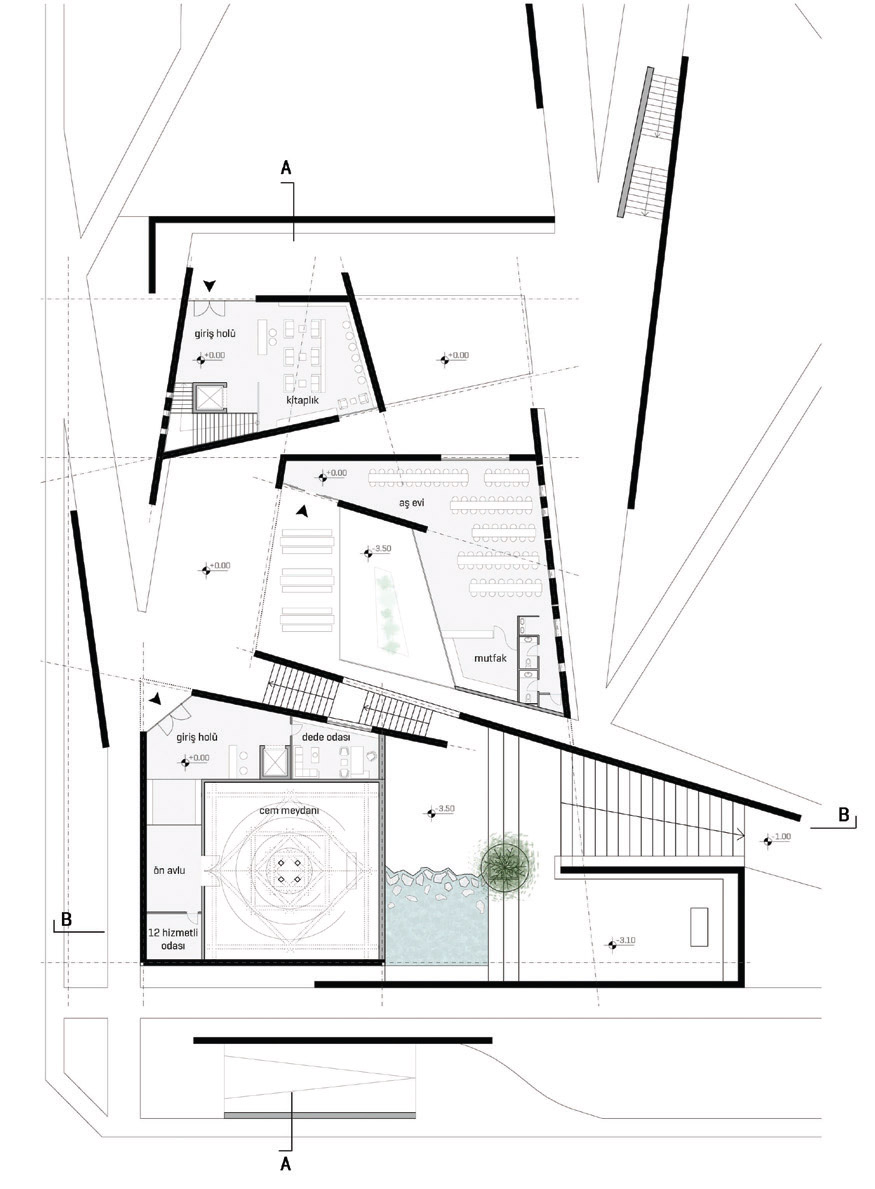
The courtyard of the djemevi is located in the level of -3.50, at the south of the land. The firm ground from the main road transforms into topographical stairs and forms this courtyard. The open space designated for various rituals and funerals, is in connection with the condolence site. The courtyard makes contact with the other functions existing on the same level such as the area for conversations and entrance hall, connecting with the meal center through a vertical circulation.
The meal center square gets limited by the walls while diversifying the functionality within open, semi open and closed spaces. The courtyard diverged from the texture of the neighbourhood through a single wall, is supported by the flow of the pedestrians nearby, through the channeling of the same wall. The djemevi block is also accessible from the courtyard where the meal center opens out at the ground level. When entered, the entrance hall comes across and from there, it’s possible to pass on to the hall of gathering or the room of the Dede(a socio-religious leader) and the 12 Servants. Another option in this courtyard is to connect with the cultural courtyard constituted through a tender perspective along with the positioning of the walls.
The cultural courtyard where the crowd coming from the green axis follows throughoutly the parking garage and the spring, allows entrance to the block embodying the cultural functions. The library and reading hall is located in the first floor and the foyer, multi functional hall, parking garage, administrative units and classrooms/workshops are situated at the ground floor. This block is able to connect with the shared atrium located in the meal center area at the level of -3.50, through the foyer. Therefore the parking garage is able to connect with the other blocks. This courtyard connecting with the yard of the djemevi at -3.50 level, facilitates all the fonctions to operate altogether.