
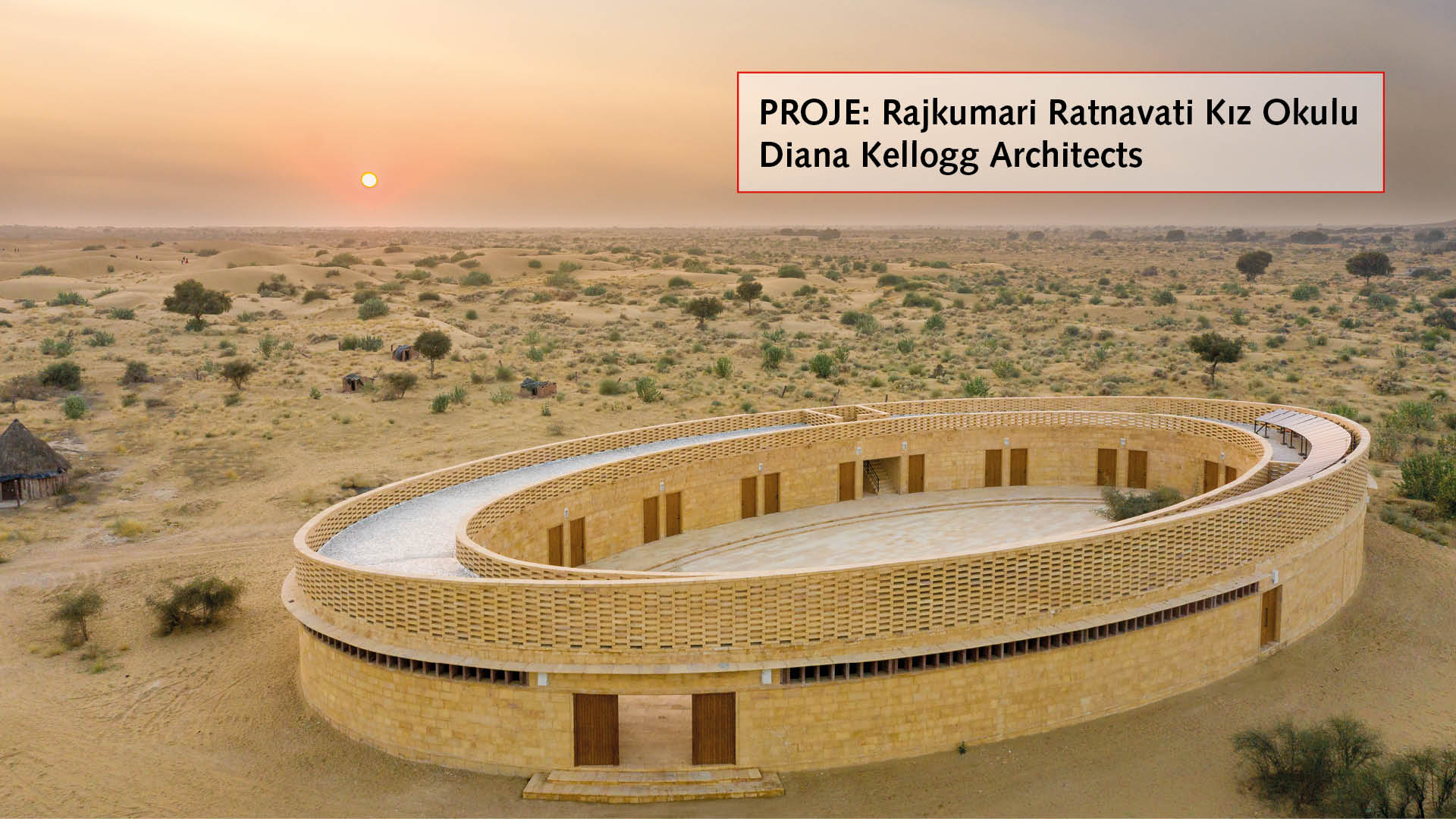
Designed by Diana Kellogg, and
commissioned by CITTA, a non-profit organization that supports development in
the most economically challenged, geographically remote or marginalized
communities in the World, The Rajkumari Ratnavati Girl’s School, a fantastical
oval sandstone structure that blends seamlessly into the arid landscape is
sitting atop numerous acres in the heart of the mystic Thar Desert in
Rajasthan, India.
The school will be the first in a complex of three buildings known as the GYAAN
Center, which will also consist of The Medha, a performance and art exhibition
space with a library and museum, and The Women’s Cooperative where local
artisans will teach mothers and other women weaving and embroidery techniques
from the region. The Rajkumari Ratnavati Girl’s School will serve more than 400
girls, from kindergarten to class 10, from below the poverty line residing in
the mystic Thar Desert region of Jaisalmer in Rajasthan, India where female
literacy barely touches 32%.
The GYAAN Center will empower and educate women, helping them establish
economic independence for themselves, their families, and their communities.
“Effective design is a process requiring deep understanding of the history of a
place – its culture, its topography and its vernacular” said Diana Kellogg. She
looked at feminine symbols across cultures when starting the design process –
specifically symbols of strength, landing on a structure of three ovals to
represent the power of femininity and infinity. The Rajkumari Ratnavati Girl’s
School is made entirely out of local hand-carved Jaisalmer sandstone by local
craftsmen -often the fathers of the girls-. It was vital to Kellogg to include
the community in a building made for the community. The design team followed
the local ancient water harvesting techniques to maximize the rainwater and
recycle gray water in the school. While the building is oriented to maximize
the prevailing wind and keep maximum sunlight out, the team also employed solar
panels for the lighting and fans in the building. At the GYAAN Center, the wall
allows air to flow through the building and keep the sun and sand out. A solar
canopy on the roof with a metal framework doubles as a jungle gym with seesaws,
swings and monkey bars for the girls. Using local material to create
infrastructure helped reduce carbon emissions, and Kellogg chose to build a
solar panel canopy on the roof as a cooling system where temperatures peak
close to 120 degrees. Both the canopy and jalis keep the heat out and the
elliptical shape of the structure also helps bring aspects of sustainability
creating a cooling panel of airflow. The GYAAN Center will equip young women
with the tools to further their education and independence as well as raise
awareness surrounding the issues faced by women in India on a global scale.
CREDITS
Architectural Design: Diana Kellogg Architects
Client: CITTA Foundation
Building Date: 2021
Location: Salkha,India
Photographs: Vinay Panjwani
NATURAL STONE:
INTERIOR AND EXTERNAL WALLS, FLOOR COVERINGS
SANDSTONE