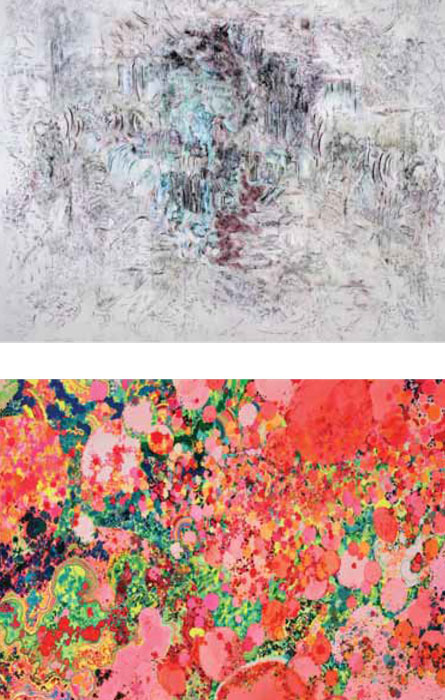
Pera Museum is hosting the exhibition
titled Out of Ink: Interpretations
from Chinese Contemporary
Art, which focuses on the different
interpretations of ink art. Curated
by Karen Smith, an expert
on Chinese contemporary art, the
exhibition echoes how artists from
different generations continuing
their practices in China, carry the
tradition of ink painting into our
time. The exhibition can be seen
until July 28.
The exhibition scrutinizes the
source of the cultural identity represented
by ink, while focusing on
artists’ explorations towards the
root of the ink painting tradition.
Curated by Karen Smith, the exhibition
features more than thirty
works by thirteen artists who are
living in different parts and cities
of China. Approaching topics such
as landscape, nature and calligraphy
with a contemporary view, the
artworks manifest themselves in
different media such as painting,
photograph, video and installation.
Engaging with ink through the reflections
of Chinese cultural heritage
on their own artistic practices,
the participating artists are Chen
Guangwu, Chen Haiyan, Li Ming,
Liang Wei, Luo Yongjin, Qiu Anxiong,
Sun Yanchu, Tang Bohua, Xu
Bing, Xu Hongming, Xing Danwen,
Jian-Jun Zhang and Zhou Fan.
Accompanying the exhibition Out
of Ink: Interpretations from Chinese
Contemporary Art, a catalogue brings together articles written by the curator Karen Smith and
Beth McKillop, the senior research fellow at Victoria and Albert Museum.
Indicating how artists participating in the exhibition consider ink as a way
to understand the relationship between human and the physical world of
form and space, Karen Smith adds that each artist makes a contribution
to the future possibilities of ink, which has been the pulse of the Chinese
culture throughout the country’s civilization. According to Smith, these
artists build an important bridge between the audience and the world,
while searching for ways to contemporize ink.
The long-established ink painting represents a worldview in Chinese culture
and is considered as a form of perceiving and interpreting the world.
Chinese ink paintings usually contain abstractions of nature. Featuring
solely water and ink, these works present landscapes, human figures,
flowers and animals in their purest forms. It is also possible to witness the
emergence and development of Chinese ink paintings on the surfaces of
porcelains, silk fabrics and hand fans.
There was an overall disengagement with China’s classical heritage in
line with the revolution developed by President Mao. Following this
disengagement, the emergence of more balanced views on art would
only be possible in the early 1980s. In recent years, several attempts to
strengthen Chinese culture have fostered interest in local artistic forms.
This development has positively influenced the interest Chinese people
have in ink painting.
Despite the daring experiments carried out by the artists in the fields
of painting and calligraphy during the 1980s, ink painting failed to establish
itself alongside of Western art practices, although some of the
most interesting works in this field were produced by artists born in the
1950s. While these artists catalyzed a great transformation with their
characters, sizes and use of materials, they also produced works nearing
abstraction through the criticism of reality. With the development of art
market in the country, which has undergone a period of rapid reform and
growth by the early 2000s, Chinese contemporary art has opened up a
new space for itself in compliance with government policies.