

The forms of natural stone, a timeless material that has shaped our living spaces since prehistoric times, continue to transform with advanced production technologies. With its advantages such as diversity, easy formability and aesthetic appearance, natural stone offers architects, artists and designers endless options for the design of qualified buildings, interiors, furniture and decorative items. Marmomac, the world’s largest natural stone fair and an international platform where industry professionals come together to discover the most advanced technologies in the marble and natural stone industry, was held for the 55th time in Verona, Italy, between 29 September and 2 October this year. In the wake of the pandemic that has caused major changes in our daily lives, Marmomac has set the theme for the 2021 edition as “Reboot” to respond to the need to restructure the industry economy and the trade fair system in general. Covering the entire natural stone supply and value chain, from quarries to processed products, from machinery and tools to new technologies, Marmomac hosted exhibitions and many innovation and educational conferences, from the unique works of world-renowned designers. Hall 1 (Italian Stone Theatre) hosted exhibitions titled “Brand&Stone 3.0”, “Percorsi d’Arte”, “In Our Time”, “Tavoli d’Autore” and “Young Stone Project”, which take place around themes focusing on architecture, design, art, furniture and objects. We have compiled the designs shaped with natural stone materials, which stand out in the “Time in Stone” exhibition, curated by Raffaello Galiotto and Vincenzo Pavan, and are proof of the evolutionary processes of our planet’s nature.
Fida
“Fida” is a bathtub whose form was inspired by nature by Marco Di Paolo. Carved from a light gray marble monolith, the sculptural design depicts the modern line between material and function. The contours of the tub, which is designed based on the organic forms of the rivers that give the design a sense of fluidity, are rounded to create smooth lines. Fida, whose interior is ergonomically designed to provide safety and comfort, creates an atmosphere that will adapt to any environment with its organic, symmetrical and inclusive style.
Dharma
“Dharma” by Studiopepe is an outdoor furniture collection consisting of unique pieces shaped with marble. Inspired by the special collaboration between Le Corbusier, Pierre Jeanneret, and the Indian local workforce who played a role in the creation of the iconic city of Chandigarh, the collection explores the relationship between East and West and the theme between a handmade reality and industrial design. “Dharma”, in which the architectural elements of Chandigarh are reinterpreted as furniture, highlights the elegance of marble.
Indoor Street Lamp
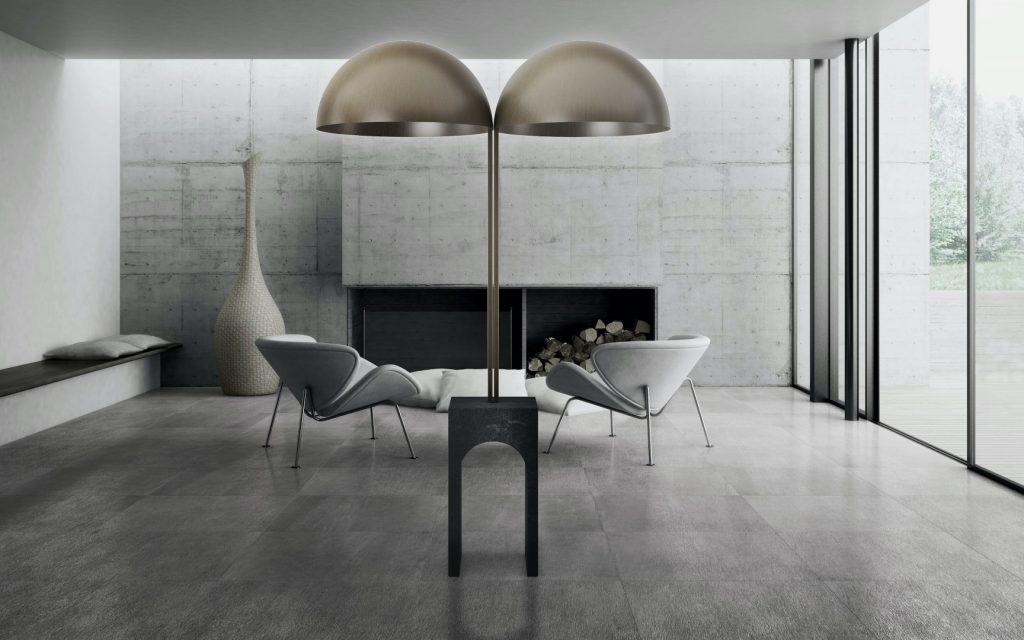
Architect Giorgio Canale reinterprets the street lamp theme with the “Indoor Street Lamp” he designed for a lighting brand. The furniture, in which two wide lampshades are supported by a slate stone base, was born from the idea that the street lamp illuminates large spaces and the light and modular surfaces extend over the natural stone floor. The natural stone base of this massive floor lamp has been split and reduced to 5 cm slabs by skilled craftsmen using a chisel technique. The base and lampshade, produced using the latest generation technologies, were assembled by hand.
Sculptura
Designer Giorgio Rava draws attention to the inextricable link between function, artistic value and sculpture with “Sculptura”, a kitchen design. The sculptural design, which is in the balance between function, past and present, mass and space, strength and lightness, is made of monolith marble material. Sculptura, which is far from today’s applications where the stone is used only as a coating, reflects the energy and archaic power of marble in its entirety.
Eggsail
Nicolas Bertoux started his “Eggsail” design, which he shaped with marble material, by being inspired by the simple form of the egg as a representation of the origin of life. The designer handled the time travel theme in his artwork, in which he conveyed the everpresent egg form, from dinosaur eggs in prehistoric times to chicken eggs today. At the same time, Bertoux, influenced by the invention of many tools, machines and technologies by making use of old sailboats, modern wind turbines and wind energy, blends the oldest lifestyles with the latest technologies with the “Eggsail”, which combines the undulating form of egg and sail.
Progressioni
Sculptor Jon Isherwood uses marble as a means of artistic expression in his “Progressioni”. Claiming that time is a continuous progression of existence and a fluid succession of past, present and future, the artist describes progress as a gradual transition to a more advanced state; he defines fluidity as a dynamic situation in which change and time exist. In this direction, “Progressioni” seeks an answer to the question of whether it is possible to consider all the methods in which marble is traditionally processed, then to use new technologies and to make the next contribution to this timeless discovery. Arguing that progress is based on fluidity, the artist aims to embrace marble’s capacity to visually describe the layering 200 million years ago and further explore the continuity of its fluid expression.
Stingray
Cynthia Sah is a sculptor who believes that marble is a wonderful gift from nature and often uses marble in her works. “Stingray” was designed with inspiration from the movements of a cartilaginous fish of the same name, whose form dates back three hundred million years. The artist sculpted his work with marble in order to draw attention to the similarity between the marble material and the metamorphic formations of this fish. Aiming to stretch the statue’s wings and break out of the block that restrains it, Sah created his work in delicate collaboration with computer programmers and technicians.
Elica
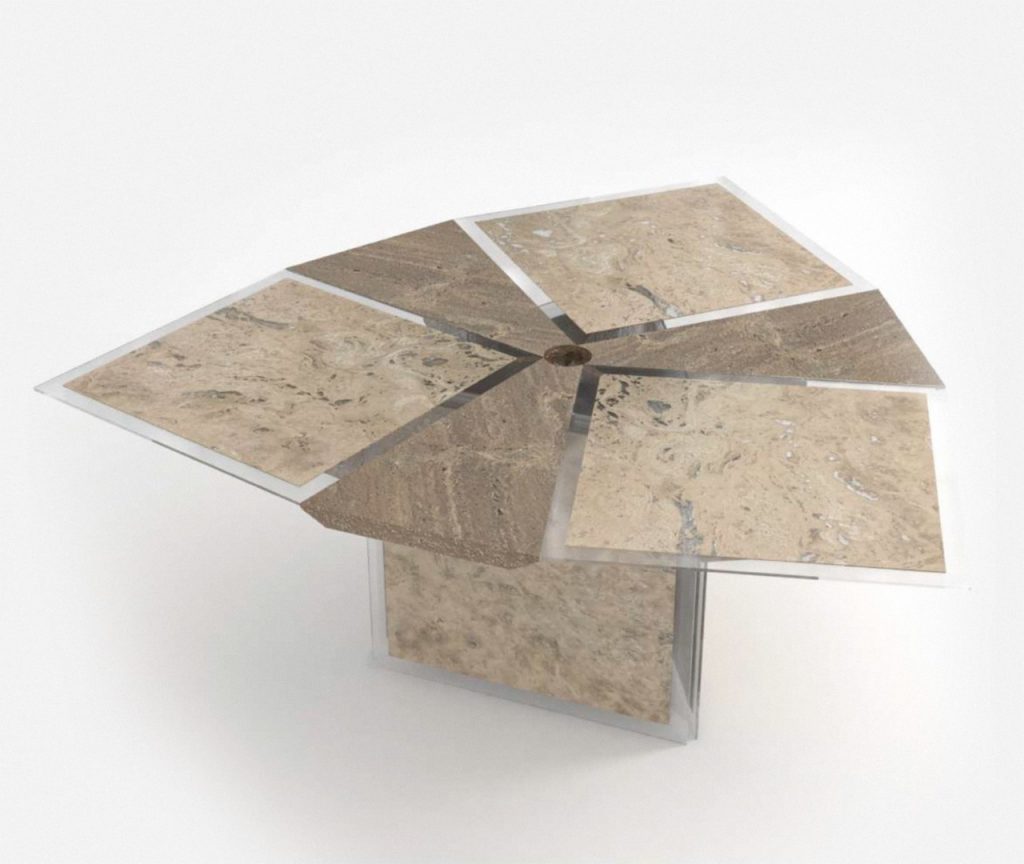
“Elica” by Paolo Criveller is a table made of six sheets of tempered glass glued to a 2 mm thick travertine sheet. Thanks to the transparent effect provided by the travertine, which is used with minimum thicknesses in order to minimize the waste of material in the design and to produce an eco-sustainable table, the entire formation process of the design can be monitored.
The Faglia Table
The Faglia Table, designed by Luigi Siard, is a table reminiscent of the movement of tectonic plates. The table legs produced by the designer by working on three different marble blocks with the same cutting technique are in perfect harmony with each other in form and texture. Preferring the table top from glass material in the design highlights the naturalness and unique texture of marble.
Logorio
“Logorio” designed by Carlo Trevisani is a dining table characterized by polished marble. In the design inspired by the wear of the handles of old tools or the aging of the contours of the sculptures over time, the surfaces that are constantly used in dishes have been lowered.
Wormhole
Luca Facchini’s design “Wormhole” is inspired by the EinsteinRosen bridge, a speculative structure that connects different points in space-time. The design, shaped by marble, a long-lasting material, represents our inability to really relate to time.
Eroso
“Eroso” is a table inspired by the ancient temples of Paestum by Carlo Trevisani, giving an identity with stone material. Eroso, which represents a reminder of the passing of time in an architecture that has been damaged for centuries, consists of two geometric volumes, the floor and the table, which represent the decay of the raw material with hammer crevices and a rough sandblasting.
Roca
Designed by Marcello Cutino, “Roca” consists of a rock base about one meter high forming the centre, and a crystal glass tabletop above it. This rough stone with organic form finds form in nature and time, bringing the object itself to the fore as an important element.
Mórfo
“Mórfo” by Silvia Sandini is an octagonal table inspired by the morphology of crystals in stone materials. Depicting a metamorphic and temporal process, the design is made from a single marble slab and combined with stainless steel pieces. Sustainability and material savings are prioritized in the design.
Trill
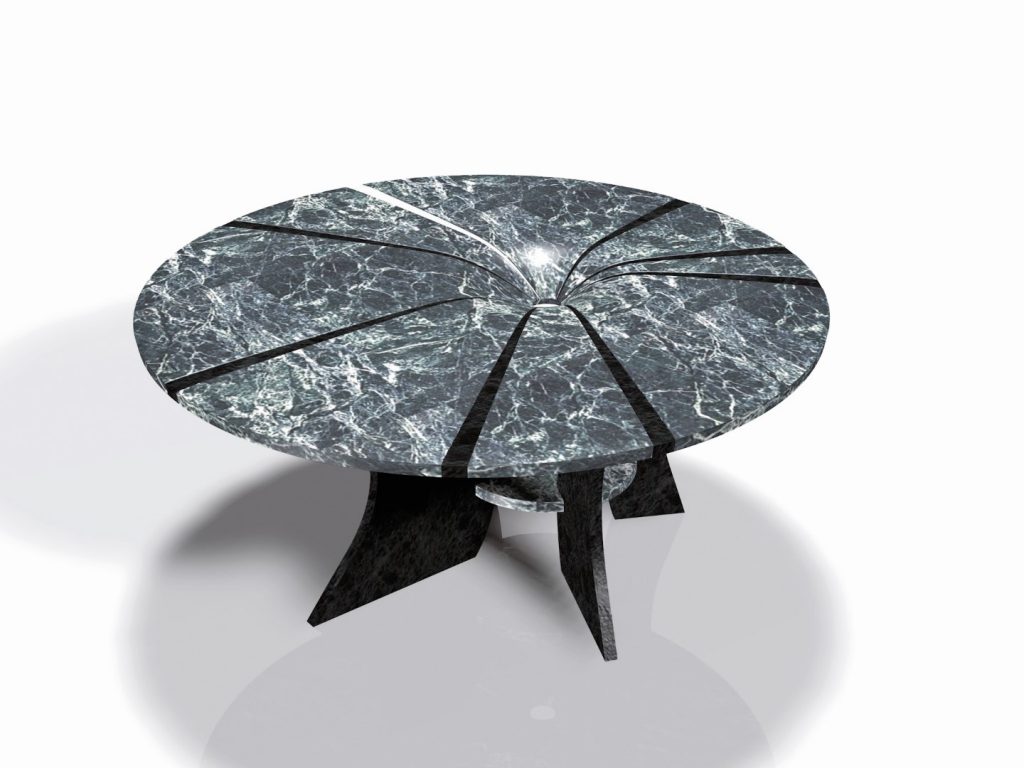
“Trill” designed by Ascanio Zocchi, inspired by spiral figures symbolizing cyclical continuity such as the universe, human DNA, and the flow of time, is produced with two kinds of marble. Black marble is used in the spirals, which represent the three forces of nature that create, protect and destroy, located on the top of the table, whose base and top are made of white marble.
Fleur De Ville
For more than two decades, Marmomac has been supporting projects focused on stone in educational institutions such as universities, art academies and vocational schools to enrich the content on the use of natural stone in the disciplines of architecture and design. “Fleur De Ville”, which was exhibited as part of the “Young Stone Project” exhibition at the fair this year, was designed by student Theophile Duquenne. “Fleur De Ville”, a canopy project, was built with inspiration from the organic forms of nature and using durable and local materials with a low ecological footprint, mainly Apricena natural stone. The basic idea of the project, which combines the tradition of materials with its curved form, with the innovation of architectural morphology and construction techniques, is to offer visual comfort with its floral form while providing protection from weather conditions.
Arcadia
“Arcadia”, another student project designed by Francesco Lasala, Alaa Abdalhameed and Lorenzo Favaron, is a flooring project consisting of 7 modular natural stones with self-supporting geometry. Produced for use in gardens and parks, the project is an expression of emphasizing the importance of the sustainable relationship between nature, people and time, which is endangered by our lifestyles.
Luminescent
“Luminescent”, designed by Simon Cannone, is a parametric patterned marble slab that reduces the thickness of the marble and allows light to pass through, thanks to a LED lighting system. In the project, where the marble becomes translucent when illuminated and can be used as a coating on the facade or indoors, flooring dimensions and geometric shapes can be customized according to preference.
Breathing Stone
Designed in collaboration with students Michele Pascucci, Giulia Bulf, Flavia Della Torre and Matteo Terzani as an evolution of traditional marble composite panels, “Breathing Stone” is a highly sustainable building element that can be adapted to any design requirement. Manufactured by 3D printing, the panel is a ventilated façade element that integrates stone cladding with the energy performance of a highly durable substrate.








Luminescent