
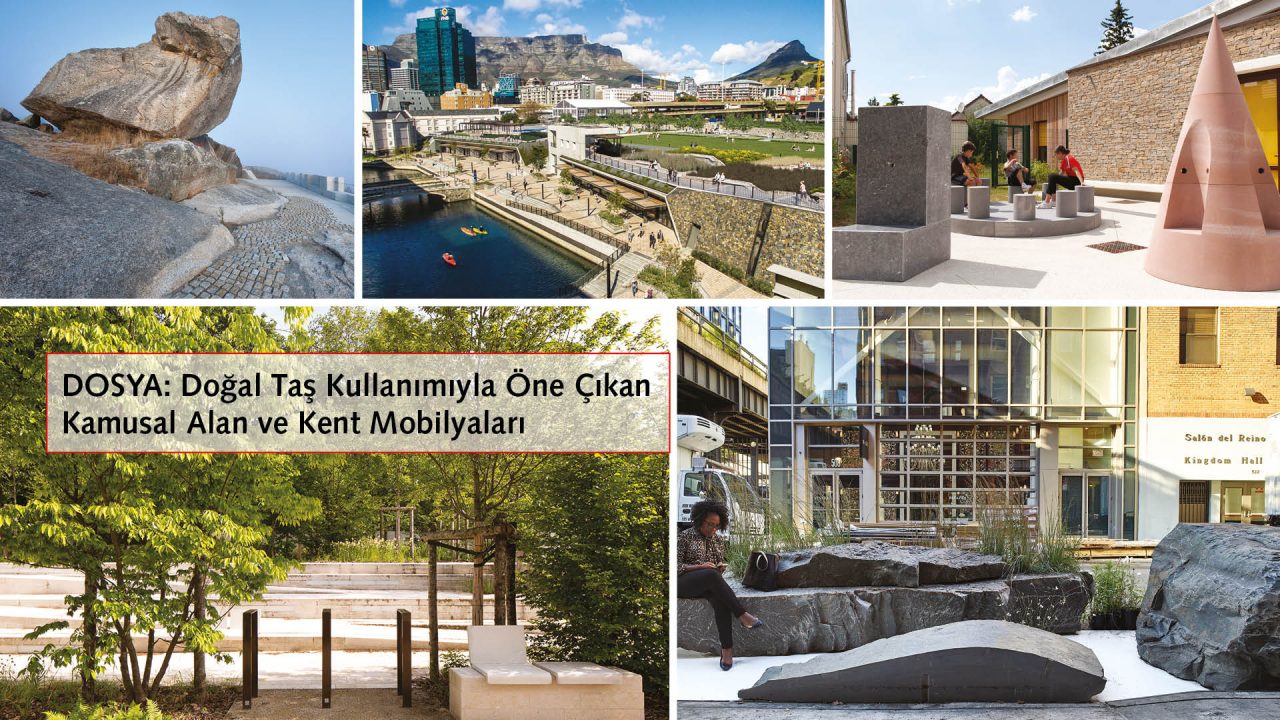
Natural stone is one of architecture and design’s oldest mediums. As a structural material its importance even centuries onwards has never withered. In fact, advances in technology have only broadened how versatile it can be. Beyond that, its straightforwardness, its ability to stand the test of time, and its sense of aesthetic all imply just how limitless its range of applications are, from micro design to public spaces, and beyond. Public spaces are where urbanites meet and mingle. Together with urban furniture, they mark the breathing points of a city. To design either means to choose their materials according to two criteria: naturalness and sustainability. Not only to they have to suit the needs of different users and different activities, but they also have to facilitate durability as well. Natural stone, hence, is only the most natural of choices for such spaces as a main medium: It is adaptable, it is sustainable, and it is shy of immortal. We have compiled for you a selection of relatively new public space and urban furniture pieces that, through natural stone, very enrich the squares, observation points, parks, and playgrounds across which they are peppered.

Pedra Da Ra Lookout Point
Architectural Design: Carlos Seoane
Area: 3.300 sqm
Building Date: 2016
Location: Ribeira, Spain
Photos: Ana Amado
Natural Stone: Granite
The lookout point known as “Pedra da Ra” has been used as such since the 1980s, a place from where one could observe the Atlantic Ocean’s horizon. Over time, the original look out point has deteriorated and lost all its meaning. Designed by architect Carlos Seoane, the new project for the lookout point is based upon a municipal investment programme that aims to promote the tourist possibilities of the Riveira City Council. The design is based around tearing down the original staircase without harming the environment around it, and then creating something that pushes the existing rock formations to the fore. They had to convert it into another look out that originated two distinct pedestrian paths as diverse as the ones towards the nearby Celtic settlement, which is of great archaeological value. Named after the unique rock formation -the Pedra de Ra- the site was turned into a space by virtue of its archaeological past and its landscape value out of granite from a nearby quarry. That, combined with creeping vegetation simultaneously achieves a resulting space of little or no maintenance at all. It goes from a space that is based on the visual, to one of archaeological pathways that allow you to contemplate nature from different points. This visual experience, when combined with the tactile characteristics of natural stone, transforms the nature-central project into a work of architecture to be experienced with one’s senses.

Battery Park
Architectural Design: dhk Architects
Area: 12.000 sqm
Building Date: 2018
Location: Cape Town, South Africa
Photos: Dave Southwood, Theo Gutter
Natural Stone: Local natural stone
Battery Park is a new 12.000 sqm urban park situated at a key entranceway to one of Africa’s most visited tourist destinations, the city of Cape Town. Developed as the nucleus of larger urban vision for the district, the site includes a park and piazza as well as pedestrian routes to invigorate the precinct with activity. The site of the park is of archaeological importance as it contains the remnants of one of the city’s oldest structures, the Amsterdam Battery. This provided a unique opportunity for the architects to pay homage to the historic landmark whilst providing spaces for recreational activities. The archaeological remnants are now perched eight metres above the canal. The walking paths were planned according to the original footscape to provide visual cues to visitors about the battery’s former size as they meander along the park. Battery Park’s design concept was manifested in breaking the barrier between the park and piazza and brining them closer to one another. The park’s natural stone-clad landscaping and retail units visually support the region’s texture. Al stone used throughout the park and piazza was excavated from the site during the construction process. These antiquated elements juxtapose contemporary design, and symbolize the desire to unite.

“Orchestre” and “Conversations”
Architectural Design: Olivier Vardot
Building Date: 2018-2019
Location: France
Photography: Graziella Antonini
Natural Stone: Sandstone, volcanic stone, marble
Designed for the campus of the University of Literature and Human Sciences in Aix-en-Provence/Marseille, “Orchestre” is a family of 26 benches, each one representing a letter from the Latin alphabet, created by designer Olivier Vardot from lava stone and marble. The entire project was inspired by the history of writing. Orchestre’s abstract forms encourage people on campus to interact, thereby creating a positive space. Most of the elements are made from lava stone (andesite) that’s been extracted from a region in France, while the smallest pieces are made from marble. The grouping arranged to form an imaginary ellipsis in reference to the stage of amphitheatres. “Conversations”, on the other hand is an open air play ground located in a north-eastern suburb of Paris, comprising of three structures that encourage children to play and chat with one another. The project was largely inspired by the desire to create a series of installations that only can withstand the test of time, but more importantly withstand the test of children, and encourage them to exchange stories. Each piece of urban furniture is made from sandstone and volcanic stone, and has a monolithic appearance about them. They invite their users to play a game that relies entirely on their imaginations.

Châtenay-Malabry Town Entrance
Architectural Design: Ateliers 2/3/4/
Area: 4.200 sqm
Building Date: 2016
Location: Hauts de Seine, France
Photos: Clément Guillaume
Natural Stone: Sandstone
Designed by Ateliers 2/3/4, Châtenay-Malabry is strategically located at the entrance of a new neighbourhood in Hauts de Seine, France. The geo-topographical characteristics of the site, a 5-metre change in level together with its location at the intersection of dense traffic roads, determined the landscape plan. Steps, ramps, tiers, and terraces integrate all pedestrian movement and car traffic, and are treated with natural stone. The architect protects pedestrians from the nuisances related to the intensity of traffic, whilst allowing for not only different uses but also visual continuity as well. The visual continuity provided by taking the main road under the square also resolved the disturbances related to traffic density. The natural stone chosen in all of the steps,ramps, terraces and seating areas of the square design allows the use of the square for different activities as well as all pedestrian movements.

Park Erratica
Architectural Design: MB Architects
Area: 12 sqm
Building Date: 2016
Location: New York, USA
Photos: Matthew Carbone
Natural Stone: Local natural stone
Funded by the Metropolitan Transit Authority, Park Erratica covers a 12 sqm area in Chelsea, New York City. The brainchild of MB Architects, the project transforms a street into a public space, complete with a terrace and other common usage spaces. The park features an assortment of benches, planters, and various pieces of urban furniture to create a hospitable atmosphere. The park’s environs are riddled with dozens of depots and heavy car traffic. Hence, the park is a response to the need to shelter residents from that whilst establishing a sense of public safety. The architects also wanted to strengthen how the district interacts with its arts community, as well as how park visitors interact with the city’s urban texture. They achieved this using natural stone, namely boulders that were selected for their user ergonomics: sitting, leaning, and even practicing yoga. The boundaries of the park are outlined using a resin matt, atop which the boulders are strategically placed. Holes in the urban furniture are fitted with a selection of grasses and plants, making it into a mini-sanctuary where you can remove yourself from the chaos of the city, however briefly.