

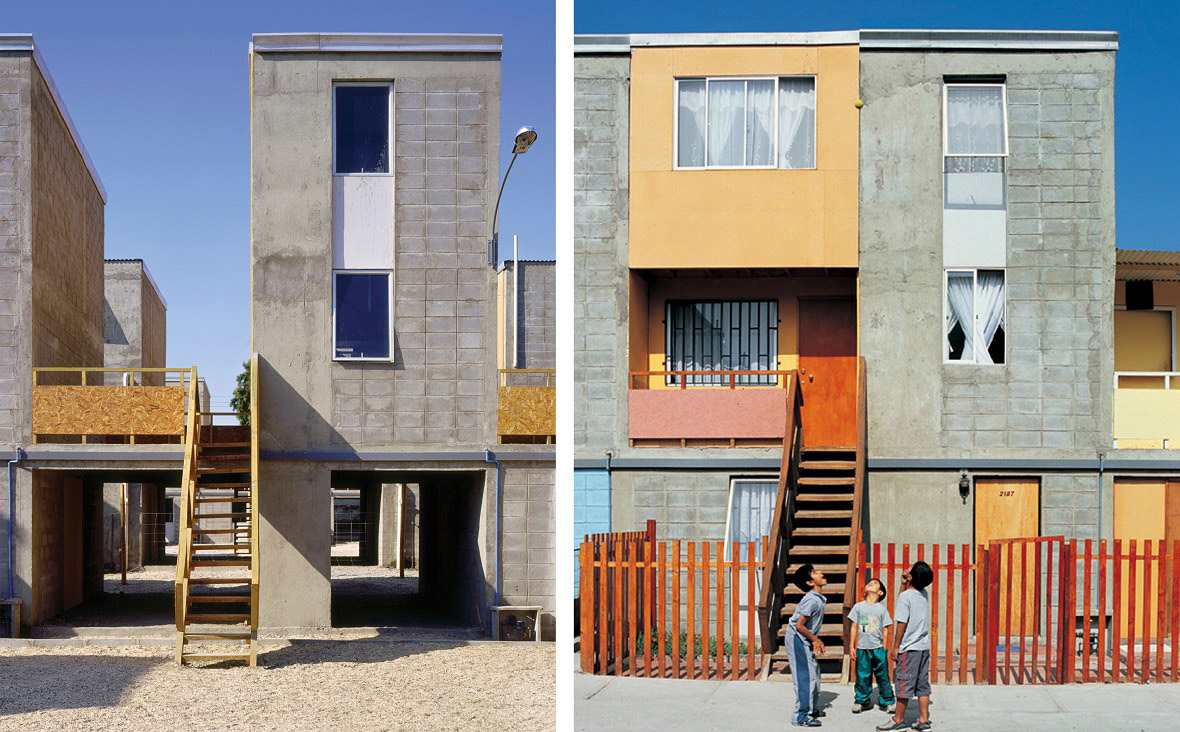
Alejandro Aravena has been named as the winner of the 2016 Pritzker Prize, ahead of curating this year’s Venice Architecture Biennale with the theme “Reporting from the Front”. Highlighting his dedication to improve urban environments and to address the global housing crisis, the Pritzker Prize jury praised the way in which the Chilean architect has “risen to the demands of practicing architecture as an artful endeavor, as well as meeting today’s social and economic challenges.” Aravena is the 41st Pritzker Prize laureate and the first Chilean to receive the award.
At 48 years of age, Aravena has a large portfolio of private, public and educational projects in Chile, the USA, Mexico, China and Switzerland. But perhaps more notably, through his “Do Tank” firm ELEMENTAL he has managed to build 2,500 units of social housing, engaging in the public housing policies of governments where he works and taking an opportunistic approach to market forces to generate a powerful impact on lower-income communities.
“Alejandro Aravena epitomizes the revival of a more socially engaged architect, especially in his long-term commitment to tackling the global housing crisis and fighting for a better urban environment for all,” explained the Jury in their citation. “He has a deep understanding of both architecture and civil society, as is reflected in his writing, his activism and his designs. The role of the architect is now being challenged to serve greater social and humanitarian needs, and Alejandro Aravena has clearly, generously and fully responded to this challenge.”
After awarding Shigeru Ban in 2014, Frei Otto in 2015 and now Alejandro Aravena in 2016, the Pritzker Prize has recently shown a tendency to recognize architects who have gone beyond the traditional boundaries of the architectural discipline; architects who are capable of wielding influence to generate solutions to the most urgent problems of society.
“The ELEMENTAL team participates in every phase of the complex process of providing dwellings for the underserved: engaging with politicians, lawyers, researchers, residents, local authorities, and builders, in order to obtain the best possible results for the benefit of the residents and society… This inventive approach enlarges the traditional scope of the architect and transforms the professional into a universal figure with the aim of finding a truly collective solution for the built environment,” explained the Jury.
“The Pritzker Prize has now rewarded an architect who, convinced of the power of good architecture, highlights the importance of architects themselves. Aravena is helping to challenge an established view of architecture; for him, an architect is much more than someone who simply reacts to a client’s desires with functional designs. In his own words, he is able to “intensify what is available instead of complaining about what is missing… to understand what design tools are needed to subvert the forces that privilege individual gain over collective benefit.
This seems to offer the inspiration and momentum architects need to take up the responsibility that once we left to others. Again quoting the new 2016 Pritzker Laureate, it is a unique opportunity to show that “architecture can introduce a broader notion of gain: design as added value instead of an extra cost; architecture as a shortcut towards equality”.